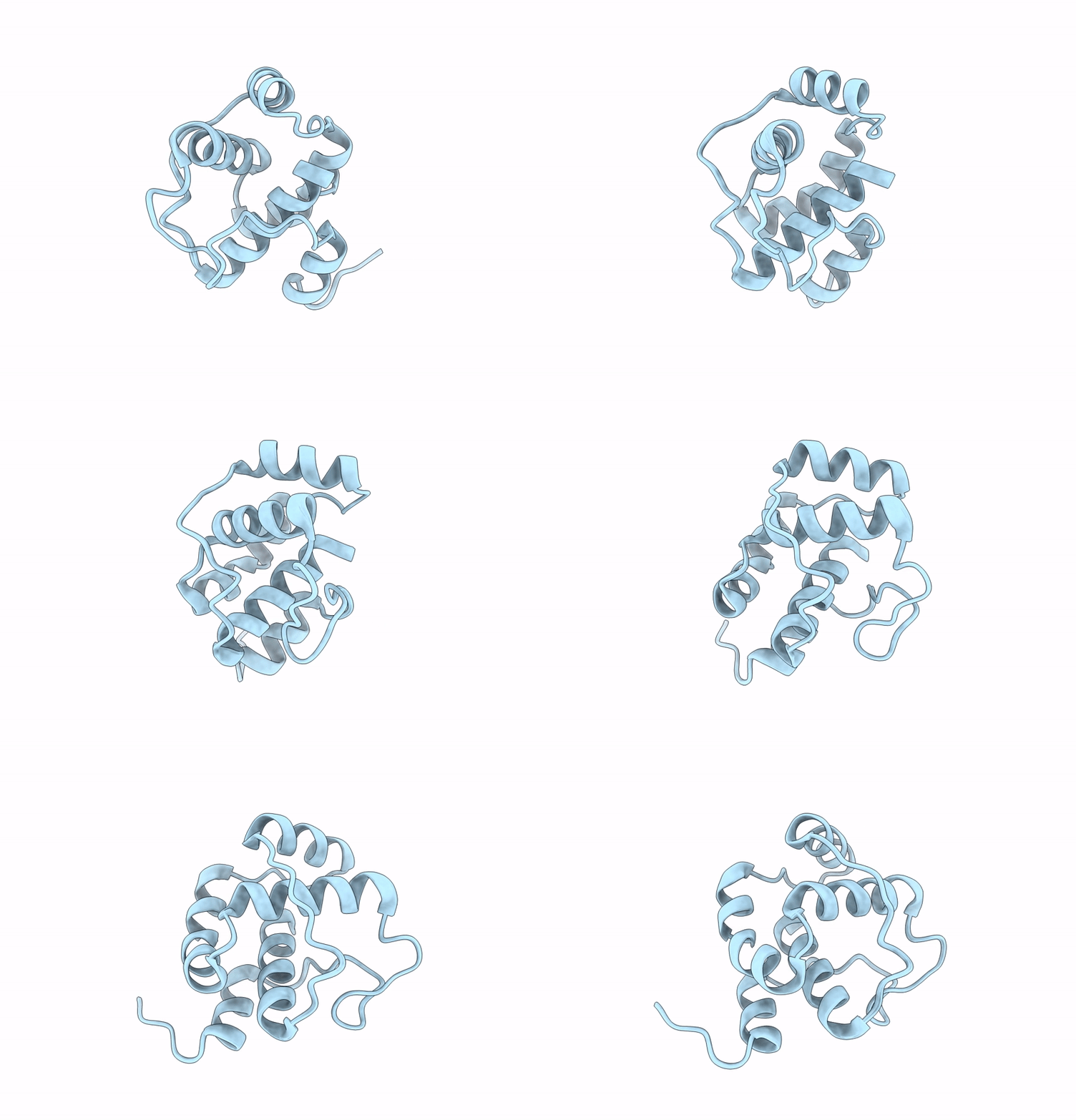
9PYS image
Deposition Date 2025-08-08
Release Date 2025-09-17
Last Version Date 2026-02-18
Entry Detail
PDB ID:
9PYS
Keywords:
Title:
NMR RDC refinement of the helical domain of the SARS-CoV-2 monomeric Main Protease (MPROH41Q,10-306)
Biological Source:
Expression System(s):
Method Details:
Experimental Method:
Conformers Calculated:
10
Conformers Submitted:
10
Selection Criteria:
all calculated structures submitted

Macromolecular Entities
Structures with similar UniProt ID
Protein Blast
Polymer Type:polypeptide(L)
Molecule:3C-like proteinase nsp5
Gene (Uniprot):rep
Mutagens:H41Q
Chain IDs:A
Chain Length:306
Number of Molecules:1
Biological Source:Severe acute respiratory syndrome coronavirus 2
Ligand Molecules
Primary Citation
Solution Domain Dynamics of Monomeric SARS-CoV‐2 Main Protease Revealed by Optimized NMR Residual Dipolar Coupling Measurements.
ACS Phys Chem Au 6 81 94 (2026)
PMID: 41624715 DOI: 10.1021/acsphyschemau.5c00081

Abstact

The main protease (MPro) of SARS-CoV-2, released from a monomeric precursor, is essential for viral replication, and multiple antiviral compounds target the active site of the mature dimer. However, the solution structure and dynamics of the monomer remain poorly understood. Here, we utilize residual dipolar couplings (RDCs) to characterize conformational and dynamical differences between monomeric and dimeric MPro. While most protein NMR studies rely primarily on 1H-15N RDCs, we demonstrate that at least four backbone RDCs can be measured at high accuracy from a single aligned sample. We compare frequency-based and intensity-based methods and introduce a mixed-time evolution scheme that improves resolution in 2D N-C' RDC measurements. These methods are applied to a 9-residue N-terminal deletion mutant of the SARS-CoV-2 MPro, revealing that the monomeric active site loop conformation closely resembles that of the SARS-CoV monomer X-ray structure, which differs substantially from the dimer. The C-terminal helical domain also undergoes large amplitude motions relative to the catalytic domain. In contrast, AlphaFold2 models of the deletion mutant predict structures adopting only the dimer-like conformation. Refinement of the monomeric X-ray structure (PDB: 2QCY) against our experimental RDCs resulted in backbone rearrangements up to ca. 1 Å, improved MolProbity statistics, and better agreement with independent 2 D C'H RDCs not included in the refinement. These findings highlight the power of RDCs for probing conformational states and dynamics and may aid future identification and characterization of compounds targeting the precursor monomer active site.

Legend

Protein

Chemical

Disease

Primary Citation of related structures
Feedback Form
Name
Email
Institute
Feedback