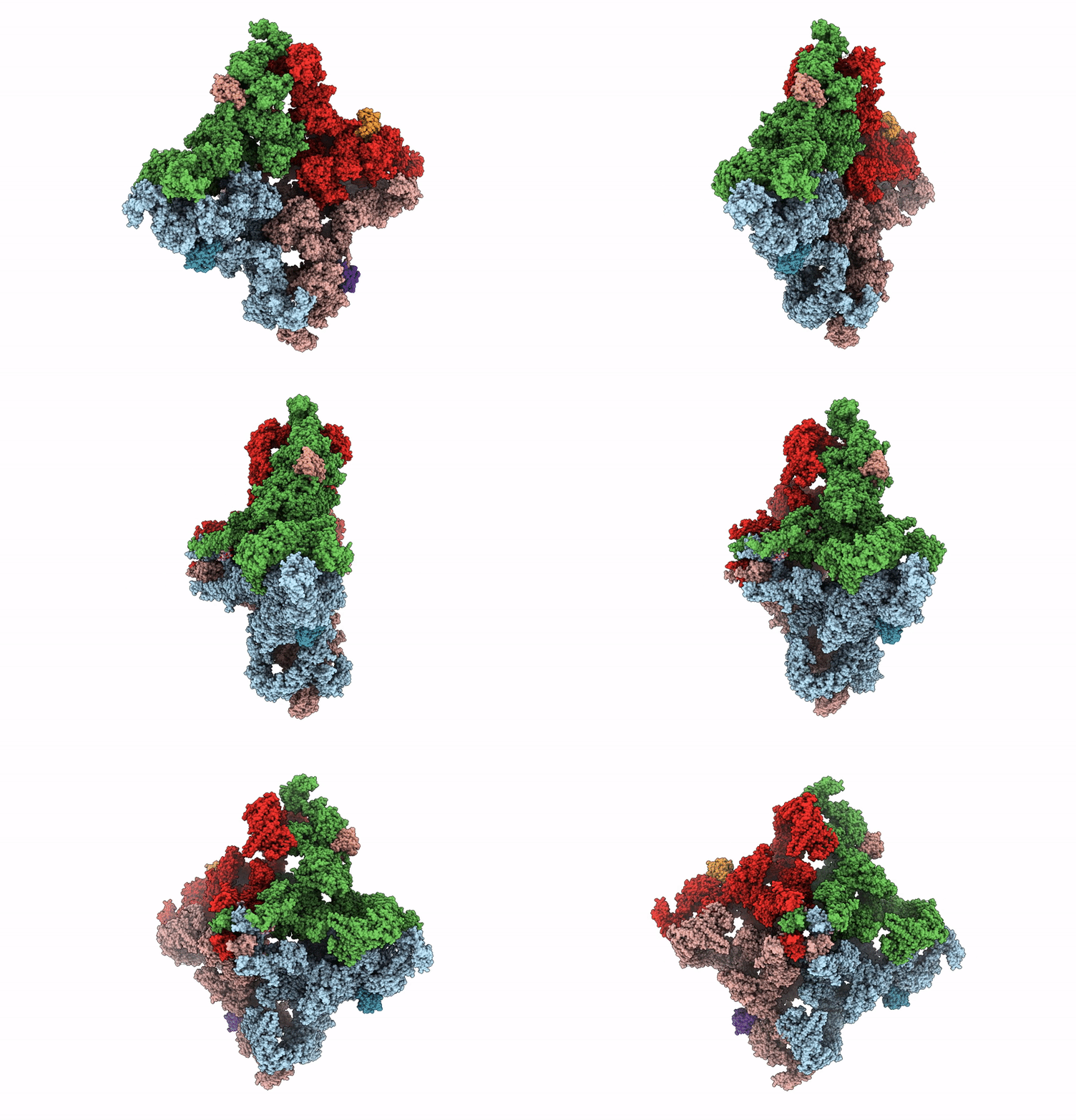
9PWO image
Deposition Date 2025-08-04
Release Date 2025-12-03
Last Version Date 2025-12-03
Entry Detail
PDB ID:
9PWO
Title:
Pig Ryanodine Receptor 1 R615C Mutant: Atorvastatin Bound Open Conformation
Biological Source:
Source Organism:
Homo sapiens (Taxon ID: 9606)
Sus scrofa (Taxon ID: 9823)
Host Organism:
Method Details:
Experimental Method:
Resolution:
3.36 Å
Aggregation State:
PARTICLE
Reconstruction Method:
SINGLE PARTICLE
Macromolecular Entities
Structures with similar UniProt ID
Protein Blast
Polymer Type:polypeptide(L)
Molecule:Ryanodine receptor 1
Gene (Uniprot):RYR1
Chain IDs:A, C (auth: G), E (auth: M), G (auth: S)
Chain Length:5035
Number of Molecules:4
Biological Source:Sus scrofa
Structures with similar UniProt ID
Protein Blast
Polymer Type:polypeptide(L)
Molecule:Peptidyl-prolyl cis-trans isomerase FKBP1B
Gene (Uniprot):FKBP1B
Chain IDs:B, D (auth: H), F (auth: N), H (auth: T)
Chain Length:111
Number of Molecules:4
Biological Source:Homo sapiens
Primary Citation
Cryo-electron microscopy reveals sequential binding and activation of Ryanodine Receptors by statin triplets.
Nat Commun ? ? ? (2025)
PMID: 41266329 DOI: 10.1038/s41467-025-66522-0

Abstact

Statins are the most prescribed class of drugs and inhibit a key enzyme in the cholesterol biosynthesis pathway. Many patients have reported mild to severe muscle related symptoms and a subset are at risk for rhabdomyolysis. Sequence variants in RyR1, the skeletal muscle Ryanodine Receptor, correlate with intolerance to statins, but whether RyR1 can bind statins directly has remained unclear. Here we report cryo-EM structures of RyR1 in the absence and presence of atorvastatin, firmly establishing RyR1 as an unintended off-target. Our results show an unusual binding mode whereby three atorvastatin molecules bind together in a cleft formed by the pseudo-voltage sensing domain, making extensive interactions with each other and with RyR1. Atorvastatin activates RyR1 in a sequential way, whereby one statin per subunit can bind to the transmembrane region of a closed RyR1, with small structural perturbations that prime the channel for opening. Binding of two additional statins per subunit is associated with a widening of the pseudo-voltage sensing domain that triggers opening of the pore. Comparison with atorvastatin binding to HMG-CoA reductase, its intended target, offers clues on how to modify the statin to reduce RyR1 binding, while leaving binding to HMG-CoA reductase unperturbed.

Legend

Protein

Chemical

Disease

Primary Citation of related structures
Feedback Form
Name
Email
Institute
Feedback