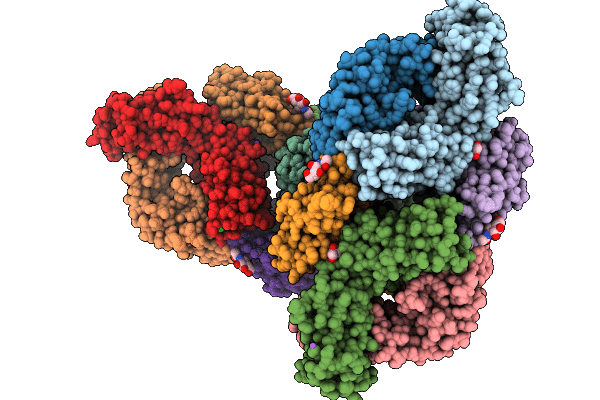
9PRU image
Deposition Date 2025-07-24
Release Date 2025-12-31
Last Version Date 2025-12-31
Entry Detail
PDB ID:
9PRU
Keywords:
Title:
Complex of the 3G8 Fab bound to Fc gamma receptor 3a / CD16a F158 allotype
Biological Source:
Source Organism:
Mus musculus (Taxon ID: 10090)
Homo sapiens (Taxon ID: 9606)
Host Organism:
Method Details:
Experimental Method:
Resolution:
1.90 Å
R-Value Free:
0.28
R-Value Work:
0.23
R-Value Observed:
0.23
Space Group:
P 21 21 21
Macromolecular Entities
Polymer Type:polypeptide(L)
Molecule:3G8 Fab light chain
Chain IDs:A, C, E, G
Chain Length:218
Number of Molecules:4
Biological Source:Mus musculus
Polymer Type:polypeptide(L)
Molecule:3G8 Fab Heavy Chain
Chain IDs:B, D, F, H
Chain Length:221
Number of Molecules:4
Biological Source:Mus musculus
Structures with similar UniProt ID
Protein Blast
Polymer Type:polypeptide(L)
Molecule:Low affinity immunoglobulin gamma Fc region receptor III-A
Gene (Uniprot):FCGR3A
Mutagens:N38Q N74Q N169Q
Chain IDs:I (auth: W), J (auth: X), K (auth: Y), L (auth: Z)
Chain Length:175
Number of Molecules:4
Biological Source:Homo sapiens
Primary Citation
The impact of N-glycan conformational entropy on the binding affinity of Fc gamma receptor IIIa/CD16a.
Structure ? ? ? (2025)
PMID: 41421343 DOI: 10.1016/j.str.2025.11.015

Abstact

The affinity of Fc γ receptor IIIa (FcγRIIIa) binding to immunoglobulin G1 (IgG1) correlates with patient responses for antibody-based therapeutics. Among multiple factors affecting affinity, a mechanism defining how the composition of the FcγRIIIa N162 glycan regulates affinity remains undefined. Here, we evaluate the binding modes of two competitive FcγRIIIa ligands. IgG1 Fc binding is sensitive to N162 glycan composition, unlike the antigen-binding fragment (Fab) of the FcγRIII-specific antibody 3G8. Both ligands bound to overlapping surfaces, utilizing different angles of attack such that the IgG1 Fc but not 3G8 Fab limited the space available to the FcγRIII N162 N-glycan. FcγRIII binding to IgG1 Fc generated a 2.1 kcal/mol penalty from a loss of N162 glycan conformational entropy, greater than the 0.3 kcal/mol penalty for 3G8 and consistent with binding measurements. Thus, the conformational entropy of the FcγRIIIa N162-glycan is the predominant force modulating differential binding affinity compared to 3G8 Fab binding for endogenous FcγRIIIa glycoforms.

Legend

Protein

Chemical

Disease

Primary Citation of related structures
Feedback Form
Name
Email
Institute
Feedback