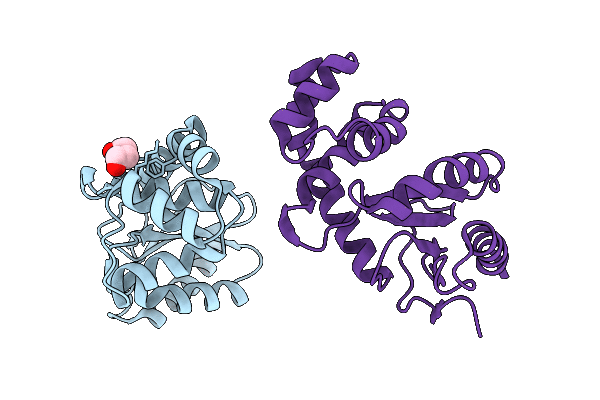
9PH2 image
Deposition Date 2025-07-08
Release Date 2025-12-31
Last Version Date 2025-12-31
Entry Detail
PDB ID:
9PH2
Keywords:
Title:
Crystal structure of Bordetella pertussis DsbA
Biological Source:
Source Organism:
Host Organism:
Method Details:
Experimental Method:
Resolution:
1.65 Å
R-Value Free:
0.20
R-Value Work:
0.16
R-Value Observed:
0.17
Space Group:
C 1 2 1

Macromolecular Entities
Structures with similar UniProt ID
Protein Blast
Polymer Type:polypeptide(L)
Molecule:Thiol:disulfide interchange protein
Gene (Uniprot):dsbA
Chain IDs:A, B
Chain Length:179
Number of Molecules:2
Biological Source:Bordetella pertussis
Ligand Molecules
Primary Citation
Structural and functional specialization of Bordetella pertussis DsbA for pertussis toxin folding.
Protein Sci. 35 e70421 e70421 (2026)
PMID: 41432344 DOI: 10.1002/pro.70421

Abstact

Disulphide bonds (Dsbs) are essential for the folding, stability, and function of many secreted and membrane-associated proteins in bacteria. In Gram-negative species, these bonds are introduced by the Dsb enzyme family, with DsbA acting as the primary thiol oxidase. While DsbA proteins share a conserved thioredoxin (TRX)-like fold, emerging evidence highlights substantial structural and functional divergence among pathogenic homologues. Here, we present the high-resolution crystal structure and functional characterization of BperDsbA, a DsbA homologue from Bordetella pertussis, the causative agent of whooping cough. BperDsbA adopts a canonical TRX fold with a CPHC active site and a threonine-containing cis-proline loop, but displays striking deviations from prototypical DsbAs. Notably, it contains a highly destabilizing catalytic Dsb, resulting in one of the most oxidizing redox potentials recorded for a DsbA enzyme. Surface electrostatic analysis reveals an unusual distribution of positive and negative charge around the active site, in contrast to the broadly hydrophobic catalytic surfaces of other DsbAs. Functionally, BperDsbA shows limited substrate promiscuity and selectively catalyzes the oxidative folding of a pertussis toxin-derived peptide, supporting a model of substrate specialization. Together, these findings suggest that BperDsbA has evolved unique redox and structural features to support virulence factor maturation in B. pertussis. This work expands our understanding of the mechanistic diversity of DsbA enzymes and highlights their potential as pathogen-specific targets for anti-virulence therapeutics.

Legend

Protein

Chemical

Disease

Primary Citation of related structures
Feedback Form
Name
Email
Institute
Feedback