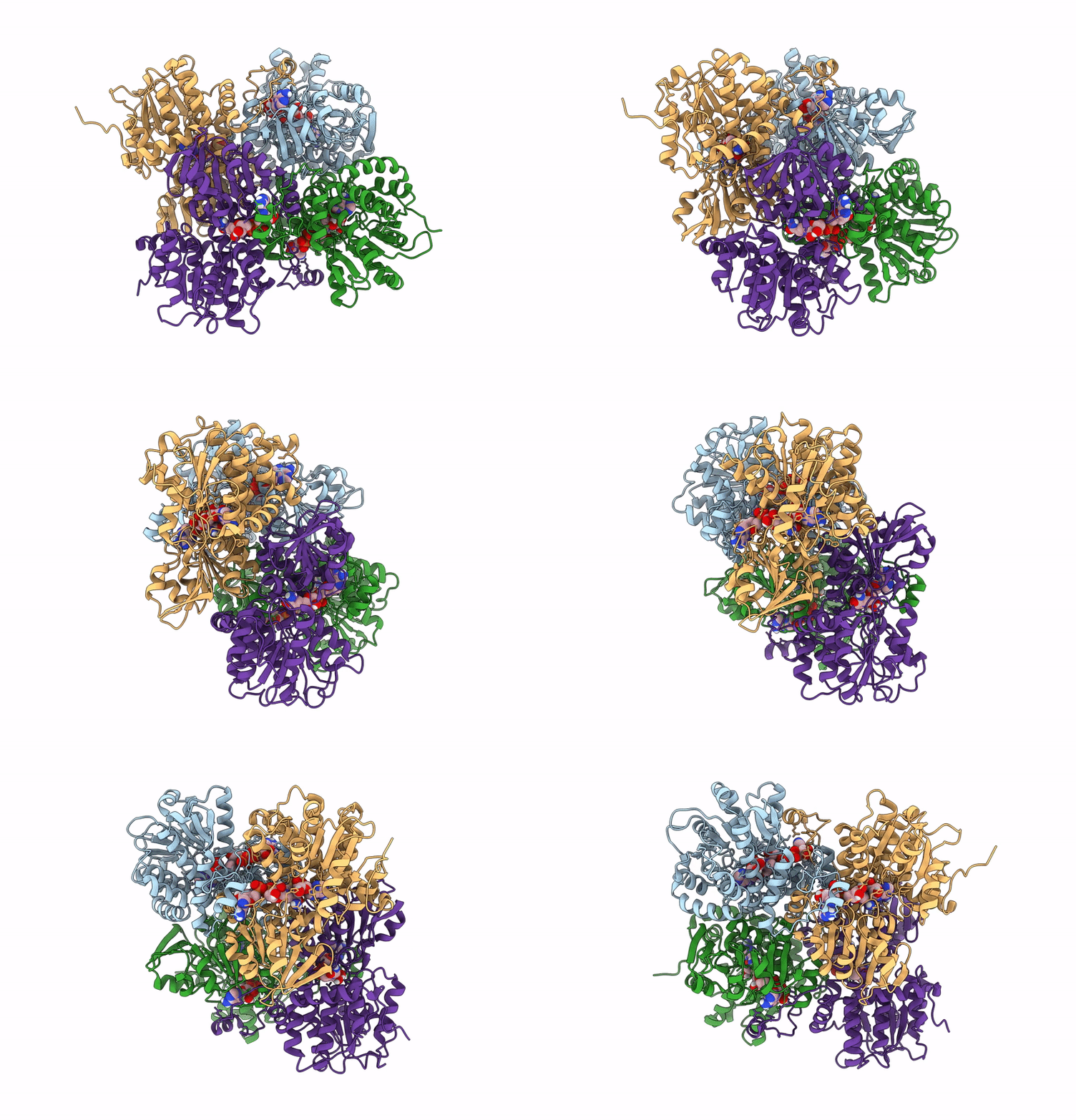
9PDH image
Deposition Date 2025-06-30
Release Date 2025-09-17
Last Version Date 2025-10-01
Entry Detail
PDB ID:
9PDH
Keywords:
Title:
X-ray structure of WT Drosophila Ahcy bound to NAD and adenosine at 2.50 A
Biological Source:
Source Organism:
Host Organism:
Method Details:
Experimental Method:
Resolution:
2.50 Å
R-Value Free:
0.27
R-Value Work:
0.22
R-Value Observed:
0.23
Space Group:
P 21 21 21

Macromolecular Entities
Structures with similar UniProt ID
Protein Blast
Polymer Type:polypeptide(L)
Molecule:Adenosylhomocysteinase
Gene (Uniprot):Ahcy
Chain IDs:A, B, C, D
Chain Length:434
Number of Molecules:4
Biological Source:Drosophila melanogaster
Primary Citation
Drosophila Ahcy is a redox sensor that modulates gene expression to protect against light stress-induced retinal degeneration.
Proc.Natl.Acad.Sci.USA 122 e2511388122 e2511388122 (2025)
PMID: 40971386 DOI: 10.1073/pnas.2511388122

Abstact

One-carbon metabolism influences gene expression by providing methyl units for DNA, RNA, and histone methylation. Robust methylation requires rapid hydrolysis of the methylation by-product S-adenosylhomocysteine (SAH) by S-adenosylhomocysteinase (Ahcy). Ahcy is essential for maintaining methylation potential; however, the mechanisms governing its enzymatic activity, particularly in response to cellular stress, remain largely uncharacterized. Here, we show Ahcy is a redox-sensitive enzyme that is inhibited by oxidation of a conserved cysteine, C195, in vitro resulting in elevated SAH levels upon oxidative stress in vivo. We leveraged High-Throughput Desorption Electrospray Ionization Mass Spectrometry to directly quantify Ahcy enzymatic activity and observed that H2O2-induced oxidation significantly reduced its catalytic efficiency. Notably, while C195 is essential for enzymatic activity in Drosophila melanogaster and humans, this residue is not conserved in Caenorhabditis elegans Ahcy that is also insensitive to H2O2. Structural analysis revealed that C195 is positioned near NAD+ in the active site, close to a second cysteine residue that is also lacking in C. elegans Ahcy. Ahcy oxidation is neuroprotective in a Drosophila light stress model that increases oxidative stress. Moreover, Ahcy knockdown suppresses light stress-induced gene expression changes in photoreceptors, although this response is uncoupled from changes in H3K4me3 and H3K27me3 levels, which were previously reported to alter in response to Ahcy knockdown in cultured cells. Thus, the one-carbon metabolism enzyme Ahcy senses changes in cellular redox homeostasis through a conserved cysteine residue that alters its activity, enabling rapid changes in gene expression that enable a neuroprotective response.

Legend

Protein

Chemical

Disease

Primary Citation of related structures
Feedback Form
Name
Email
Institute
Feedback