Planned Maintenance: Some services may turn out to be unavailable from 15th January, 2026 to 16th January, 2026. We apologize for the inconvenience!

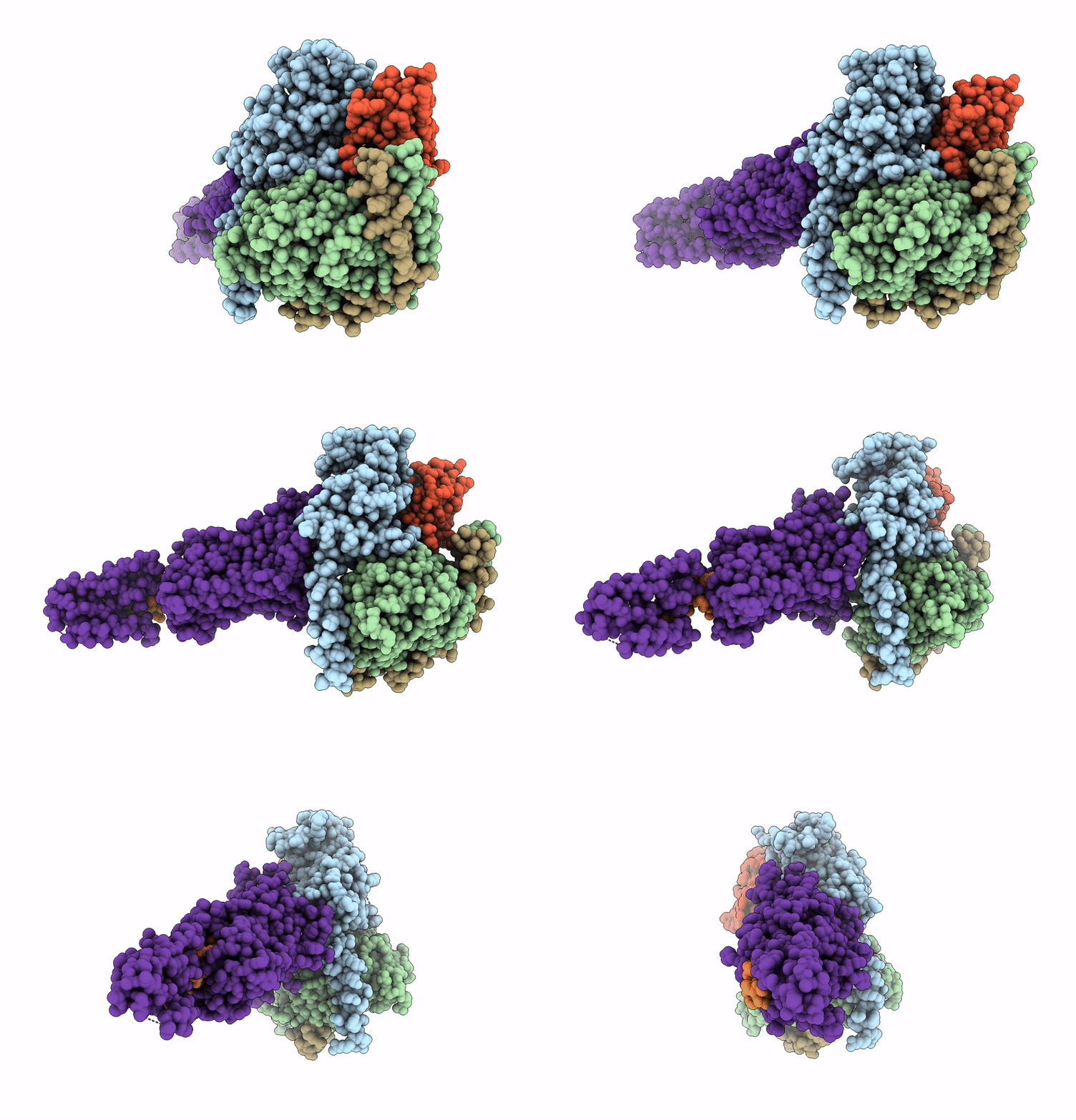
9P94 image
Deposition Date 2025-06-24
Release Date 2025-11-19
Last Version Date 2025-12-03
Entry Detail
PDB ID:
9P94
Title:
Cryo-EM structure of the PAC1sR-PACAP27-Gs complex
Biological Source:
Source Organism(s):
Homo sapiens (Taxon ID: 9606)
Lama glama (Taxon ID: 9844)
Method Details:
Experimental Method:
Resolution:
3.00 Å
Aggregation State:
PARTICLE
Reconstruction Method:
SINGLE PARTICLE
Macromolecular Entities
Structures with similar UniProt ID
Protein Blast
Polymer Type:polypeptide(L)
Molecule:Guanine nucleotide-binding protein G(s) subunit alpha isoforms short
Gene (Uniprot):GNAS
Mutagens:S54N G226A E268A N271K K274D R280K T284D I285T A366S
Chain IDs:F (auth: A)
Chain Length:394
Number of Molecules:1
Biological Source:Homo sapiens
Structures with similar UniProt ID
Protein Blast
Polymer Type:polypeptide(L)
Molecule:Guanine nucleotide-binding protein G(I)/G(S)/G(T) subunit beta-1
Gene (Uniprot):GNB1
Chain IDs:A (auth: B)
Chain Length:350
Number of Molecules:1
Biological Source:Homo sapiens
Structures with similar UniProt ID
Protein Blast
Polymer Type:polypeptide(L)
Molecule:Guanine nucleotide-binding protein G(I)/G(S)/G(O) subunit gamma-2
Gene (Uniprot):GNG2
Chain IDs:B (auth: G)
Chain Length:71
Number of Molecules:1
Biological Source:Homo sapiens
Polymer Type:polypeptide(L)
Molecule:Nanobody35
Chain IDs:C (auth: N)
Chain Length:138
Number of Molecules:1
Biological Source:Lama glama
Structures with similar UniProt ID
Protein Blast
Polymer Type:polypeptide(L)
Molecule:Pituitary adenylate cyclase-activating polypeptide
Gene (Uniprot):ADCYAP1
Chain IDs:D (auth: P)
Chain Length:27
Number of Molecules:1
Biological Source:Homo sapiens
Structures with similar UniProt ID
Protein Blast
Polymer Type:polypeptide(L)
Molecule:Isoform S of Pituitary adenylate cyclase-activating polypeptide type I receptor
Gene (Uniprot):ADCYAP1R1
Chain IDs:E (auth: R)
Chain Length:462
Number of Molecules:1
Biological Source:Homo sapiens
Ligand Molecules
Primary Citation
Structural basis of modified ligand selectivity from N-terminal PAC1R alternative splicing.
Proc.Natl.Acad.Sci.USA 122 e2521157122 e2521157122 (2025)
PMID: 41264251 DOI: 10.1073/pnas.2521157122

Abstact

The pituitary adenylate cyclase-activating polypeptide (PACAP) 1 receptor (PAC1R) is a class B1 G protein-coupled receptor activated by the endogenous peptide agonists PACAP and vasoactive intestinal peptide (VIP). Alternate splicing within the receptor extracellular domain (ECD) generates the PAC1R short variant (PAC1sR) that has selectively enhanced VIP function compared to the full-length, PAC1R null variant (PAC1nR). However, to date, a comprehensive pharmacological assessment of the downstream signaling outcomes of PAC1sR activation compared to PAC1nR has not been performed, and little information is available to mechanistically understand how ECD splicing may alter ligand engagement. Here, we demonstrated that VIP, but not PACAP, has globally enhanced activity across a broad range of functional endpoints at PAC1sR compared to PAC1nR. Cryo-EM structures of VIP-bound, stimulatory G protein (Gs)-coupled PAC1sR and PAC1nR, supported by molecular dynamics (MD) simulations, demonstrate transient engagement of the null loop in PAC1nR, which is absent in PAC1sR, with residues in extracellular loop 2 (ECL2) and the N-terminal helix of the ECD. These interactions result in differential engagement of VIP with these domains and the top of TM2/ECL1 with PAC1sR and PAC1nR. Moreover, MD simulations predicted differential interactions of the Gs protein with the two PAC1R variants when bound by VIP that correlate with a greater allosteric influence of the Gs protein on VIP affinity at the PAC1sR, relative to PAC1nR. Our study provides insights into the structural basis and functional consequences of PAC1R ECD splicing, increasing understanding of PAC1R ligand selectivity and signaling.

Legend

Protein

Chemical

Disease

Primary Citation of related structures
Feedback Form
Name
Email
Institute
Feedback