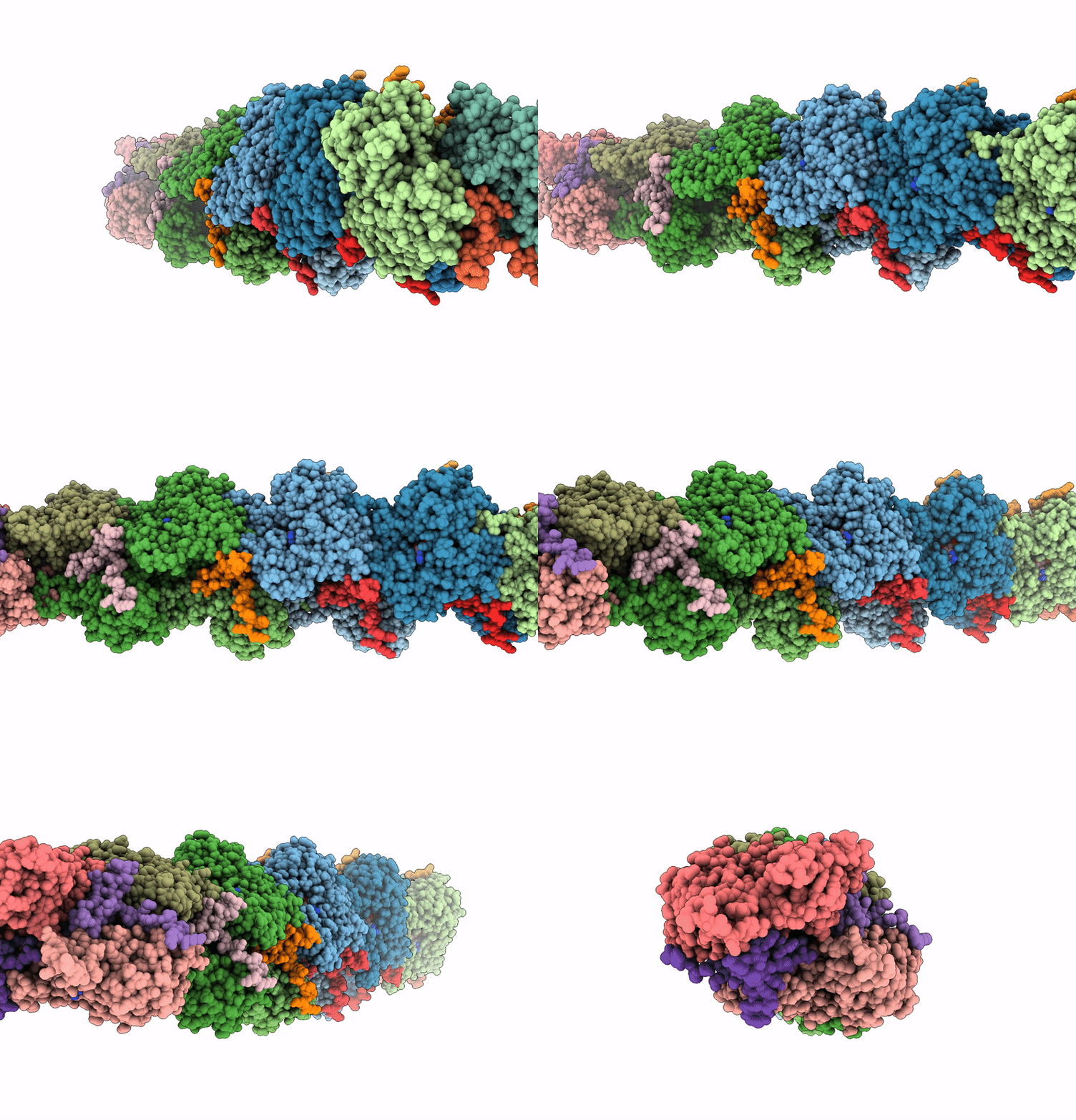
9P1I image
Deposition Date 2025-06-10
Release Date 2025-11-19
Last Version Date 2025-12-10
Entry Detail
PDB ID:
9P1I
Title:
Atomic structure of vibrio effector fragment VopV bound to Beta-cytoplasmic/gamma1-cytoplasmic F-actin
Biological Source:
Source Organism:
Host Organism:
Method Details:
Experimental Method:
Resolution:
3.00 Å
Aggregation State:
FILAMENT
Reconstruction Method:
HELICAL
Macromolecular Entities
Structures with similar UniProt ID
Protein Blast
Polymer Type:polypeptide(L)
Molecule:Actin, cytoplasmic 1
Gene (Uniprot):ACTB
Chain IDs:A (auth: Q), B (auth: R), C (auth: S), D (auth: T), E (auth: U), F (auth: V), G (auth: W), H (auth: X), I (auth: Y), J (auth: Z), K (auth: a), L (auth: b)
Chain Length:375
Number of Molecules:12
Biological Source:Homo sapiens
Structures with similar UniProt ID
Protein Blast
Polymer Type:polypeptide(L)
Molecule:VopV
Gene (Uniprot):MAVP-QPI_00061
Chain IDs:M (auth: c), N (auth: d), O (auth: e), P (auth: f), Q (auth: g), R (auth: h), S (auth: i), T (auth: j), U (auth: k), V (auth: l), W (auth: m), X (auth: n)
Chain Length:2402
Number of Molecules:12
Biological Source:Vibrio parahaemolyticus
Modified Residue
Compound ID Chain ID Parent Comp ID Details 2D Image
HIC A HIS modified residue
Primary Citation
Actin isoform-specific interactions revealed by Vibrio VopV actin-binding repeats.
Proc.Natl.Acad.Sci.USA 122 e2523856122 e2523856122 (2025)
PMID: 41289390 DOI: 10.1073/pnas.2523856122

Abstact

Despite an evolutionary separation of over 300 Mya, there are no amino acid substitutions in certain actin isoforms from reptiles to mammals. What divergence that does exist between different actin isoforms is primarily tissue-specific, rather than species-specific. Sorting of actin isoforms into distinct cellular compartments is believed to be controlled by actin-binding proteins (ABPs), but little is known about how ABPs can differentiate between actin isoforms. We show that the actin-binding repeat (ABR) of the Vibrio parahaemolyticus effector VopV binds to cytoplasmic actin in a unique mode with a low nanomolar affinity, over a thousand times stronger than to muscle actin. Actin mutagenesis and cryo-EM reconstructions reveal that isoform-specific residues of previously unassigned function deep in the cleft between the two actin protofilament strands determine this selectivity. These results suggest a mechanism of highly selective, isoform-specific interactions between actin and its partners, and have broad implications for understanding the evolution of actin. Furthermore, our findings have implications in the pathogenesis of V.parahaemolyticus, whose invasion of intestinal epithelial cells relies on the interaction of VopV with cytoplasmic F-actin.

Legend

Protein

Chemical

Disease

Primary Citation of related structures
Feedback Form
Name
Email
Institute
Feedback