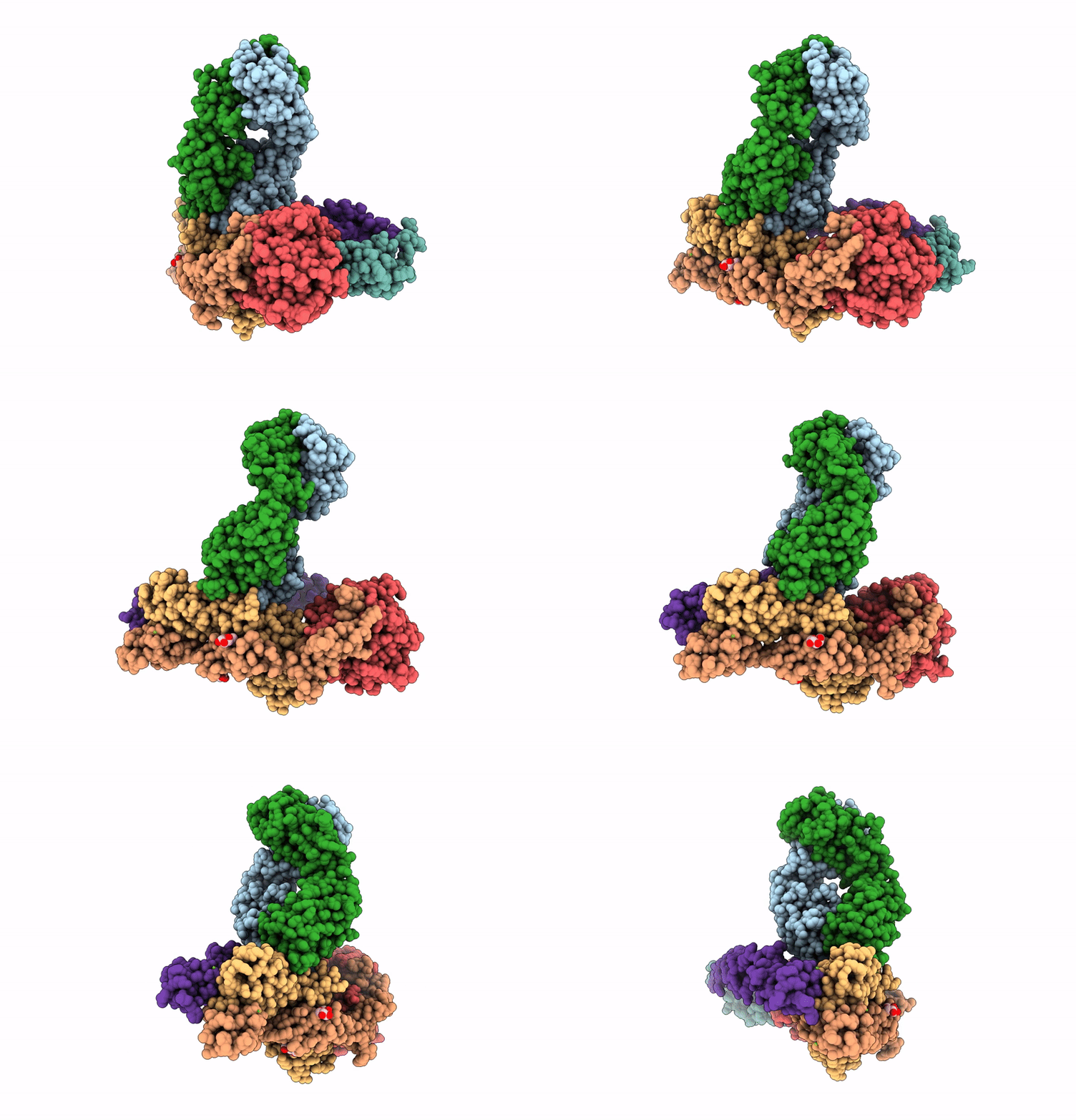
9P0X image
Deposition Date 2025-06-07
Release Date 2025-08-27
Last Version Date 2025-12-17
Entry Detail
PDB ID:
9P0X
Keywords:
Title:
Nanodisc-embedded human TF/FVIIa/XK1 in complex with 10H10 Fab (nanodisc-subtracted)
Biological Source:
Source Organism:
Homo sapiens (Taxon ID: 9606)
Escherichia coli (Taxon ID: 562)
Mus musculus (Taxon ID: 10090)
Host Organism:
Method Details:
Experimental Method:
Resolution:
3.70 Å
Aggregation State:
PARTICLE
Reconstruction Method:
SINGLE PARTICLE

Macromolecular Entities
Polymer Type:polypeptide(L)
Molecule:Human 10H10 antibody Fab heavy chain
Chain IDs:F (auth: H)
Chain Length:221
Number of Molecules:1
Biological Source:Mus musculus
Structures with similar UniProt ID
Protein Blast
Polymer Type:polypeptide(L)
Molecule:Tissue factor pathway inhibitor
Gene (Uniprot):TFPI
Chain IDs:E (auth: K)
Chain Length:68
Number of Molecules:1
Biological Source:Homo sapiens
Polymer Type:polypeptide(L)
Molecule:Human 10H10 antibody Fab light chain
Chain IDs:G (auth: L)
Chain Length:220
Number of Molecules:1
Biological Source:Mus musculus
Structures with similar UniProt ID
Protein Blast
Polymer Type:polypeptide(L)
Molecule:Coagulation factor VII Heavy Chain
Gene (Uniprot):F7
Chain IDs:C (auth: S)
Chain Length:254
Number of Molecules:1
Biological Source:Homo sapiens
Protein Blast
Polymer Type:polypeptide(L)
Molecule:Tissue factor,Maltose/maltodextrin-binding periplasmic protein
Gene (Uniprot):malE, F3
Chain IDs:D (auth: T)
Chain Length:611
Number of Molecules:1
Biological Source:Homo sapiens, Escherichia coli
Structures with similar UniProt ID
Protein Blast
Polymer Type:polypeptide(L)
Molecule:Factor VII light chain
Gene (Uniprot):F7
Chain IDs:A (auth: V)
Chain Length:142
Number of Molecules:1
Biological Source:Homo sapiens
Structures with similar UniProt ID
Protein Blast
Polymer Type:polypeptide(L)
Molecule:Factor X light chain
Gene (Uniprot):F10
Chain IDs:B (auth: X)
Chain Length:131
Number of Molecules:1
Biological Source:Homo sapiens
Modified Residue
Compound ID Chain ID Parent Comp ID Details 2D Image
CGU A GLU modified residue
Primary Citation
Cryo-EM structure of the tissue factor/factor VIIa complex with a factor X mimetic reveals a novel allosteric mechanism.
Blood 146 2833 2842 (2025)
PMID: 40811856 DOI: 10.1182/blood.2025029430

Abstact

Blood clotting is triggered in hemostasis and thrombosis when the membrane-bound tissue factor (TF)/factor VIIa (FVIIa) complex activates factor X (FX). There are no structures of TF/FVIIa on membranes, with or without FX. Using cryo-EM to address this gap, we assembled TF/FVIIa complexes on nanoscale membrane bilayers (nanodiscs), bound to XK1 and an antibody fragment. XK1 is a FX mimetic whose protease domain is replaced by the first Kunitz-type (K1) domain of tissue factor pathway inhibitor, while 10H10 is a non-inhibitory, anti-TF antibody. We determined a cryo-EM structure of a TF/FVIIa/XK1/10H10/nanodisc complex with a resolution of 3.7 Å, allowing us to model all the protein backbones. TF/FVIIa extends perpendicularly from the membrane, interacting with a "handle shaped" XK1 at two locations: the K1 domain docks into FVIIa's active site, while the γ-carboxyglutamate-rich (GLA) domain binds to TF's substrate-binding exosite. The FX and FVIIa GLA domains also contact each other and the membrane surface. Except for a minor contact between the first epidermal growth factor (EGF)-like domain of XK1 and TF, the rest of the FX light chain does not interact with TF/FVIIa. The structure reveals a previously unrecognized, membrane-dependent allosteric activation mechanism between FVIIa and TF where a serine-rich loop in TF that partially obscures the TF exosite must undergo a shift to allow access of the FX GLA domain to its final binding location on the membrane-bound TF/FVIIa complex. This mechanism also provides a novel explanation for the otherwise puzzling phenomenon of TF encryption/decryption on cell surfaces.

Legend

Protein

Chemical

Disease

Primary Citation of related structures
Feedback Form
Name
Email
Institute
Feedback