9ORK image
Deposition Date 2025-05-22
Release Date 2025-11-26
Last Version Date 2025-11-26
Entry Detail
PDB ID:
9ORK
Title:
Antarctic Rhodopsin crystallized in LCP at pH 8.5
Biological Source:
Source Organism:
unidentified (Taxon ID: 32644)
Host Organism:
Method Details:
Experimental Method:
Resolution:
2.59 Å
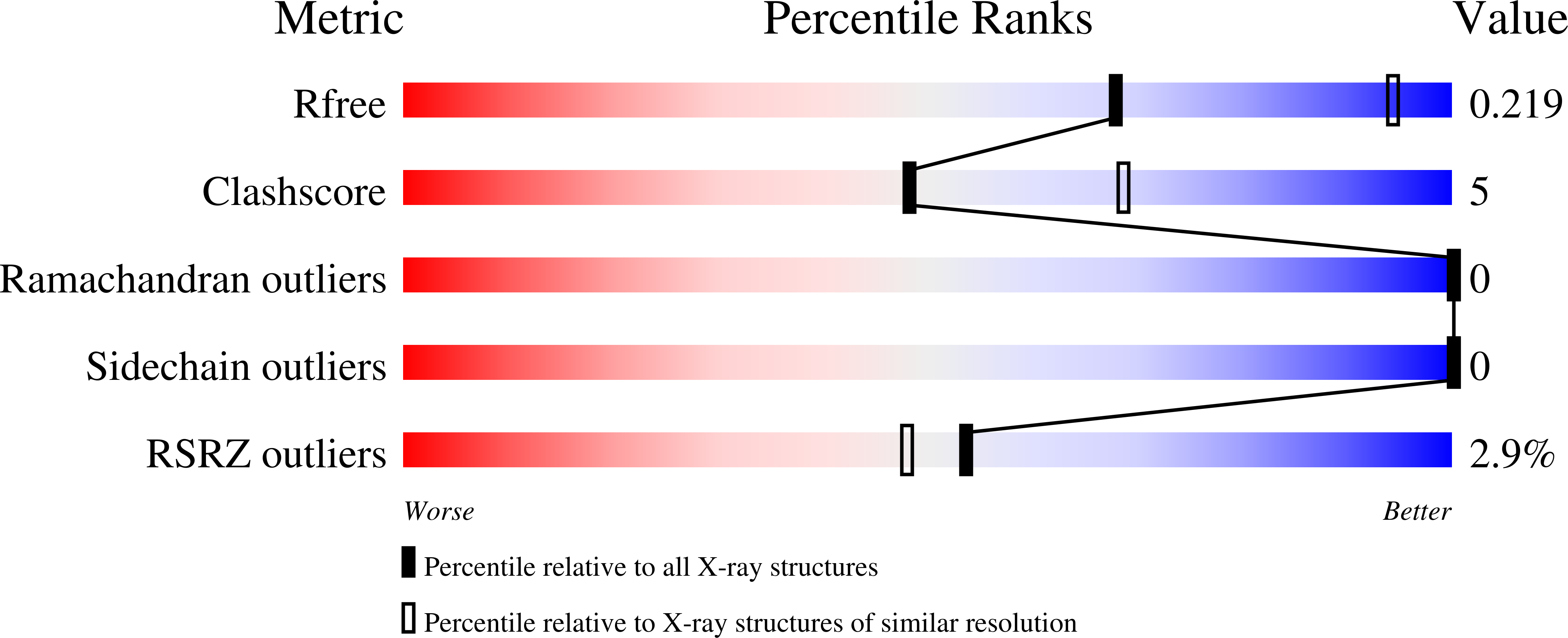
R-Value Free:
0.21
R-Value Work:
0.19
R-Value Observed:
0.19
Space Group:
P 3 2 1
Macromolecular Entities
Polymer Type:polypeptide(L)
Molecule:Antarctic Rhodopsin
Chain IDs:A (auth: AA1)
Chain Length:223
Number of Molecules:1
Biological Source:unidentified
Primary Citation
Structural insights into an inward proton pumping rhodopsin.
Biophys.J. ? ? ? (2025)
PMID: 41229115 DOI: 10.1016/j.bpj.2025.11.011

Abstact

Two phylogenetically distinct groups of microbial rhodopsins show light-induced inward proton transport activity, xenorhodopsins (XeRs) and schizorhodopsins (SzRs). However, structural insights into inward proton pumps are limited, as only three structures have been determined to date, Nanosalina xenorhodopsin (NsXeR), Bacillus coahuilensis xenorhodopsin (BcXeR), and Lokiarchaeota archaeon Schizorhodopsin-4 (SzR4). In contrast, numerous structures of outward proton-pumping rhodopsins are available, posing challenges for broad structure-function comparisons and limiting the study of structural variations among inward proton pumps. Here, we report the crystal structure of the light-driven inward proton pumping rhodopsin, Antarctic Rhodopsin (AntR), a representative member of the SzR group. As AntR displayed a pH-dependent retinal configuration, it was crystallized under acidic and basic conditions. The structures revealed short transmembrane α-helices and large water-filled cavities, which are similar to SzR4 and exceedingly different to NsXeR and BcXeR. AntR possesses a long C-terminal α-helix that extends into the cytoplasm to cover the proton conducting pathway, a feature which has not been observed in other microbial rhodopsins. Truncating this cytoplasmic α-helix results in decreased inward proton pumping efficiency. Integrating the structural and functional results with existing mutagenesis data, we propose a putative inward proton transport mechanism for AntR. The AntR structure provided insights into the conserved and distinctive characteristics of SzRs, highlighting structural variations from type I rhodopsins and heliorhodopsins.

Legend

Protein

Chemical

Disease

Primary Citation of related structures
Feedback Form
Name
Email
Institute
Feedback