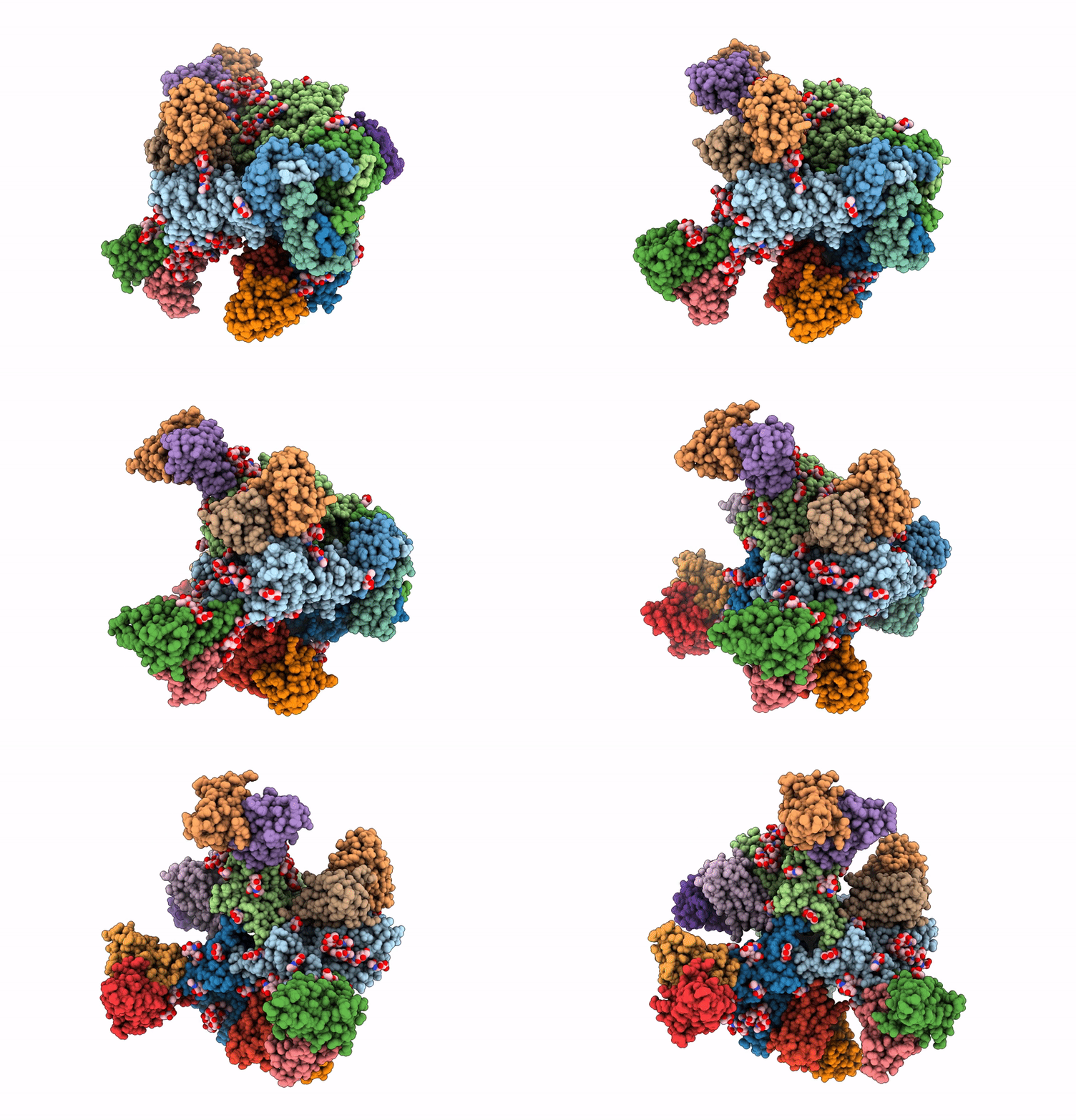
9OGT image
Deposition Date 2025-05-01
Release Date 2025-08-27
Last Version Date 2025-10-08
Entry Detail
PDB ID:
9OGT
Title:
HIV-1 Env BG505 SOSIP.664-His in complex with PGT122 and 3BNC117 Fabs
Biological Source:
Source Organism:
Host Organism:
Method Details:
Experimental Method:
Resolution:
3.00 Å
Aggregation State:
PARTICLE
Reconstruction Method:
SINGLE PARTICLE

Macromolecular Entities
Structures with similar UniProt ID
Protein Blast
Polymer Type:polypeptide(L)
Molecule:HIV-1 Envelope Glycoprotein BG505 SOSIP.664 gp120
Gene (Uniprot):env
Chain IDs:E (auth: A), K (auth: C), Q (auth: E)
Chain Length:516
Number of Molecules:3
Biological Source:Human immunodeficiency virus 1
Structures with similar UniProt ID
Protein Blast
Polymer Type:polypeptide(L)
Molecule:Envelope glycoprotein gp160
Gene (Uniprot):env
Chain IDs:F (auth: B), L (auth: D), R (auth: F)
Chain Length:169
Number of Molecules:3
Biological Source:Human immunodeficiency virus 1
Polymer Type:polypeptide(L)
Molecule:PGT122 Fab heavy chain
Chain IDs:C (auth: G), I (auth: J), O
Chain Length:235
Number of Molecules:3
Biological Source:Homo sapiens
Polymer Type:polypeptide(L)
Molecule:3BNC117 Fab heavy chain
Chain IDs:A (auth: H), G (auth: K), M (auth: P)
Chain Length:226
Number of Molecules:3
Biological Source:Homo sapiens
Polymer Type:polypeptide(L)
Molecule:PGT122 Fab light chain
Chain IDs:D (auth: I), J (auth: M), P (auth: Q)
Chain Length:211
Number of Molecules:3
Biological Source:Homo sapiens
Polymer Type:polypeptide(L)
Molecule:3BNC117 Fab light chain
Chain IDs:B (auth: L), H (auth: N), N (auth: R)
Chain Length:206
Number of Molecules:3
Biological Source:Homo sapiens
Ligand Molecules
Primary Citation
A modification to heptad repeat 1 of gp41 improves yield and/or quality of soluble pre-fusion HIV-1 envelope glycoprotein trimers.
J.Virol. 99 e0091325 e0091325 (2025)
PMID: 40862550 DOI: 10.1128/jvi.00913-25

Abstact

UNLABELLED Native-like HIV-1 envelope glycoprotein (Env) trimers, exemplified by the SOSIP design, are widely used as immunogens, analytical antigens, and for structural studies. These vaccine research and development programs require trimers that are based on multiple HIV-1 genotypes. While a wide range of protein engineering strategies can produce SOSIP trimers from most Env gene sequences, there are still examples of trimers that are expressed only at impractically low yields or that are unstable. Accordingly, additional protein modifications aimed at overcoming such limitations need to be evaluated. Here, we describe a new heptad repeat 1 modification of gp41, known as dPG, that helps to further stabilize the gp41 component of prototypic and germline-targeting SOSIP trimers in the pre-fusion state and thereby increases post-purification yields substantially. The dPG modification involves a deletion (d) at the highly conserved 566 position that disrupts the heptad repeat and introduces proline (P) and glycine (G) substitutions at positions 567 and 568, respectively. We show that the dPG strategy reinforces previously described stabilization changes in existing SOSIP trimers and can rescue otherwise problematic trimer constructs. The latter includes trimers used to target or analyze human germline antibodies and others derived from the global HIV-1 neutralization panel. In summary, the dPG modification strategy can increase the yield and/or quality of Env trimers that are otherwise difficult to produce. IMPORTANCE Stabilized, soluble, pre-fusion SOSIP trimers are widely used in HIV-1 Env vaccine research. Protein engineering techniques have identified multiple ways to stabilize SOSIP trimers from a range of genotypes. However, some SOSIP trimers remain difficult to express at adequate yields and/or purity, so there is a need for additional modifications. Here, we identified a sequence change, designated dPG, to the gp41 subunit that increases the yield and/or quality of various otherwise problematic SOSIP trimers without compromising their antigenicity or structure. This new modification may have general value for HIV-1 vaccine research and development.

Legend

Protein

Chemical

Disease

Primary Citation of related structures
Feedback Form
Name
Email
Institute
Feedback