9OGN image
Deposition Date 2025-05-01
Release Date 2025-11-26
Last Version Date 2025-12-03
Entry Detail
PDB ID:
9OGN
Title:
Crystal Structure of KPT396 in complex with CRM1-Ran-RanBP1
Biological Source:
Source Organism(s):
Method Details:
Experimental Method:
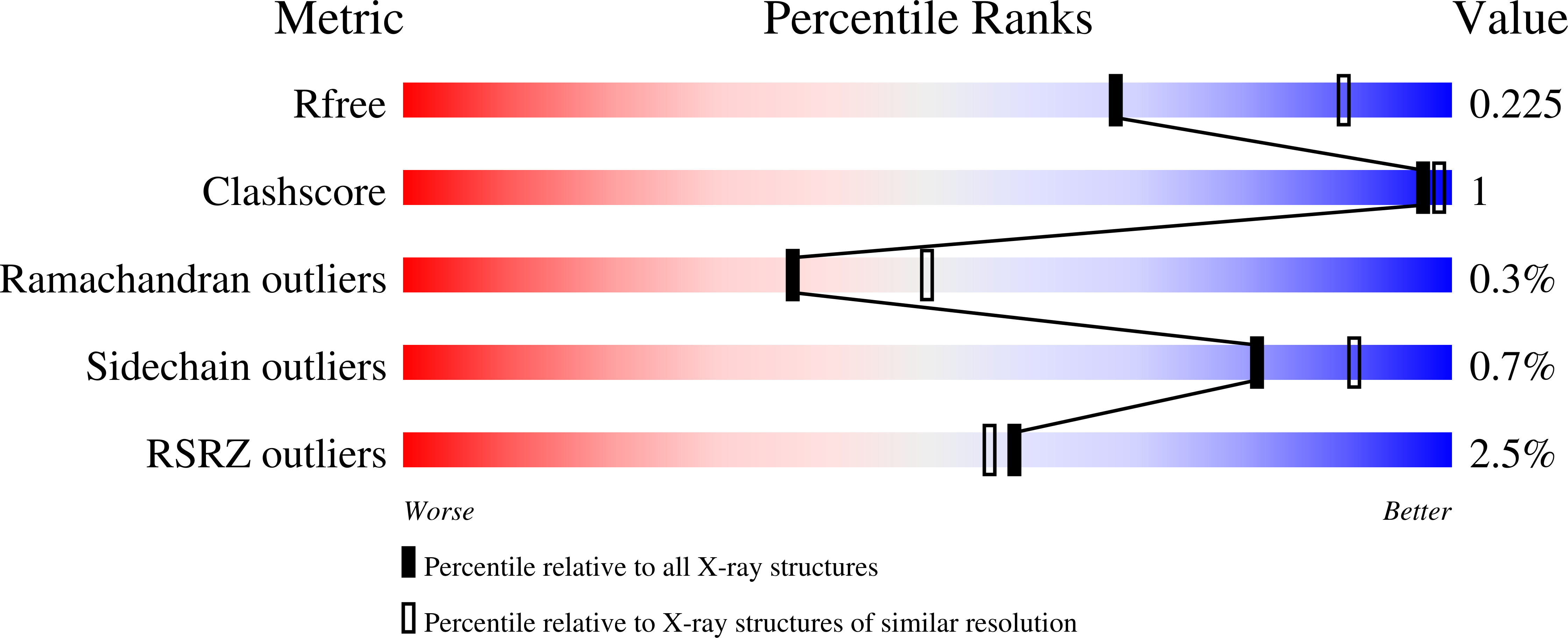
Resolution:
2.41 Å
R-Value Free:
0.22
R-Value Work:
0.18
R-Value Observed:
0.18
Space Group:
P 43 21 2
Macromolecular Entities
Structures with similar UniProt ID
Protein Blast
Polymer Type:polypeptide(L)
Molecule:GTP-binding nuclear protein Ran
Gene (Uniprot):RAN
Chain IDs:A
Chain Length:237
Number of Molecules:1
Biological Source:Homo sapiens
Structures with similar UniProt ID
Protein Blast
Polymer Type:polypeptide(L)
Molecule:Ran-specific GTPase-activating protein 1
Gene (Uniprot):YRB1
Chain IDs:B
Chain Length:143
Number of Molecules:1
Biological Source:Saccharomyces cerevisiae
Structures with similar UniProt ID
Protein Blast
Polymer Type:polypeptide(L)
Molecule:Exportin-1
Gene (Uniprot):CRM1
Mutagens:T539C, Y1022C
Chain IDs:C
Chain Length:1024
Number of Molecules:1
Biological Source:Saccharomyces cerevisiae
Primary Citation
SINE compounds activate exportin-1 degradation via an allosteric mechanism.
Biorxiv ? ? ? (2025)
PMID: 39416201 DOI: 10.1101/2024.10.07.617049

Abstact

The nuclear export receptor exportin 1 (XPO1/CRM1) is often overexpressed in cancer cells, leading to the mislocalization of numerous cancer-related protein cargoes 1,2 . Selinexor, a covalent XPO1 inhibitor, and other Selective Inhibitor of Nuclear Export (SINEs) restore proper nuclear localization by blocking XPO1-cargo binding 2-7 . SINEs also induce XPO1 degradation via the Cullin-RING E3 ubiquitin ligase (CRL) substrate receptor ASB8 7 . Here we elucidate the mechanism underlying the high-affinity engagement of CRL5 ASB8 with SINE-conjugated XPO1. Cryogenic electron microscopy (cryoEM) structures reveal that ASB8 binds to a cryptic site on XPO1, which becomes accessible only upon SINE conjugation. While molecular glue degraders typically interact with both CRL and the substrate 8-10 , SINEs bind to XPO1 without requiring interaction with ASB8 for efficient XPO1 degradation. Instead, an allosteric mechanism facilitates high affinity XPO1-ASB8 interaction, leading to XPO1 ubiquitination and degradation. ASB8-mediated degradation is also observed upon treatment of the endogenous itaconate derivate 4-octyl itaconate, which suggests a native mechanism that is inadvertently exploited by synthesized XPO1 inhibitors. This allosteric XPO1 degradation mechanism of SINE compounds expands the known modes of targeted protein degradation beyond the well-characterized molecular glue degraders and proteolysis targeting chimeras of CRL4.

Legend

Protein

Chemical

Disease

Primary Citation of related structures
Feedback Form
Name
Email
Institute
Feedback