9OAA image
Deposition Date 2025-04-21
Release Date 2026-01-21
Last Version Date 2026-01-21
Entry Detail
PDB ID:
9OAA
Title:
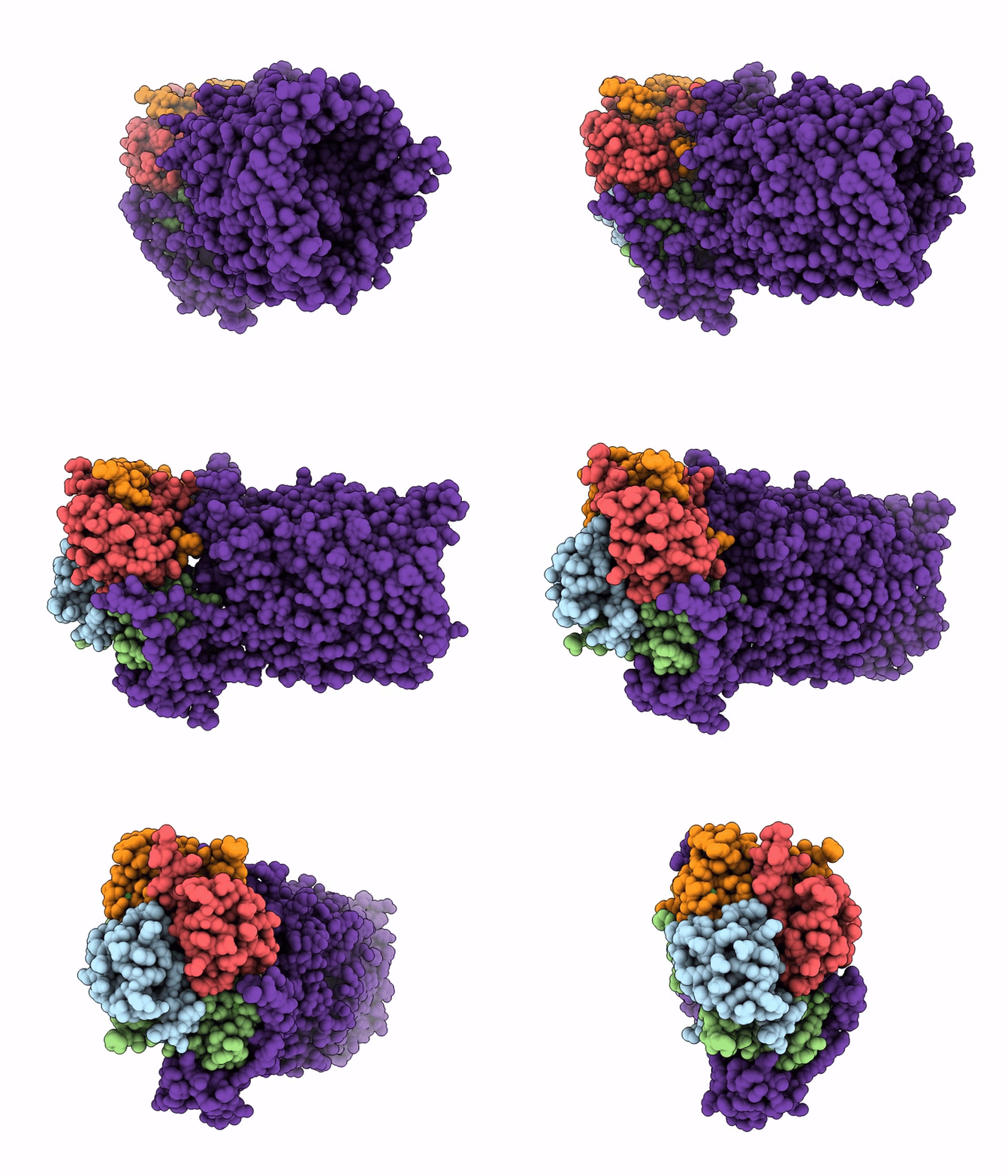
The structure of TdfH from Neisseria gonorrhoeae
Biological Source:
Source Organism(s):
Expression System(s):
Method Details:
Experimental Method:
Resolution:
3.67 Å
Aggregation State:
PARTICLE
Reconstruction Method:
SINGLE PARTICLE
Macromolecular Entities
Structures with similar UniProt ID
Protein Blast
Polymer Type:polypeptide(L)
Molecule:Protein S100-A8
Gene (Uniprot):S100A8
Chain IDs:B (auth: A), D (auth: C)
Chain Length:93
Number of Molecules:2
Biological Source:Homo sapiens
Structures with similar UniProt ID
Protein Blast
Polymer Type:polypeptide(L)
Molecule:Protein S100-A9
Gene (Uniprot):S100A9
Chain IDs:C (auth: B), E (auth: D)
Chain Length:114
Number of Molecules:2
Biological Source:Homo sapiens
Structures with similar UniProt ID
Protein Blast
Polymer Type:polypeptide(L)
Molecule:TonB-dependent receptor
Gene (Uniprot):NGO_0952
Chain IDs:A (auth: T)
Chain Length:901
Number of Molecules:1
Biological Source:Neisseria gonorrhoeae FA 1090
Primary Citation
Structural insights into zinc piracy by Neisseria gonorrhoeae to overcome nutritional immunity.
Structure ? ? ? (2025)
PMID: 41418777 DOI: 10.1016/j.str.2025.11.014

Abstact

With an estimated 106 million global cases annually, Neisseria gonorrhoeae (Ngo) poses a significant public health problem. Ngo demonstrates a remarkable capacity to overcome nutritional immunity through the deployment of specialized transporters that pirate metals such as zinc from human proteins such as calprotectin (hCP). We report the cryo-EM structure of Ngo TdfH in complex with a heterotetramer of hCP. An extensive binding interface is mediated almost entirely by the S100A9 subunits of hCP. Mutagenesis studies of residues in the large binding interface reveal minimal effects from single-site mutations, whereas larger truncations disrupt binding and function. These results support a mechanistic model based on the large interaction interface overcoming a steric clash between α-helix III of S100A9 and loops 5 and 9 of TdfH, which leads to the distortion of the proximal His6 site, followed by zinc release, and import through the barrel domain.

Legend

Protein

Chemical

Disease

Primary Citation of related structures
Feedback Form
Name
Email
Institute
Feedback