9O97 image
Deposition Date 2025-04-17
Release Date 2026-01-07
Last Version Date 2026-01-21
Entry Detail
PDB ID:
9O97
Title:
Cryo-EM structure of CLC-ec1 at pH 3.0
Biological Source:
Source Organism(s):
Escherichia coli (Taxon ID: 562)
Expression System(s):
Method Details:
Experimental Method:
Resolution:
3.10 Å
Aggregation State:
PARTICLE
Reconstruction Method:
SINGLE PARTICLE
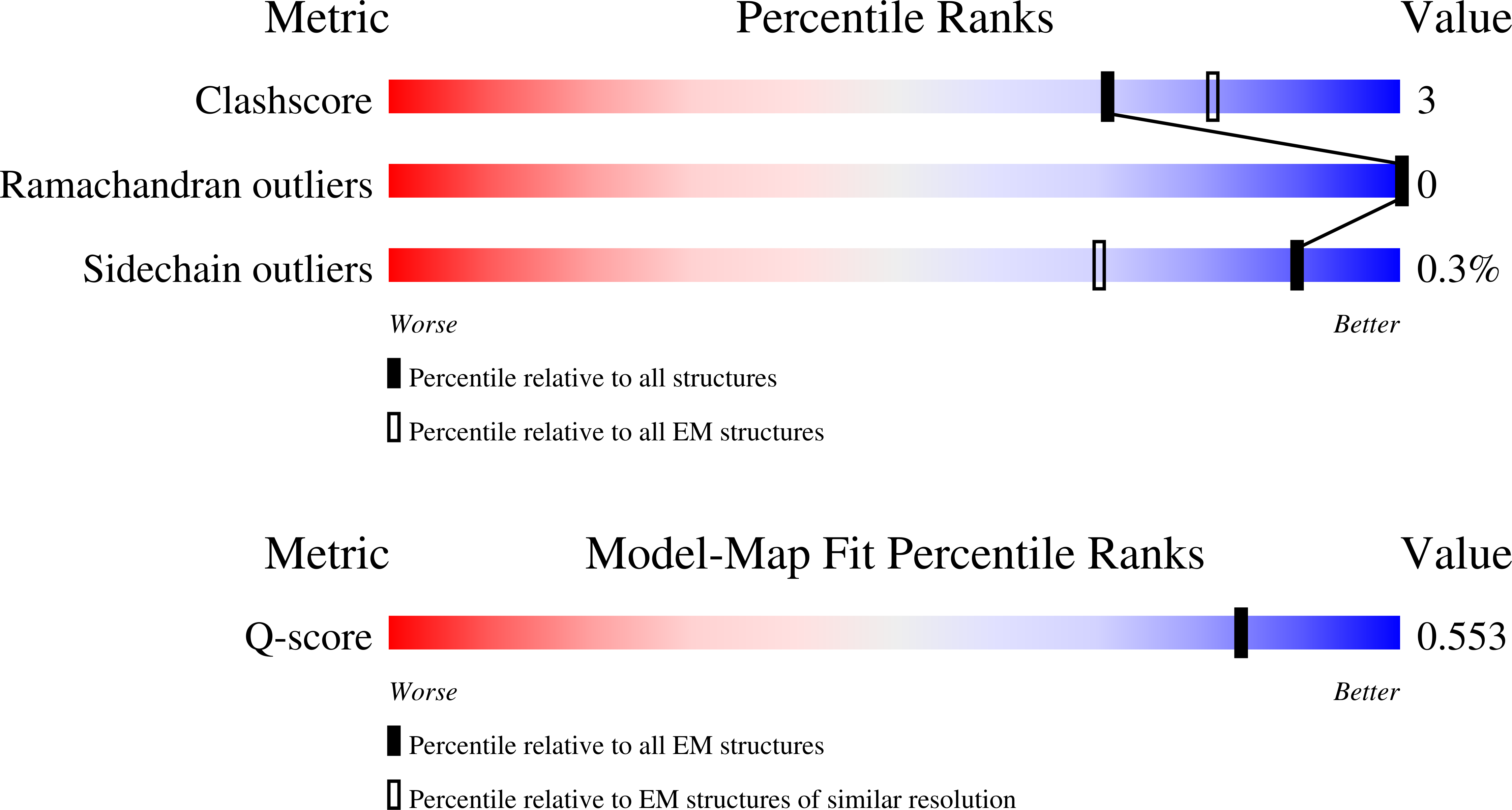
Macromolecular Entities
Structures with similar UniProt ID
Protein Blast
Polymer Type:polypeptide(L)
Molecule:H(+)/Cl(-) exchange transporter ClcA
Gene (Uniprot):clcA
Chain IDs:A, B
Chain Length:489
Number of Molecules:2
Biological Source:Escherichia coli
Ligand Molecules
Primary Citation
Molecular mechanism of exchange coupling in CLC chloride/proton antiporters.
Nat Commun ? ? ? (2026)
PMID: 41507156 DOI: 10.1038/s41467-025-68098-1

Abstact

The ubiquitous CLC membrane transporters are unique in their ability to exchange anions for cations. Despite extensive study, there is no mechanistic model that fully explains their 2:1 Cl‒/H+ stoichiometric exchange mechanism. Here, we provide such a model. Using differential hydrogen-deuterium exchange mass spectrometry, cryo-EM structure determination, and molecular dynamics simulations, we uncovered conformational dynamics in CLC-ec1, a bacterial CLC homolog that has served as a paradigm for this family of transporters. Simulations based on a cryo-EM structure at pH 3 revealed critical steps in the transport mechanism, including release of Cl‒ ions to the extracellular side, opening of the inner gate, and water wires that facilitate H+ transport. Surprisingly, these water wires occurred independently of Cl‒ binding, prompting us to reassess the relationship between Cl‒ binding and Cl‒/H+ coupling. Using isothermal titration calorimetry and quantitative flux assays on mutants with reduced Cl‒ binding affinity, we conclude that, while Cl‒ binding is necessary for coupling, even weak binding can support Cl‒/H+ coupling. By integrating our findings with existing literature, we establish a complete and efficient CLC 2:1 Cl‒/H+ exchange mechanism.

Legend

Protein

Chemical

Disease

Primary Citation of related structures
Feedback Form
Name
Email
Institute
Feedback