9O65 image
Deposition Date 2025-04-11
Release Date 2026-01-21
Last Version Date 2026-01-21
Entry Detail
PDB ID:
9O65
Title:
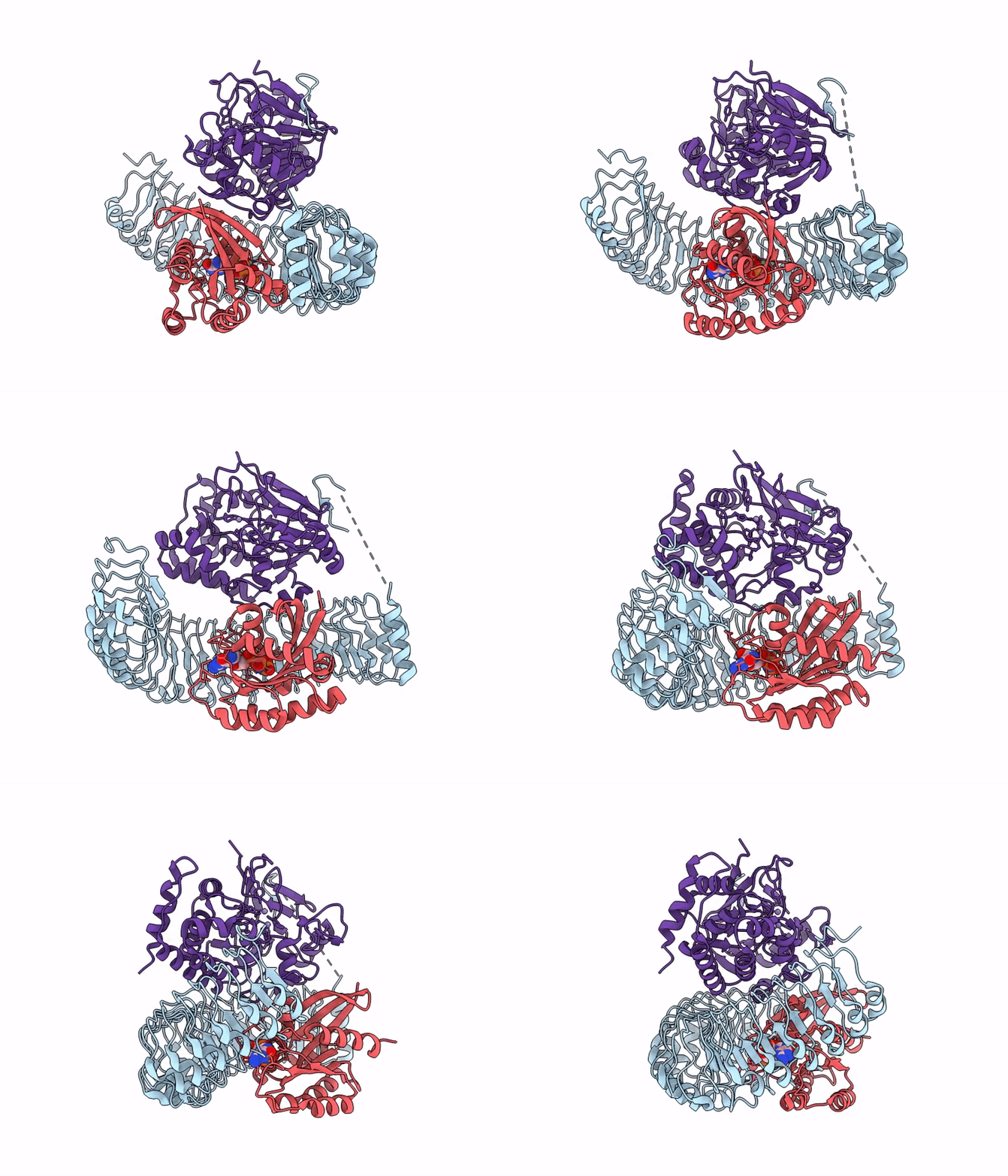
Cryo-EM structure of SHOC2-KRAS-PP1CA (SKP) complex
Biological Source:
Source Organism(s):
Homo sapiens (Taxon ID: 9606)
Expression System(s):
Method Details:
Experimental Method:
Resolution:
3.00 Å
Aggregation State:
PARTICLE
Reconstruction Method:
SINGLE PARTICLE
Macromolecular Entities
Structures with similar UniProt ID
Protein Blast
Polymer Type:polypeptide(L)
Molecule:Leucine-rich repeat protein SHOC-2
Gene (Uniprot):SHOC2
Mutagens:M173I
Chain IDs:A
Chain Length:582
Number of Molecules:1
Biological Source:Homo sapiens
Structures with similar UniProt ID
Protein Blast
Polymer Type:polypeptide(L)
Molecule:Isoform 2B of GTPase KRas
Gene (Uniprot):KRAS
Mutagens:Q61R
Chain IDs:B
Chain Length:169
Number of Molecules:1
Biological Source:Homo sapiens
Structures with similar UniProt ID
Protein Blast
Polymer Type:polypeptide(L)
Molecule:Serine/threonine-protein phosphatase PP1-alpha catalytic subunit
Gene (Uniprot):PPP1CA
Mutagens:P50R
Chain IDs:C
Chain Length:330
Number of Molecules:1
Biological Source:Homo sapiens
Primary Citation
Structure of SHOC2-KRAS-PP1C complex reveals RAS isoform-specific determinants and insights into targeting complex assembly by RAS inhibitors.
Nat Commun ? ? ? (2026)
PMID: 41519889 DOI: 10.1038/s41467-026-68319-1

Abstact

RAF activation is essential for MAPK signaling and is mediated by RAS binding and the dephosphorylation of a conserved phosphoserine by the SHOC2-RAS-PP1C complex. MRAS forms a high-affinity SHOC2-MRAS-PP1C (SMP) complex, while canonical RAS isoforms (KRAS, HRAS, NRAS) form analogous but lower-affinity assemblies. Yet, cancers driven by oncogenic KRAS, HRAS, or NRAS remain strongly SHOC2-dependent, suggesting that these weaker complexes contribute to tumorigenesis. To elucidate how canonical RAS proteins form lower-affinity ternary complexes, the cryo-EM structure of the SHOC2-KRAS-PP1C (SKP) complex stabilized by Noonan syndrome mutations is described. The SKP architecture is similar to the SMP complex but forms fewer contacts and buries less surface area due to the absence of MRAS-specific structural features in KRAS that enhance complex stability. RAS inhibitors MRTX1133 and RMC-6236 alter Switch-I/II conformations, thereby blocking SKP assembly more effectively than they disrupt preformed complexes. These RAS inhibitors do not affect SMP formation because they do not bind MRAS. Since MRAS is upregulated in resistance to KRAS inhibition, we characterize a MRAS mutant capable of binding MRTX1133. This MRAS mutant can form an SMP complex, but MRTX1133 blocks its assembly, demonstrating the feasibility of dual SKP and SMP targeting. Overall, our findings define isoform-specific differences in SHOC2-RAS-PP1C complex formation and support a strategy to prevent both SKP and SMP assemblies to overcome resistance in RAS-driven cancers.

Legend

Protein

Chemical

Disease

Primary Citation of related structures
Feedback Form
Name
Email
Institute
Feedback