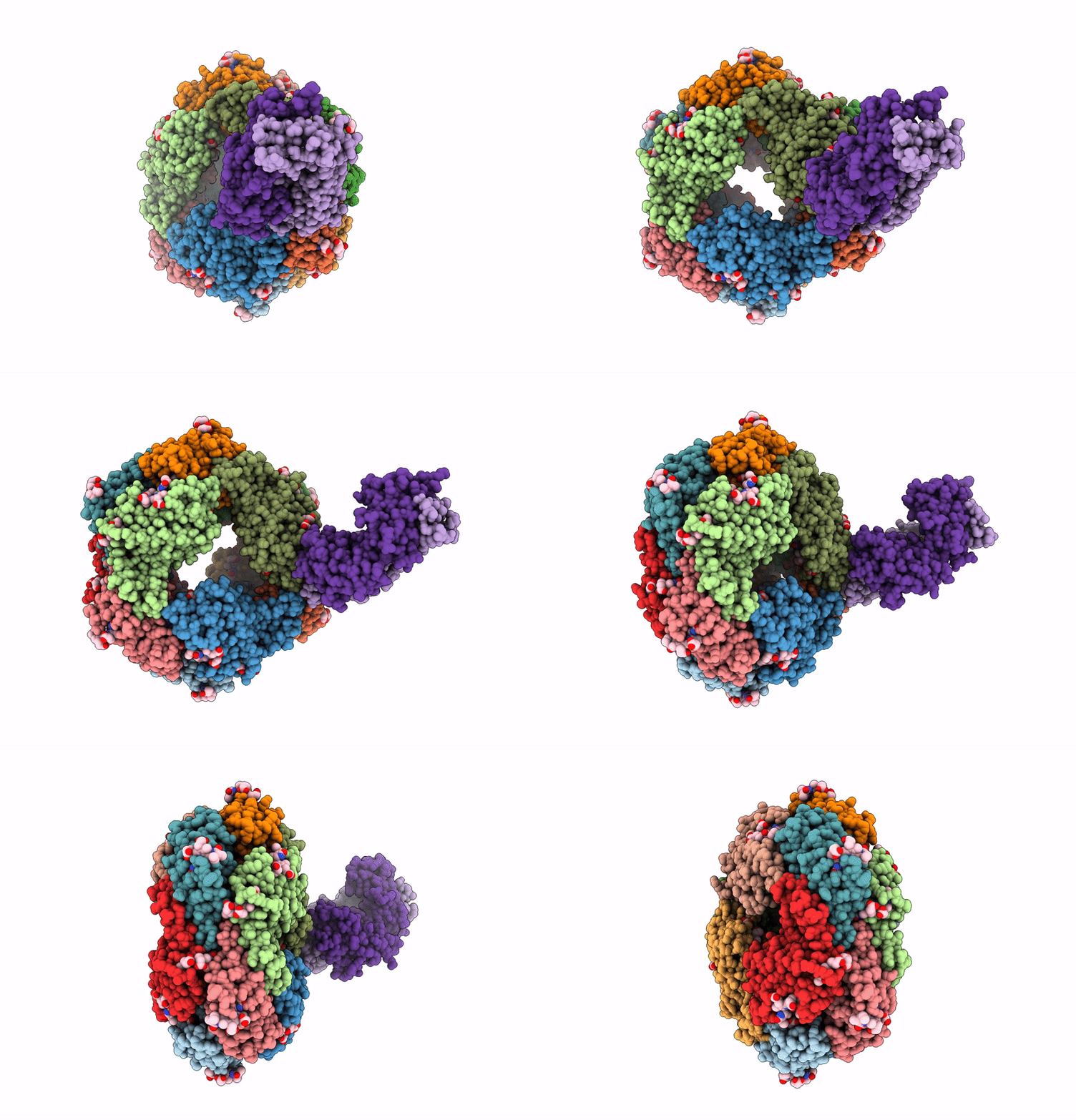
9O62 image
Deposition Date 2025-04-10
Release Date 2025-08-06
Last Version Date 2025-10-15
Entry Detail
PDB ID:
9O62
Keywords:
Title:
1C5H TCR bound to R-phycoerythrin
Biological Source:
Source Organism:
Homo sapiens (Taxon ID: 9606)
Pyropia tenera (Taxon ID: 2785)
Host Organism:
Method Details:
Experimental Method:
Resolution:
2.03 Å
Aggregation State:
PARTICLE
Reconstruction Method:
SINGLE PARTICLE

Macromolecular Entities
Structures with similar UniProt ID
Protein Blast
Polymer Type:polypeptide(L)
Molecule:R-phycoerythrin class I alpha subunit
Gene (Uniprot):cpeA
Chain IDs:A, C, E, G, I, K
Chain Length:164
Number of Molecules:6
Biological Source:Pyropia tenera
Structures with similar UniProt ID
Protein Blast
Polymer Type:polypeptide(L)
Molecule:R-phycoerythrin class I beta subunit
Gene (Uniprot):cpeB
Chain IDs:B, D, F, H, J, L
Chain Length:176
Number of Molecules:6
Biological Source:Pyropia tenera
Polymer Type:polypeptide(L)
Molecule:1C5H TCR delta chain
Chain IDs:M (auth: a)
Chain Length:164
Number of Molecules:1
Biological Source:Homo sapiens
Polymer Type:polypeptide(L)
Molecule:TCR gamma chain
Chain IDs:N (auth: b)
Chain Length:176
Number of Molecules:1
Biological Source:Homo sapiens
Primary Citation
Antibody-like recognition of a gamma delta T cell receptor toward a foreign antigen.
Structure 33 1649 ? (2025)
PMID: 40744007 DOI: 10.1016/j.str.2025.07.006

Abstact

The antigen recognition principles of B cells and αβ T cells have been well described compared to those of the γδ T cell. By way of their specificity conferring receptor (γδTCR), γδ T cells can directly bind proteinaceous antigens. A known γδ T cell and B cell model antigen is phycoerythrin (PE), a light harvesting protein from rhodophytes and cyanobacteria. Here we probed human γδTCR reactivity to PE, in which a Vδ1Vγ5 TCR bound directly to induce proximal signaling and cellular activation. We determined the cryoelectron microscopy (cryo-EM) structure of the γδTCR-phycoerythrin immune complex. We then determined the cryo-EM structures of an antibody fragment and an αβTCR bound to PE. This revealed convergent use of apical aromatic residues to mediate contacts with a common PE epitope. Comparative analyses of the γδTCR revealed multiple antibody-like characteristics, including an enrichment of apical aromatic residues. Our findings reveal further distinct facets of antigen recognition by the γδTCR.

Legend

Protein

Chemical

Disease

Primary Citation of related structures
Feedback Form
Name
Email
Institute
Feedback