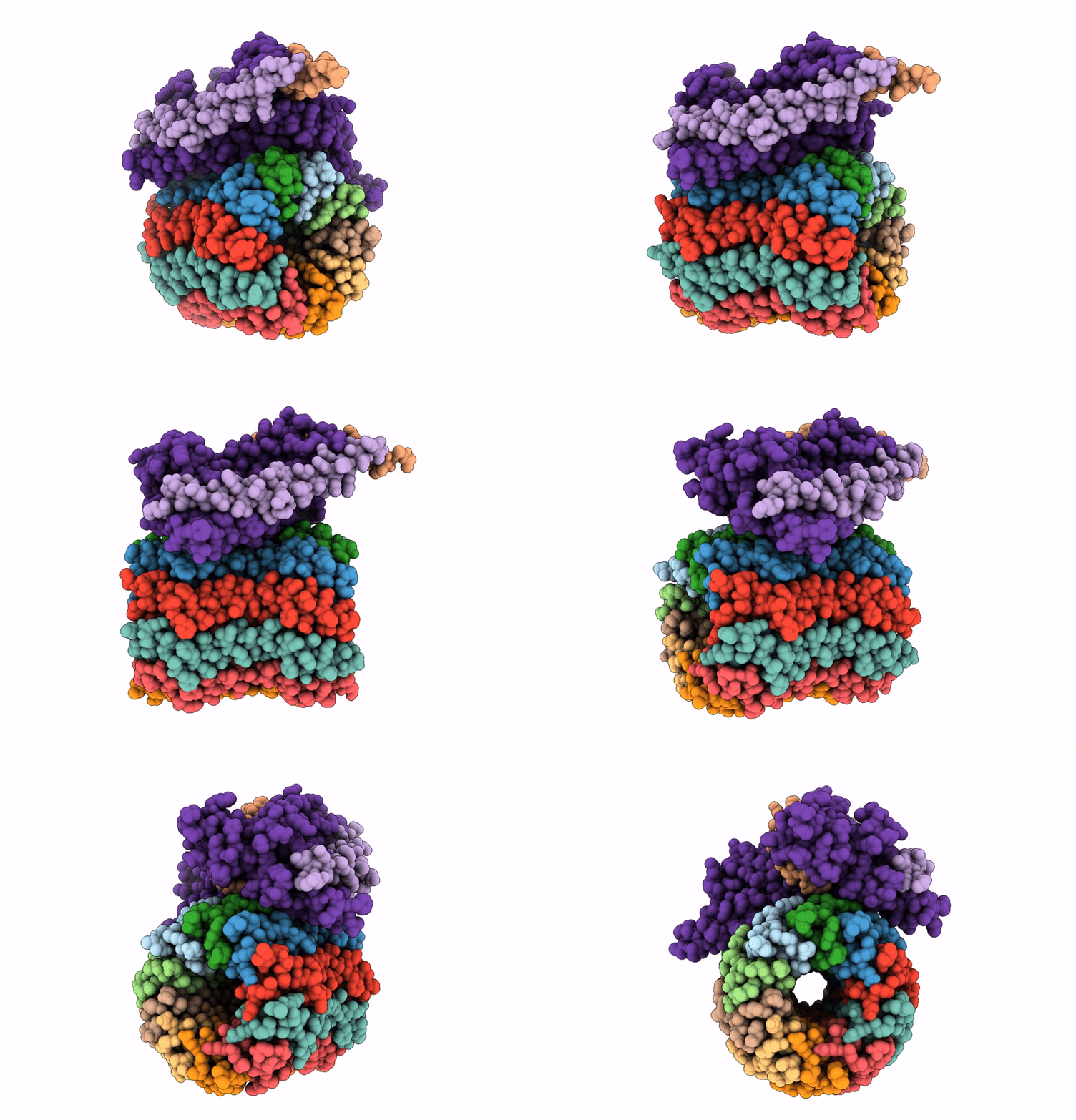
9O1G image
Deposition Date 2025-04-03
Release Date 2025-12-10
Last Version Date 2026-01-28
Entry Detail
PDB ID:
9O1G
Title:
Pseudomonas aeruginosa ATPase State2b Fo focused
Biological Source:
Source Organism(s):
Expression System(s):
Method Details:
Experimental Method:
Resolution:
2.66 Å
Aggregation State:
PARTICLE
Reconstruction Method:
SINGLE PARTICLE
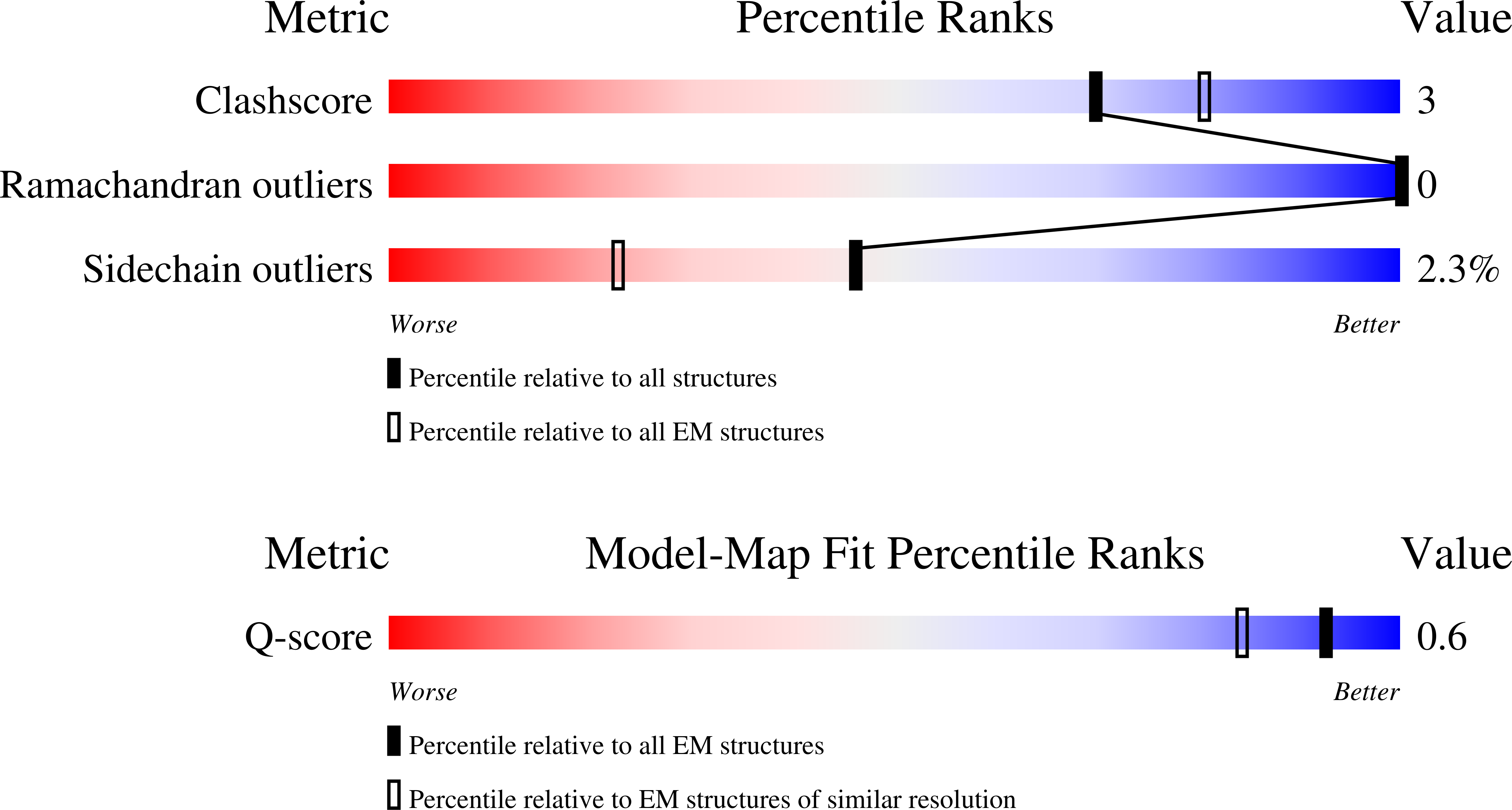
Macromolecular Entities
Structures with similar UniProt ID
Protein Blast
Polymer Type:polypeptide(L)
Molecule:ATP synthase subunit c
Gene (Uniprot):atpE
Chain IDs:A (auth: I), B (auth: J), C (auth: L), D (auth: M), E (auth: N), F (auth: O), G (auth: P), H (auth: Q), I (auth: R), J (auth: S)
Chain Length:85
Number of Molecules:10
Biological Source:Pseudomonas aeruginosa
Structures with similar UniProt ID
Protein Blast
Polymer Type:polypeptide(L)
Molecule:ATP synthase subunit b
Gene (Uniprot):atpF
Chain IDs:K (auth: X), L (auth: Y)
Chain Length:156
Number of Molecules:2
Biological Source:Pseudomonas aeruginosa
Structures with similar UniProt ID
Protein Blast
Polymer Type:polypeptide(L)
Molecule:ATP synthase subunit a
Gene (Uniprot):atpB
Chain IDs:M (auth: a)
Chain Length:289
Number of Molecules:1
Biological Source:Pseudomonas aeruginosa
Ligand Molecules
Primary Citation
Distinct structural features of Pseudomonas aeruginosa ATP synthase revealed by cryo-electron microscopy.
Nat Commun 17 406 406 (2025)
PMID: 41366214 DOI: 10.1038/s41467-025-67100-0

Abstact

F1Fo ATP synthase is the ubiquitous enzyme that synthesizes cellular ATP by coupling proton-motive force with rotational catalysis. Structural differences between prokaryotic and eukaryotic ATP synthases offer potential targets for antimicrobial development. Here, we present the 2.0-2.4 Å resolution cryo-electron microscopy structures of the ATP synthase from Pseudomonas aeruginosa, an opportunistic bacterial pathogen capable of causing serious infections in humans. Our structures identify two distinctive features of this species' enzyme: a distinct binding site for the inhibitory ε subunit, and a coordinated metal ion capping the cytoplasmic proton channel. Lower-resolution maps of the enzyme following incubation with MgATP showed conformational rearrangements of the ε subunit during activation. Visualization of bound water molecules in the periplasmic half-channel supports a Grotthuss proton-transfer mechanism. Focused classification of the Fo motor resolves distinct ~11° sub-steps in the c-ring, corresponding to protonation and deprotonation events. Functional analyses show that modifications to either the ε subunit or the metal binding site influence ATP synthesis and hydrolysis. Mass spectrometry analyses suggests that the physiological metal within the complex is zinc. Collectively, these findings define structural features of P. aeruginosa ATP synthase that could serve as targets for antimicrobial therapeutics.

Legend

Protein

Chemical

Disease

Primary Citation of related structures
Feedback Form
Name
Email
Institute
Feedback