9NYQ image
Deposition Date 2025-03-28
Release Date 2026-03-04
Last Version Date 2026-03-04
Entry Detail
PDB ID:
9NYQ
Keywords:
Title:
Crystal structure of CDK2/CyclinE1 in complex with Cpd 3
Biological Source:
Source Organism(s):
Homo sapiens (Taxon ID: 9606)
Expression System(s):
Method Details:
Experimental Method:
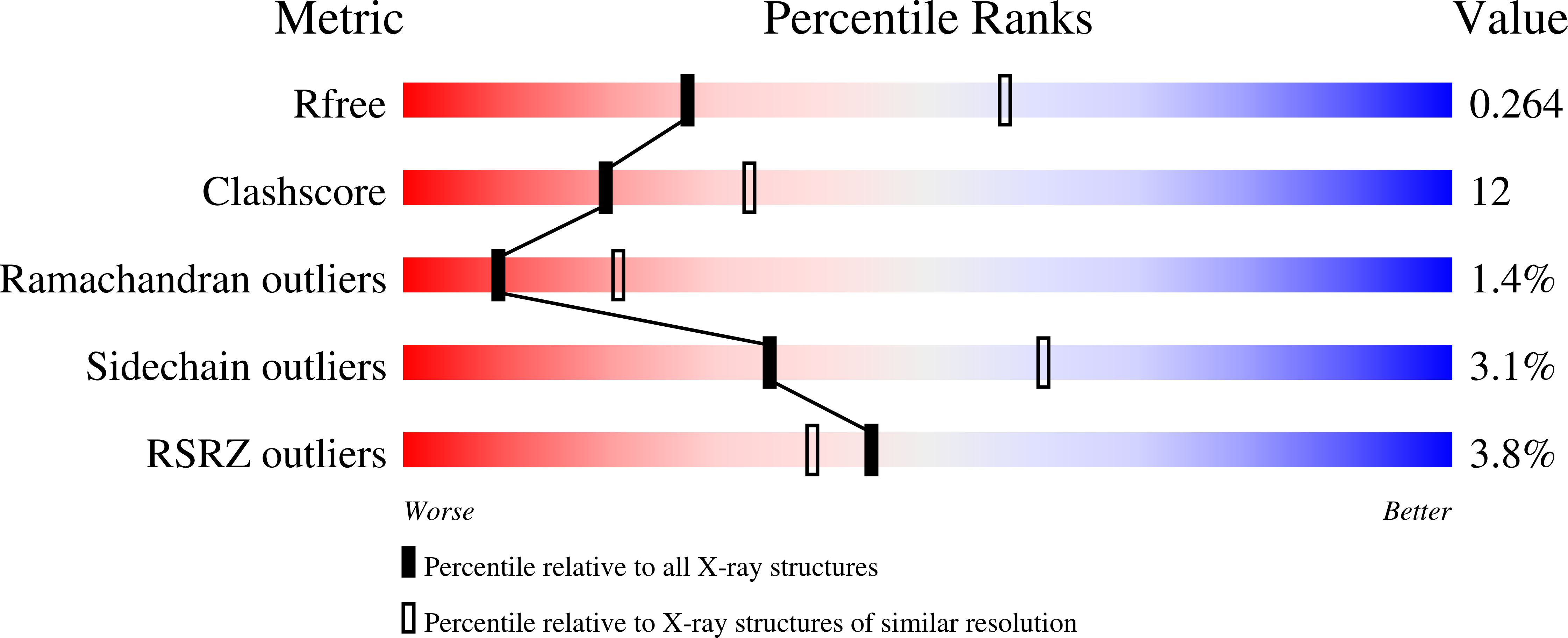
Resolution:
2.85 Å
R-Value Free:
0.26
R-Value Work:
0.23
R-Value Observed:
0.24
Space Group:
P 41 21 2
Macromolecular Entities
Structures with similar UniProt ID
Protein Blast
Polymer Type:polypeptide(L)
Molecule:Cyclin-dependent kinase 2
Gene (Uniprot):CDK2
Chain IDs:A
Chain Length:299
Number of Molecules:1
Biological Source:Homo sapiens
Structures with similar UniProt ID
Protein Blast
Polymer Type:polypeptide(L)
Molecule:G1/S-specific cyclin-E1
Gene (Uniprot):CCNE1
Chain IDs:B
Chain Length:410
Number of Molecules:1
Biological Source:Homo sapiens
Modified Residue
Compound ID Chain ID Parent Comp ID Details 2D Image
TPO A THR modified residue
Primary Citation
Discovery of Selective and Orally Bioavailable Heterobifunctional Degraders of Cyclin-Dependent Kinase 2.
J.Med.Chem. 68 18407 18422 (2025)
PMID: 40833690 DOI: 10.1021/acs.jmedchem.5c01160

Abstact

Cyclin-dependent kinase 2 (CDK2) plays an important role in cell cycle regulation and has emerged as a compelling target for the treatment of cancer, largely because of its potential to overcome the resistance associated with CDK4/6 inhibition. Efforts to develop CDK2 inhibitors have historically proven challenging due to undesirable safety profiles associated with inhibiting off-target CDK isoforms. Herein, we describe the structure-guided discovery of a series of orally bioavailable and selective degraders of CDK2. Degrader 37 demonstrated improved phenotypic selectivity compared to a clinical CDK2 inhibitor, with greater specificity for disease-relevant cyclin E1 (CCNE1)-amplified cancer cells vs nonamplified cohort. The antitumor activity of 37 in mice bearing CCNE1-amplified HCC1569 tumors correlated with sustained >90% degradation of CDK2 and sustained 90% inhibition of Rb phosphorylation.

Legend

Protein

Chemical

Disease

Primary Citation of related structures
Feedback Form
Name
Email
Institute
Feedback