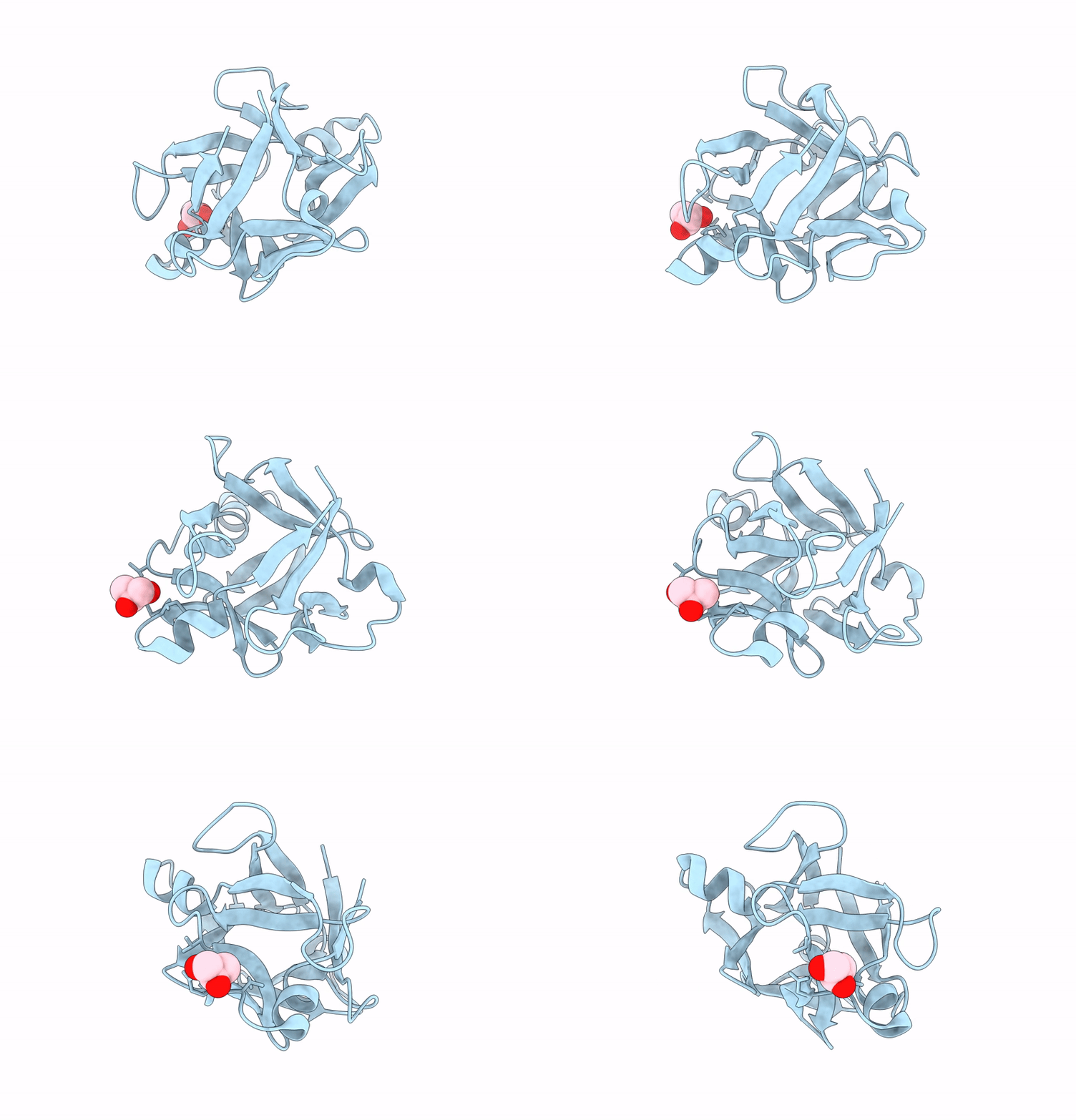
9NXI image
Deposition Date 2025-03-25
Release Date 2025-08-20
Last Version Date 2025-10-15
Entry Detail
PDB ID:
9NXI
Keywords:
Title:
CBM42 domain of alpha-l-arabinofuranosidase (AtAbf43C) from Acetivibrio thermocellus DSM1313
Biological Source:
Source Organism:
Host Organism:
Method Details:
Experimental Method:
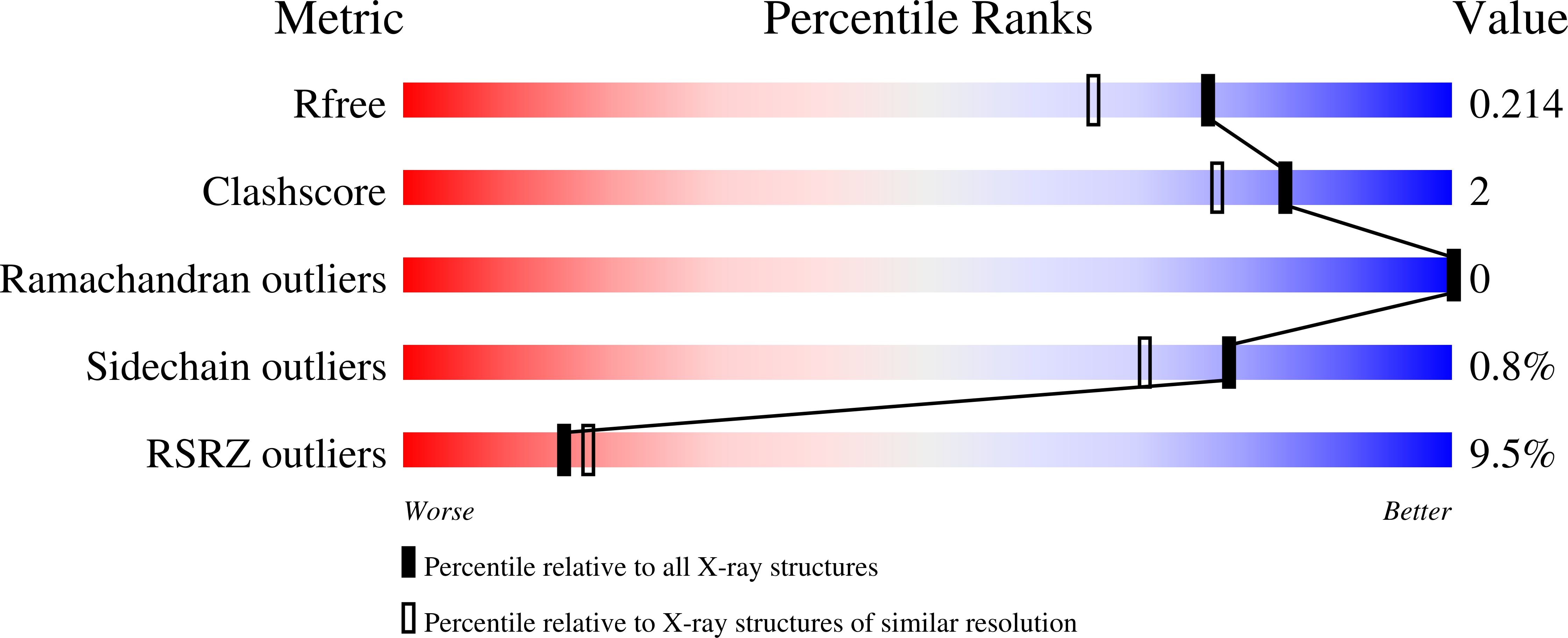
Resolution:
1.75 Å
R-Value Free:
0.21
R-Value Work:
0.19
R-Value Observed:
0.19
Space Group:
P 21 21 2
Macromolecular Entities
Structures with similar UniProt ID
Protein Blast
Polymer Type:polypeptide(L)
Molecule:Glycoside hydrolase family 43
Gene (Uniprot):Cthe_2138
Chain IDs:A
Chain Length:156
Number of Molecules:1
Biological Source:Acetivibrio thermocellus DSM 1313
Ligand Molecules
Primary Citation
Functional and structural characterization of AtAbf43C: an exo-1,5-alpha-L-arabinofuranosidase from Acetivibrio thermocellus DSM1313.
Biochem.J. 482 1181 1195 (2025)
PMID: 40785600 DOI: 10.1042/BCJ20253186

Abstact

Acetivibrio thermocellus degrades diverse polysaccharides found in plant biomass using an array of glycoside hydrolase (GH) enzymes. Here, we describe the structure and function of AtAbf43C, an uncharacterized GH family 43 subfamily 26 (GH43_26) α-L-arabinofuranosidase (EC 3.2.1.55) from A. thermocellus. AtAbf43C is optimally active on para-nitrophenol-α-L-arabinofuranoside at pH 5.5 and 65 °C, making it the most thermophilic bacterial GH43_26 enzyme characterized to date. We solved high-resolution crystal structures of full-length AtAbf43C and its individual carbohydrate binding module family 42 (CBM42) and GH43 domains, including a structure with L-arabinofuranose molecules bound to the CBM42. The CBM42 domain adopts a typical β-trefoil fold, and the GH43 domain forms a canonical 5-bladed β-propeller, each resembling those in the mesophilic GH43_26 enzyme SaAraf43A from Streptomyces avermitilis (PDB 3AKH). However, AtAbf43C exhibits a unique domain organization, with the CBM42 at the N-terminus and the GH43 domain at the C-terminus, the reverse of the arrangement observed in SaAraf43A. Structural alignment enabled identification of the conserved catalytic triad (D168, D283, and E344) in AtAbf43C, which we confirmed experimentally with site-directed mutagenesis. The deep-narrow topology of the AtAbf43C GH43 binding pocket is consistent with exo activity on arabino-oligosaccharide (AOS) substrates. Indeed, liquid chromatography-mass spectrometry (LC-MS) analysis of polysaccharides and oligosaccharides hydrolyzed by AtAbf43C confirmed exo activity primarily toward α-1,5-linked AOSs. This suggests AtAbf43C contributes to the degradation of AOS released from arabinose-rich polysaccharides by other A. thermocellus enzymes. Together, these results expand our understanding of the structure-function of GH43_26 enzymes and their role in plant biomass deconstruction.

Legend

Protein

Chemical

Disease

Primary Citation of related structures
Feedback Form
Name
Email
Institute
Feedback