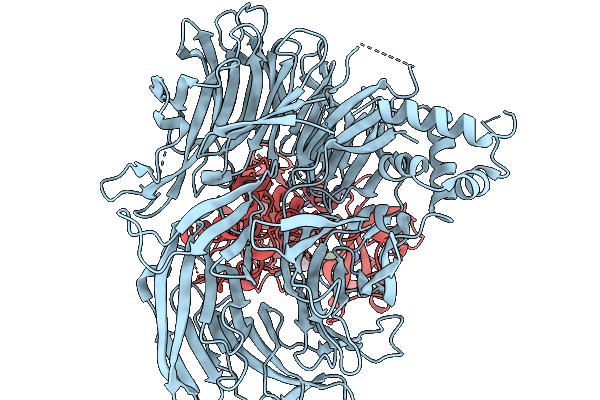
9NWS image
Deposition Date 2025-03-24
Release Date 2026-02-04
Last Version Date 2026-02-04
Entry Detail
PDB ID:
9NWS
Keywords:
Title:
Cryo-EM structure of DDB1dB:CRBN:mezigdomide:SALL4(392-449)
Biological Source:
Source Organism(s):
Homo sapiens (Taxon ID: 9606)
Expression System(s):
Method Details:
Experimental Method:
Resolution:
2.70 Å
Aggregation State:
PARTICLE
Reconstruction Method:
SINGLE PARTICLE
Macromolecular Entities
Polymer Type:polypeptide(L)
Molecule:DNA damage-binding protein 1
Chain IDs:B (auth: A)
Chain Length:860
Number of Molecules:1
Biological Source:Homo sapiens
Polymer Type:polypeptide(L)
Molecule:Protein cereblon
Chain IDs:C (auth: B)
Chain Length:485
Number of Molecules:1
Biological Source:Homo sapiens
Polymer Type:polypeptide(L)
Molecule:Sal-like protein 4
Chain IDs:A (auth: C)
Chain Length:102
Number of Molecules:1
Biological Source:Homo sapiens
Primary Citation

Abstact

Glutarimide analogs, such as thalidomide, redirect the E3 ubiquitin ligase CRL4CRBN to induce degradation of certain zinc finger (ZF) proteins. Although the core structural motif recognized by CRBN has been characterized, it does not fully explain substrate specificity. To explore the role of residues adjacent to this core motif, we constructed a comprehensive ZF reporter library of 9,097 reporters derived from 1,655 human ZF proteins and conducted a library-on-library screen with 29 glutarimide analogs to identify compounds that collectively degrade 38 ZF reporters. Cryo-electron microscopy and crystal structures of ZFs in complex with CRBN revealed the importance of interactions beyond the core ZF degron. We used systematic mutagenesis of ZFs and CRBN to identify modes of neosubstrate recruitment requiring distinct amino acids. Finally, we found subtle chemical variations in glutarimide analogs that alter target scope and selectivity, thus providing a roadmap for their rational design.

Legend

Protein

Chemical

Disease

Primary Citation of related structures
Feedback Form
Name
Email
Institute
Feedback