9NWB image
Deposition Date 2025-03-21
Release Date 2025-06-04
Last Version Date 2026-02-18
Entry Detail
PDB ID:
9NWB
Keywords:
Title:
Crystal structure of SARS-CoV-2 main protease in complex with an inhibitor TKB-280-5I
Biological Source:
Expression System(s):
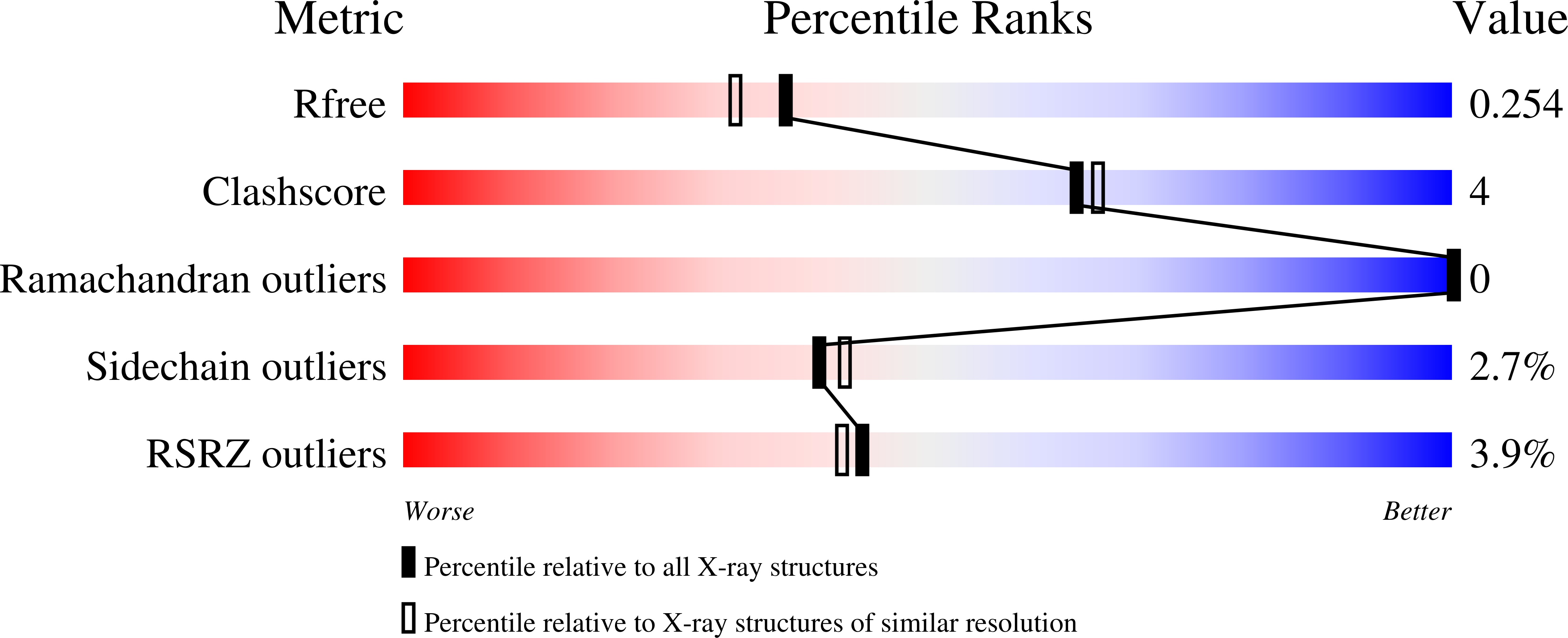
Method Details:
Experimental Method:
Resolution:
2.01 Å
R-Value Free:
0.24
R-Value Work:
0.20
R-Value Observed:
0.20
Space Group:
P 21 21 2
Macromolecular Entities
Structures with similar UniProt ID
Protein Blast
Polymer Type:polypeptide(L)
Molecule:ORF1a polyprotein
Gene (Uniprot):ORF1ab
Chain IDs:A
Chain Length:306
Number of Molecules:1
Biological Source:Severe acute respiratory syndrome coronavirus
Ligand Molecules
Primary Citation
Impact of Single Halogen Atom Substitutions on Antiviral Profile of Inhibitors Targeting SARS-CoV‐2 Main Protease.
Acs Omega 11 4541 4550 (2026)
PMID: 41626465 DOI: 10.1021/acsomega.5c10895

Abstact

The SARS-CoV-2 main protease (Mpro) remains a prime antiviral target because its inhibition halts viral replication. To probe how subtle atomic changes influence drug performance, we carried out a systematic halogen scan on a potent ketoamide scaffold, replacing a single fluorine with chlorine, bromine, or iodine. Enzymatic assays revealed that the F- and Cl-substituted analogues inhibit Mpro at nanomolar levels, whereas Br and I variants are 10- to 20-fold weaker. Cell-based antiviral tests mirrored this trend, yet uptake studies showed the opposite: iodine markedly enhances intracellular accumulation. High-resolution X-ray structures (1.6-1.8 Å) explain the dichotomy: small halogens fit snugly in the S1' σ-hole pocket, maximizing hydrogen-bond geometry, while bulkier atoms distort binding but create a lipophilic patch that boosts permeability. These data yield the first fluorine-to-iodine structure-activity map for SARS-CoV-2 Mpro inhibitors. These findings highlight the critical role of halogen selection in antiviral inhibitor design.

Legend

Protein

Chemical

Disease

Primary Citation of related structures
Feedback Form
Name
Email
Institute
Feedback