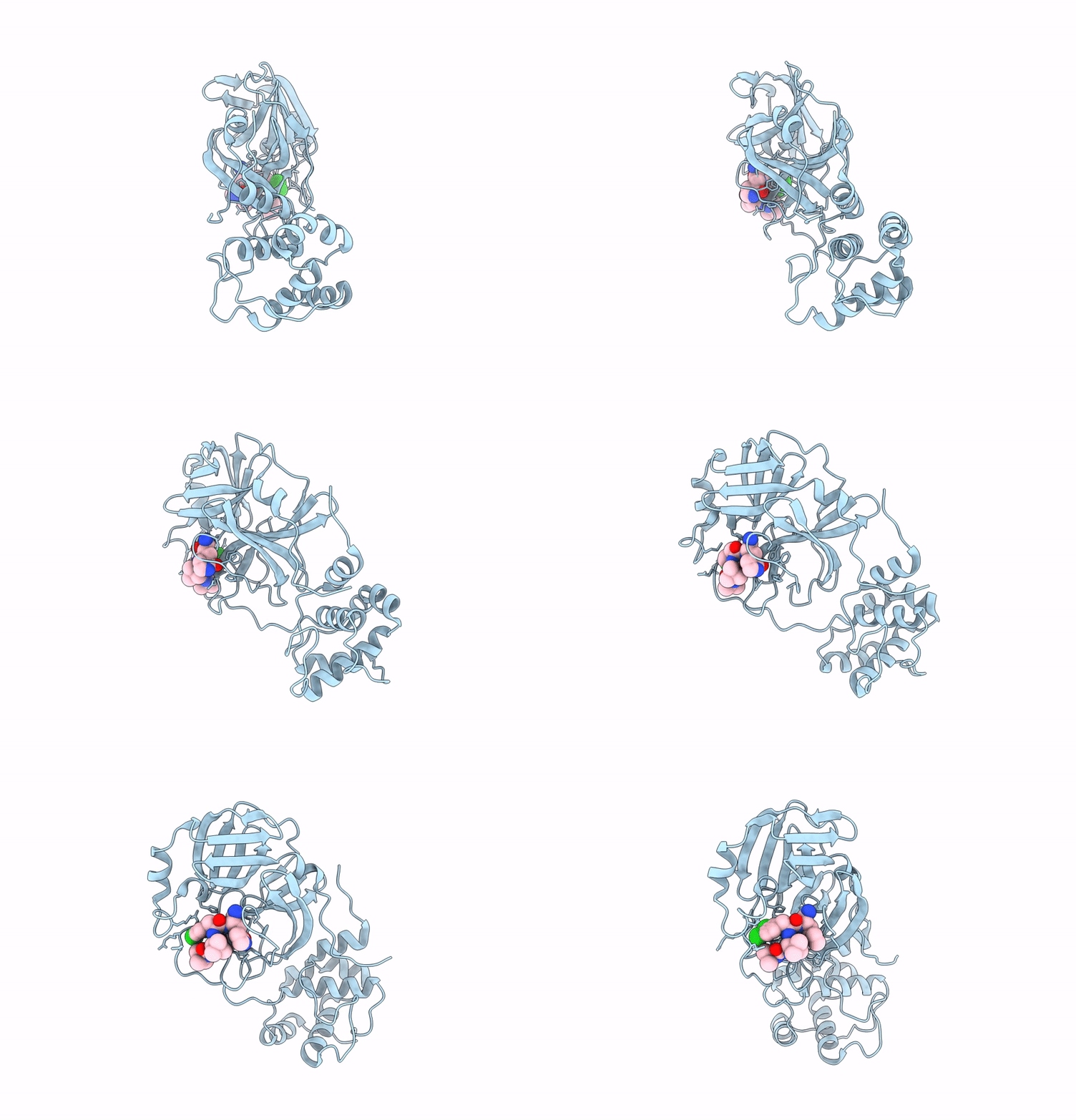
9NSK image
Deposition Date 2025-03-17
Release Date 2025-07-30
Last Version Date 2025-07-30
Entry Detail
PDB ID:
9NSK
Title:
Room-temperature X-ray structure of SARS-CoV-2 main protease in complex with inhibitor BBH-3
Biological Source:
Host Organism:
Method Details:
Experimental Method:
Resolution:
1.90 Å
R-Value Free:
0.20
R-Value Work:
0.16
R-Value Observed:
0.16
Space Group:
I 1 2 1

Macromolecular Entities
Structures with similar UniProt ID
Protein Blast
Polymer Type:polypeptide(L)
Molecule:3C-like proteinase nsp5
Gene (Uniprot):rep
Chain IDs:A
Chain Length:306
Number of Molecules:1
Biological Source:Severe acute respiratory syndrome coronavirus 2
Ligand Molecules
Primary Citation
Influence of Steric and Electronic Properties of P2 Groups on Covalent Inhibitor Binding to SARS-CoV-2 Main Protease.
Acs Infect Dis. 11 1697 1706 (2025)
PMID: 40437897 DOI: 10.1021/acsinfecdis.5c00246

Abstact

The main protease (MPro) of SARS-CoV-2 is a critical enzyme required for viral replication, making it a prime target for antiviral drug development. Covalent inhibitors, which form a stable interaction with the catalytic C145, have demonstrated strong inhibition of MPro, but the influence of steric and electronic properties of P2 substituents, designed to engage the S2 substrate-binding subsite within the MPro active site, on inhibitor binding affinity remains underexplored. In this study, we design and characterize two hybrid covalent inhibitors, BBH-3 and BBH-4, and present their X-ray crystallographic structures in complex with MPro, providing molecular insights into how their distinct P2 groups, a dichlorobenzyl moiety in BBH-3 and an adamantyl substituent in BBH-4, affect binding conformation and active site adaptability. Comparative structural analyses with previously characterized inhibitors, including BBH-2 and Mcule-5948770040, reveal how the P2 bulkiness and electronic properties influence active site dynamics, particularly through interactions with the S2 and S5 subsites. The P2 group of BBH-3 induces conformational shifts in the S2 helix and the S5 loop, while BBH-4 displaces M49, stabilizing its binding through hydrophobic interactions. Isothermal titration calorimetry further elucidates the impact of P2 modifications on inhibitor affinity, revealing a delicate balance between enthalpic and entropic contributions. The data demonstrate that BBH-3 exhibits less favorable binding, affirming that dichlorobenzyl substitution at the P2 position has a more negative impact on the affinity for MPro than bulky saturated cyclic groups. This underscores the feature that MPro active site malleability may be accompanied by a conformational strain.

Legend

Protein

Chemical

Disease

Primary Citation of related structures
Feedback Form
Name
Email
Institute
Feedback