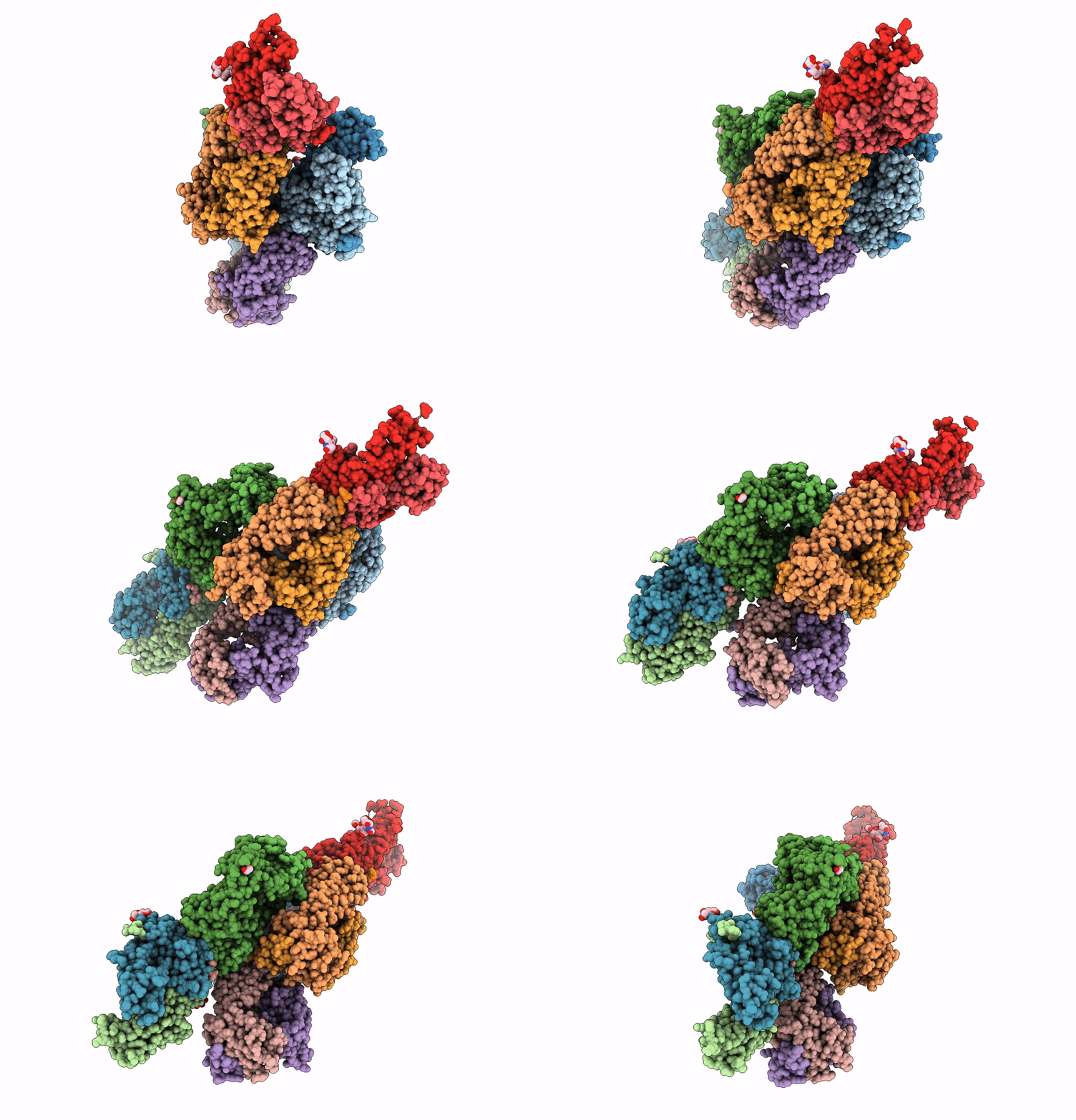
9NIG image
Deposition Date 2025-02-26
Release Date 2025-05-21
Last Version Date 2025-12-03
Entry Detail
PDB ID:
9NIG
Keywords:
Title:
PB TCR in complex with HLA-DR4 presenting citrullinated Tenascin C peptide
Biological Source:
Source Organism:
Homo sapiens (Taxon ID: 9606)
Host Organism:
Method Details:
Experimental Method:
Resolution:
3.20 Å
R-Value Free:
0.26
R-Value Work:
0.21
R-Value Observed:
0.22
Space Group:
P 1
Macromolecular Entities
Structures with similar UniProt ID
Protein Blast
Polymer Type:polypeptide(L)
Molecule:HLA class II histocompatibility antigen, DR alpha chain
Gene (Uniprot):HLA-DRA
Chain IDs:A, F (auth: C), K (auth: H)
Chain Length:189
Number of Molecules:3
Biological Source:Homo sapiens
Structures with similar UniProt ID
Protein Blast
Polymer Type:polypeptide(L)
Molecule:HLA class II histocompatibility antigen DR beta chain
Gene (Uniprot):HLA-DRB1
Chain IDs:B, G (auth: D), L (auth: I)
Chain Length:190
Number of Molecules:3
Biological Source:Homo sapiens
Polymer Type:polypeptide(L)
Molecule:PB TCR alpha chain
Chain IDs:C (auth: M), H (auth: E), M (auth: J)
Chain Length:208
Number of Molecules:3
Biological Source:Homo sapiens
Polymer Type:polypeptide(L)
Molecule:PB TCR beta chain
Chain IDs:D (auth: N), I (auth: F), N (auth: K)
Chain Length:239
Number of Molecules:3
Biological Source:Homo sapiens
Structures with similar UniProt ID
Protein Blast
Polymer Type:polypeptide(L)
Molecule:Tenascin
Gene (Uniprot):TNC
Chain IDs:E (auth: P), J (auth: G), O (auth: L)
Chain Length:14
Number of Molecules:3
Biological Source:Homo sapiens
Modified Residue
Compound ID Chain ID Parent Comp ID Details 2D Image
CIR E ARG modified residue
Primary Citation
The molecular basis of T cell receptor recognition of citrullinated tenascin-C presented by HLA-DR4.
J.Biol.Chem. 301 110326 110326 (2025)
PMID: 40466907 DOI: 10.1016/j.jbc.2025.110326

Abstact

CD4+ T cell autoreactivity against citrullinated (cit) self-epitopes presented by HLA-DRB1 is associated with rheumatoid arthritis (RA) pathogenesis. We understand the molecular bases of T cell receptor (TCR) recognition of cit-fibrinogen, cit-vimentin, and cit-α-enolase epitopes, and the role of citrulline in shaping TCR repertoire usage. Nevertheless, how TCRs recognize other cit-epitopes, including tenascin-C (TNC) and how alternative citrullination positions may modulate the T cell recognition remains unclear. Here, we examined TNC1014,1016cit peptide, which contains citrullination at position P-1 and P2, to study the underlying TCR-HLA-DRB1∗04:01-TNC1014,1016cit molecular interactions. Crystal structure of HLA-DRB1∗04:01TNC1014,1016cit at 2.4 Å resolution revealed a conserved peptide binding register to the established HLA-DRB1∗04:01-peptide structures, where both citrullines protruded upward. Next, we determined the crystal structure of a RA patient-derived TRAV35+/TRBV10-2+ (PB) TCR in complex with HLA-DRB1∗04:01TNC1014,1016cit at 3.2 Å resolution. The CDR3α loop (109VGNTN113) of PB TCR formed a secondary helical conformation at the N-terminus of the peptide binding cleft, allowing extensive interactions between the P-1 and P2 citrullines of TNC1014,1016cit peptide. Surface plasmon resonance, tetramer staining, and CD69 activation assays revealed that the PB TCR did not cross-react to other RA autoantigens, and the P-1-Cit, P2-Cit, and P5-Tyr of TNC1014,1016cit are the key determinants underlying the strict specificity of the PB TCR. Collectively, we provide molecular insight into citrullination in modulating TCR recognition.

Legend

Protein

Chemical

Disease

Primary Citation of related structures
Feedback Form
Name
Email
Institute
Feedback