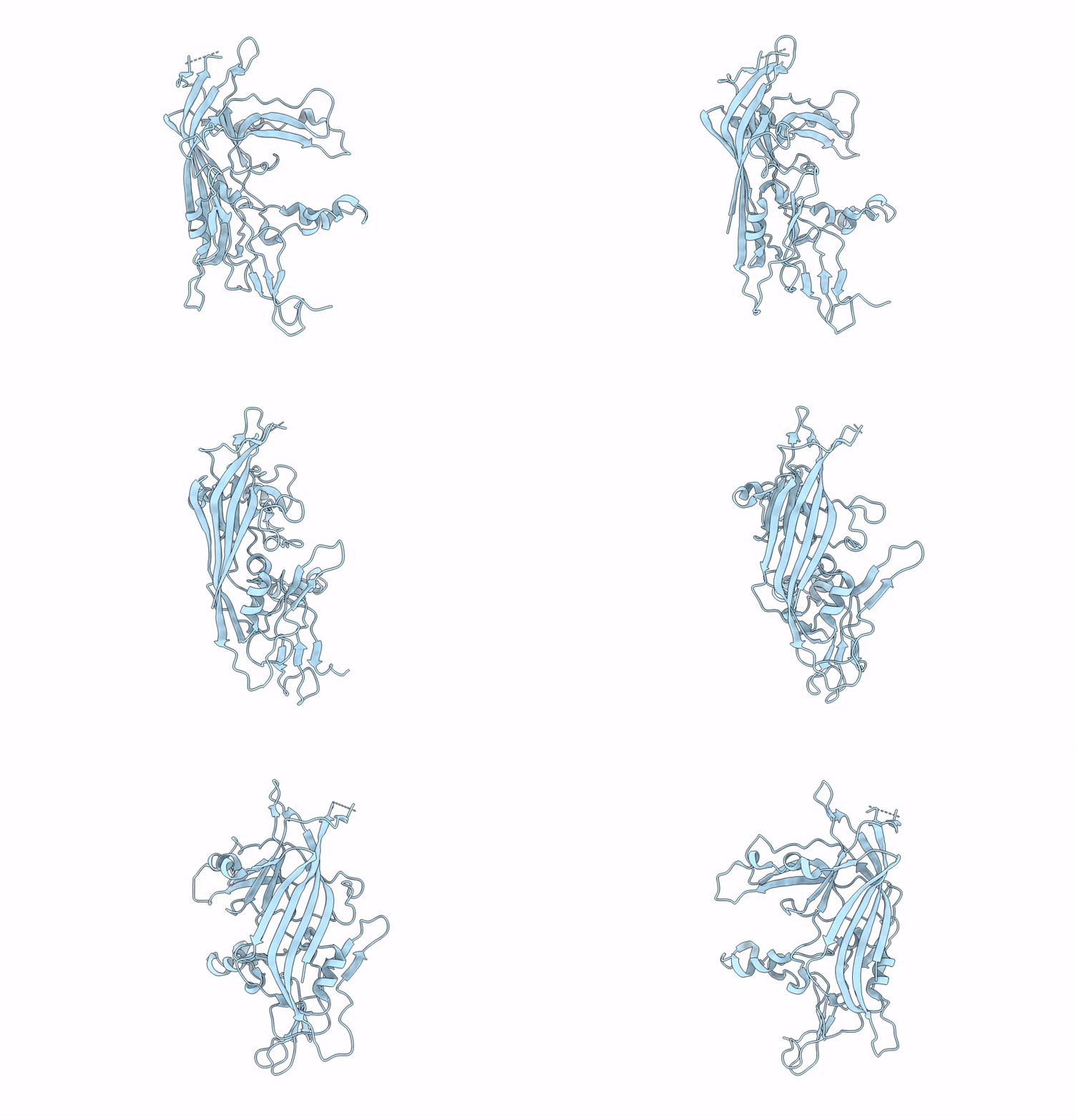
9NEK image
Deposition Date 2025-02-19
Release Date 2025-03-05
Last Version Date 2025-07-30
Entry Detail
PDB ID:
9NEK
Title:
Capsid structure of the Syngnathus scovelli chapparvovirus virus-like particle
Biological Source:
Method Details:
Experimental Method:
Resolution:
2.93 Å
Aggregation State:
PARTICLE
Reconstruction Method:
SINGLE PARTICLE
Macromolecular Entities
Structures with similar UniProt ID
Protein Blast
Polymer Type:polypeptide(L)
Molecule:Putative structural protein VP
Chain IDs:A
Chain Length:364
Number of Molecules:1
Biological Source:Syngnathus scovelli chapparvovirus
Ligand Molecules
Primary Citation
Capsid Structure of the Fish Pathogen Syngnathus Scovelli Chapparvovirus Offers a New Perspective on Parvovirus Structural Biology.
Viruses 17 ? ? (2025)
PMID: 40431691 DOI: 10.3390/v17050679

Abstact

Chapparvoviruses (ChPVs) comprise a divergent lineage of the Parvoviridae ssDNA virus family and evolved to infect vertebrate animals independently from the Parvovirinae subfamily. Despite being pathogenic and widespread in environmental samples and metagenomic assemblies, their structural characterization has proven challenging. Here, we report the first structural analysis of a ChPV, represented by the fish pathogen, Syngnathus scovelli chapparvovirus (SsChPV). We show through the SsChPV structure that the lineage harbors a surface morphology, subunit structure, and multimer interactions that are unique among parvoviruses. The SsChPV capsid evolved a threefold-related depression of α-helices that is analogous to the β-annulus pore of denso- and hamaparvoviruses and may play a role in monomer oligomerization during assembly. As interacting β-strands are absent from the twofold symmetry axis, the viral particle lacks the typical stability and resilience of parvovirus capsids. Although all parvoviruses thus far rely on the threading of large, flexible N-terminal domains to the capsid surface for their intracellular trafficking, our results show that ChPVs completely lack any such N-terminal sequences. This led to the subsequent degradation of their fivefold channel, the site of N-terminus externalization. These findings suggest that ChPVs harbor an infectious pathway that significantly deviates from the rest of the Parvoviridae.

Legend

Protein

Chemical

Disease

Primary Citation of related structures
Feedback Form
Name
Email
Institute
Feedback