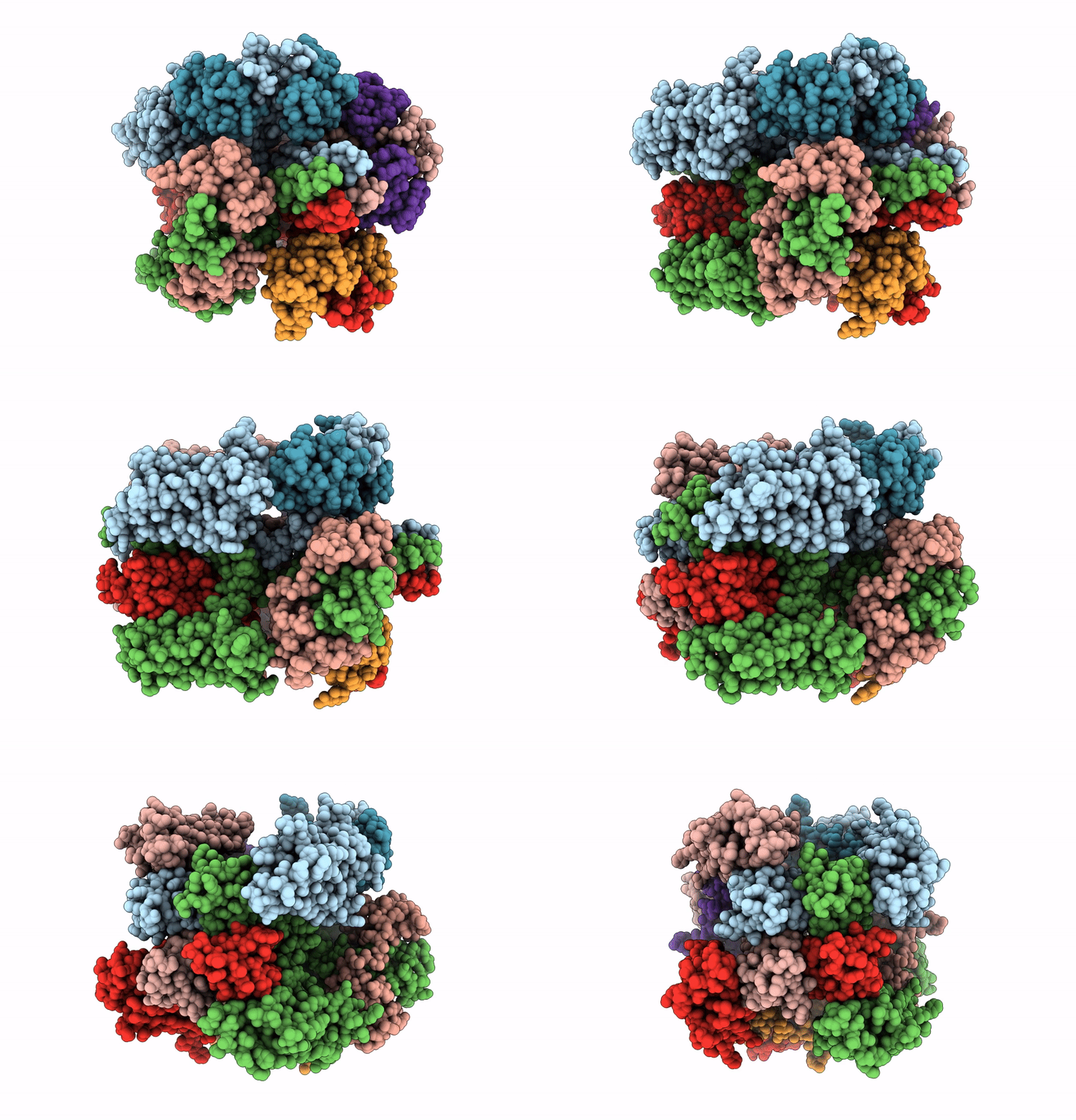
9MY3 image
Deposition Date 2025-01-21
Release Date 2025-10-15
Last Version Date 2025-10-15
Entry Detail
PDB ID:
9MY3
Title:
Structure of Xenopus KCNQ1-CaM in GDN
Biological Source:
Source Organism:
Xenopus laevis (Taxon ID: 8355)
Homo sapiens (Taxon ID: 9606)
Host Organism:
Method Details:
Experimental Method:
Resolution:
3.46 Å
Aggregation State:
PARTICLE
Reconstruction Method:
SINGLE PARTICLE
Macromolecular Entities
Structures with similar UniProt ID
Protein Blast
Polymer Type:polypeptide(L)
Molecule:Potassium voltage-gated channel subfamily KQT member 1
Gene (Uniprot):kcnq1
Chain IDs:A, C, E, G
Chain Length:545
Number of Molecules:4
Biological Source:Xenopus laevis
Structures with similar UniProt ID
Protein Blast
Polymer Type:polypeptide(L)
Molecule:Calmodulin-1
Gene (Uniprot):CALM1
Chain IDs:B, D, F, H
Chain Length:149
Number of Molecules:4
Biological Source:Homo sapiens
Ligand Molecules
Primary Citation
A physiologically-relevant intermediate state structure of a voltage-gated potassium channel.
Nat Commun 16 8814 8814 (2025)
PMID: 41044058 DOI: 10.1038/s41467-025-64060-3

Abstact

Voltage-gated potassium ion (K+) channels perform critical roles in many physiological processes, while gain- or loss-of-function mutations lead to life-threatening pathologies. Here, we establish the high-resolution structure of a pivotal intermediate state of the Kv7.1 (KCNQ1) channel using cryogenic electron microscopy. The 3.53 Å resolution structure reveals straightened upper S1 and S2 voltage sensor helices, distancing them from the pore filter helix compared to fully activated channels. The outward translation of the S4 voltage sensor is essentially complete in this intermediate state, and the S4-S6 helices and the S4-S5 linker do not change position significantly between intermediate and activated states. The PIP2 ligand can bind in both states. Movement of S1 and S2 helices towards the filter helix from intermediate to activated states may explain smaller components of KCNQ1 voltage sensor fluorescence, differential Rb+/K+ selectivity, and pharmacological responses to activators and inhibitors. Single channel recordings and the location of long QT mutations suggest the potential physiological and disease importance of the intermediate state.

Legend

Protein

Chemical

Disease

Primary Citation of related structures
Feedback Form
Name
Email
Institute
Feedback