Planned Maintenance: Some services may turn out to be unavailable from 15th January, 2026 to 16th January, 2026. We apologize for the inconvenience!

9MT5 image
Deposition Date 2025-01-10
Release Date 2025-11-19
Last Version Date 2025-11-26
Entry Detail
PDB ID:
9MT5
Keywords:
Title:
Helical tail assembly of phage JohannRWettstein (Bas63)
Biological Source:
Source Organism(s):
Method Details:
Experimental Method:
Resolution:
3.17 Å
Aggregation State:
PARTICLE
Reconstruction Method:
HELICAL
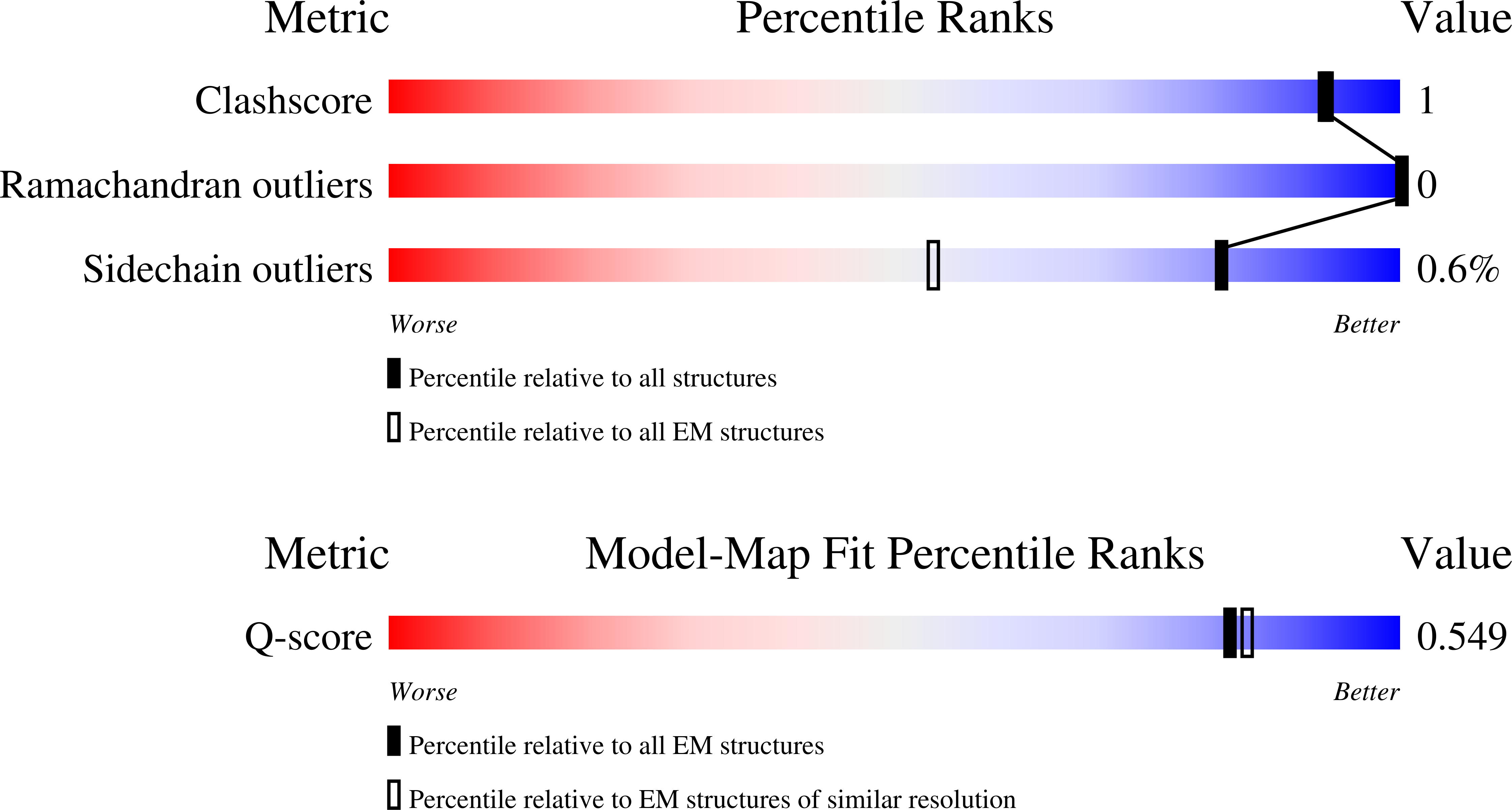
Macromolecular Entities
Structures with similar UniProt ID
Protein Blast
Polymer Type:polypeptide(L)
Molecule:Tube protein
Gene (Uniprot):bas63_0014
Chain IDs:A
Chain Length:148
Number of Molecules:1
Biological Source:Escherichia phage JohannRWettstein
Structures with similar UniProt ID
Protein Blast
Polymer Type:polypeptide(L)
Molecule:Structural protein
Gene (Uniprot):bas63_0013
Chain IDs:B
Chain Length:450
Number of Molecules:1
Biological Source:Escherichia phage JohannRWettstein
Ligand Molecules
Primary Citation
Cryo-EM structure of bacteriophage Bas63 reveals structural conservation and diversity in the Felixounavirus genus.
Sci Adv 11 eadx0790 eadx0790 (2025)
PMID: 41223280 DOI: 10.1126/sciadv.adx0790

Abstact

The BASEL phage collection was developed to provide access to diverse bacteriophages, distinct from model phages. Escherichia phage JohannRWettstein (Bas63), a myophage in the collection, is a member of the subfamily Ounavirinae and the Felixounavirus genus. Using cryo-electron microscopy, we investigated Bas63's structure to explore its evolutionary relationships and functional adaptations. Our structures reveal a series of gene products: (i) a capsid decorated with β-tulip proteins at three-fold symmetry axes and a Hoc-like protein at hexamer centers, (ii) a conserved connector with an additional 12-fold ring of collar proteins that extend unique whisker proteins that are structurally related to podophage GP4 tail fibers, and (iii) a baseplate with long tail fibers resembling a contracted form of T4's long tail fibers. Sequence conservation analysis of Bas63 structural proteins across ICTV-recognized Felixounavirus' supports its role as a structural model for Felixounavirus evolution. This study advances the mechanistic understanding of phage architecture and reinforces the structural mosaicism of bacteriophages.

Legend

Protein

Chemical

Disease

Primary Citation of related structures
Feedback Form
Name
Email
Institute
Feedback