9MRT image
Deposition Date 2025-01-08
Release Date 2025-10-29
Last Version Date 2025-11-12
Entry Detail
PDB ID:
9MRT
Title:
Cryo-EM structure of the human TRPM4 channel in a calcium and PI(4,5)P2 bound open state
Biological Source:
Source Organism:
Homo sapiens (Taxon ID: 9606)
Host Organism:
Method Details:
Experimental Method:
Resolution:
2.44 Å
Aggregation State:
PARTICLE
Reconstruction Method:
SINGLE PARTICLE
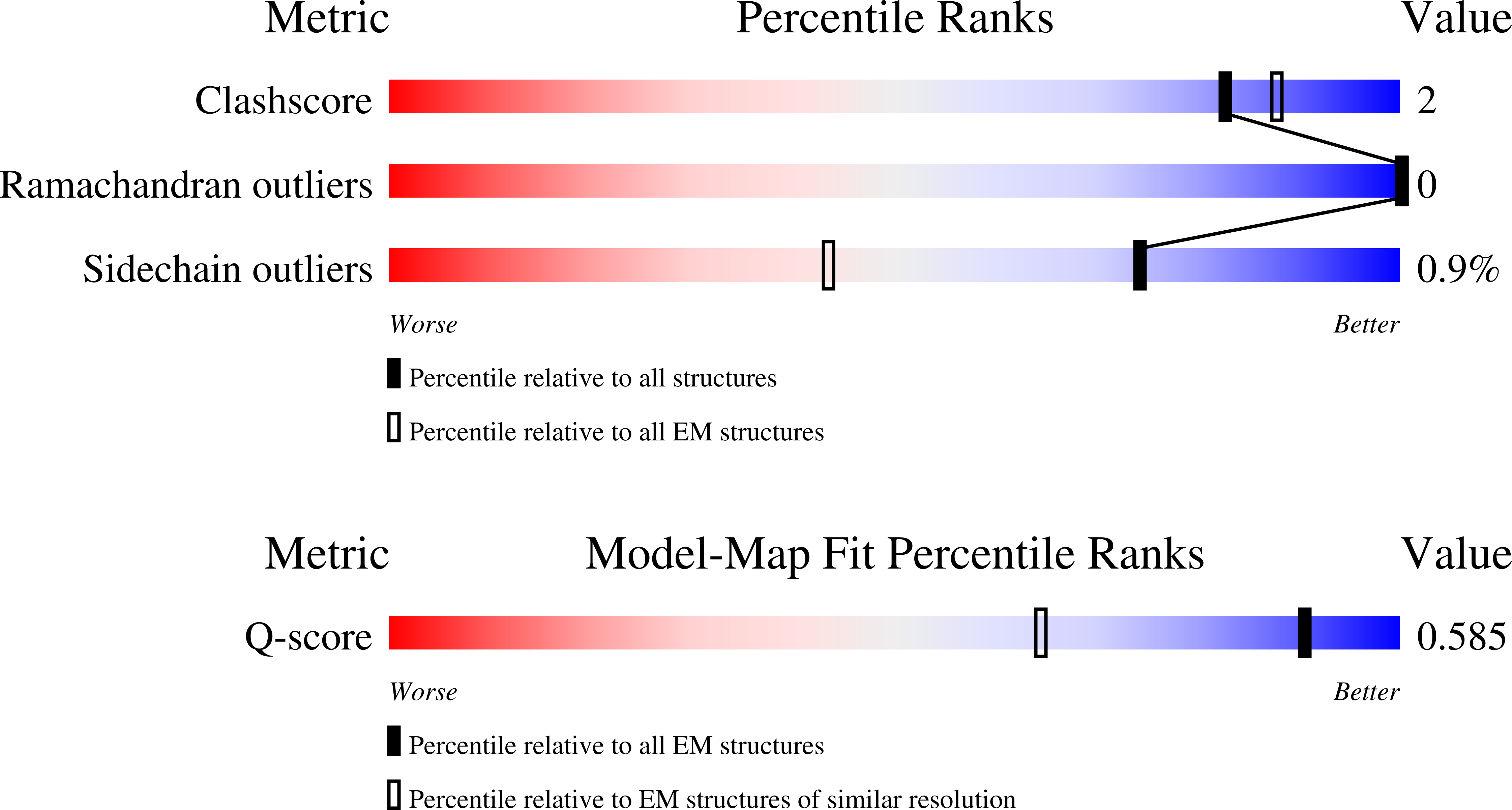
Macromolecular Entities
Structures with similar UniProt ID
Protein Blast
Polymer Type:polypeptide(L)
Molecule:Transient receptor potential cation channel subfamily M member 4
Gene (Uniprot):TRPM4
Chain IDs:A (auth: B), B (auth: A), C, D
Chain Length:1214
Number of Molecules:4
Biological Source:Homo sapiens
Primary Citation
Structural landscape of activation, desensitization and inhibition in the human TRPM4 channel.
Nat.Struct.Mol.Biol. ? ? ? (2025)
PMID: 41174278 DOI: 10.1038/s41594-025-01705-3

Abstact

TRPM4 is a member of the transient receptor potential melastatin channel subfamily and functions as a Ca2+-activated monovalent-selective cation channel. It is widely expressed in various cells and tissues, where its activation depolarizes the plasma membrane potential and modulates various Ca2+-dependent biological processes. TRPM4 activity is potentiated by membrane phosphatidylinositol 4,5-bisphosphate (PtdIns(4,5)P2) and inhibited by cytosolic free adenosine triphosphate (ATP), allowing the channel to transition between different functional states in response to dynamic changes in cellular Ca2+, ATP and PtdIns(4,5)P2 levels during signaling events. Here we present single-particle cryo-electron microscopy structures of human TRPM4 in four distinct states: apo closed, Ca2+-bound putative desensitized, Ca2+-PtdIns(4,5)P2-bound open and ATP-bound inhibited. Combined with mutagenesis and electrophysiological analyses, these structures reveal the molecular mechanisms underlying TRPM4 activation, desensitization and inhibition. Given the central roles of Ca2+, PtdIns(4,5)P2 and ATP in cellular signaling, this work provides a structural foundation to decipher the physiological functions of TRPM4 across diverse biological systems.

Legend

Protein

Chemical

Disease

Primary Citation of related structures
Feedback Form
Name
Email
Institute
Feedback