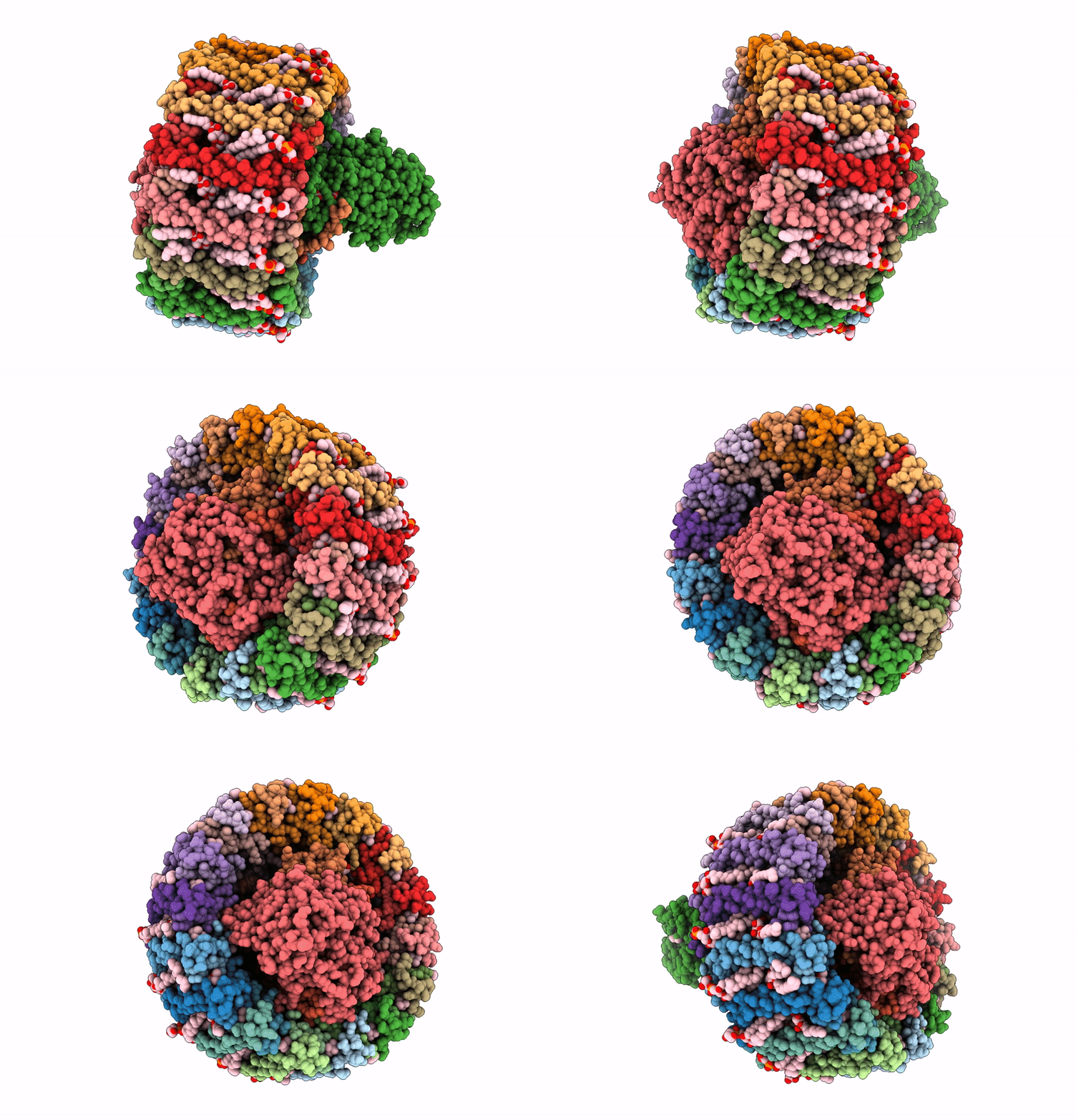
9M8M image
Deposition Date 2025-03-12
Release Date 2025-07-02
Last Version Date 2025-07-30
Entry Detail
PDB ID:
9M8M
Keywords:
Title:
Structure of photosynthetic LH1-RC complex the Halophilic Nonsulfur Purple Bacterium, Rhodothalassium salexigens
Biological Source:
Source Organism:
Method Details:
Experimental Method:
Resolution:
2.30 Å
Aggregation State:
PARTICLE
Reconstruction Method:
SINGLE PARTICLE

Macromolecular Entities
Structures with similar UniProt ID
Protein Blast
Polymer Type:polypeptide(L)
Molecule:Light-harvesting complex 1 alpha chain
Gene (Uniprot):EV659_104115
Chain IDs:E (auth: A), G (auth: D), I (auth: F), K (auth: I), M (auth: K), O, Q, S, U, W, Y, AA (auth: 1), CA (auth: 3), EA (auth: 5), GA (auth: 7), IA (auth: 9)
Chain Length:59
Number of Molecules:16
Biological Source:Rhodothalassium salexigens DSM 2132
Structures with similar UniProt ID
Protein Blast
Polymer Type:polypeptide(L)
Molecule:Light-harvesting complex 1 beta chain
Gene (Uniprot):EV659_104114
Chain IDs:F (auth: B), H (auth: E), J (auth: G), L (auth: J), N, P, R, T, V, X, Z, BA (auth: 2), DA (auth: 4), FA (auth: 6), HA (auth: 8), JA (auth: 0)
Chain Length:67
Number of Molecules:16
Biological Source:Rhodothalassium salexigens DSM 2132
Structures with similar UniProt ID
Protein Blast
Polymer Type:polypeptide(L)
Molecule:Photosynthetic reaction center cytochrome c subunit
Gene (Uniprot):EV659_104118
Chain IDs:A (auth: C)
Chain Length:385
Number of Molecules:1
Biological Source:Rhodothalassium salexigens DSM 2132
Structures with similar UniProt ID
Protein Blast
Polymer Type:polypeptide(L)
Molecule:Photosynthetic reaction center subunit H
Gene (Uniprot):EV659_104173
Chain IDs:D (auth: H)
Chain Length:324
Number of Molecules:1
Biological Source:Rhodothalassium salexigens DSM 2132
Structures with similar UniProt ID
Protein Blast
Polymer Type:polypeptide(L)
Molecule:Reaction center protein L chain
Gene (Uniprot):psbL
Chain IDs:B (auth: L)
Chain Length:275
Number of Molecules:1
Biological Source:Rhodothalassium salexigens DSM 2132
Structures with similar UniProt ID
Protein Blast
Polymer Type:polypeptide(L)
Molecule:Reaction center protein M chain
Gene (Uniprot):psbM
Chain IDs:C (auth: M)
Chain Length:323
Number of Molecules:1
Biological Source:Rhodothalassium salexigens DSM 2132
Modified Residue
Compound ID Chain ID Parent Comp ID Details 2D Image
FME E MET modified residue
Primary Citation
Structure and Biochemistry of the LH1-RC Photocomplex from the Halophilic Purple Bacterium, Rhodothalassium salexigens .
Biochemistry 64 3070 3080 (2025)
PMID: 40551662 DOI: 10.1021/acs.biochem.5c00181

Abstact

Rhodothalassium (Rts.) salexigens is a moderately halophilic purple nonsulfur bacterium whose unique cell wall composition and phylogeny are distinct from those of all other purple phototrophs. Here we present a cryo-EM structure and biochemical analysis of the light-harvesting 1-reaction center (LH1-RC) complex from Rts. salexigens at 2.29 Å resolution. The LH1 complex forms a closed ring structure with 16 αβ-polypeptides surrounding the RC and contains 16 phosphatidylglycerols regularly positioned between the β-polypeptides. Extensive interactions were observed between the C-terminal domains of LH1 α-and β-polypeptides and between the regularly arranged phosphatidylglycerols and β-polypeptides, supporting the hypothesis that LH1 C-terminal interactions define the post-translational truncation sites of αβ-polypeptides in phototrophic purple bacteria. Multiple insertions were identified in the membrane-extruded RC cytochrome- and H-subunits of Rts. salexigens. Insertions in the periplasm-exposed cytochrome subunit contain high proportions of Gly, Asp, and Glu, contributing to an overall negatively charged surface of this subunit. The cytoplasm-exposed H-subunit contained an unusually long 57-residue insert rich in Pro and Ala that was invisible in the cryo-EM density map, indicating its highly flexible nature. The extensive Pro-Ala repetitive motifs in this insertion points to a regulatory role in assemblies of the RC and LH1-RC complexes. The structural features of Rts. salexigens LH1-RC are also discussed in relation to differences in the physiological environment between the periplasmic and cytoplasmic sides of membranes in halophiles, necessary for maintaining cellular activities under the high ionic strength conditions of hypersaline environments.

Legend

Protein

Chemical

Disease

Primary Citation of related structures
Feedback Form
Name
Email
Institute
Feedback