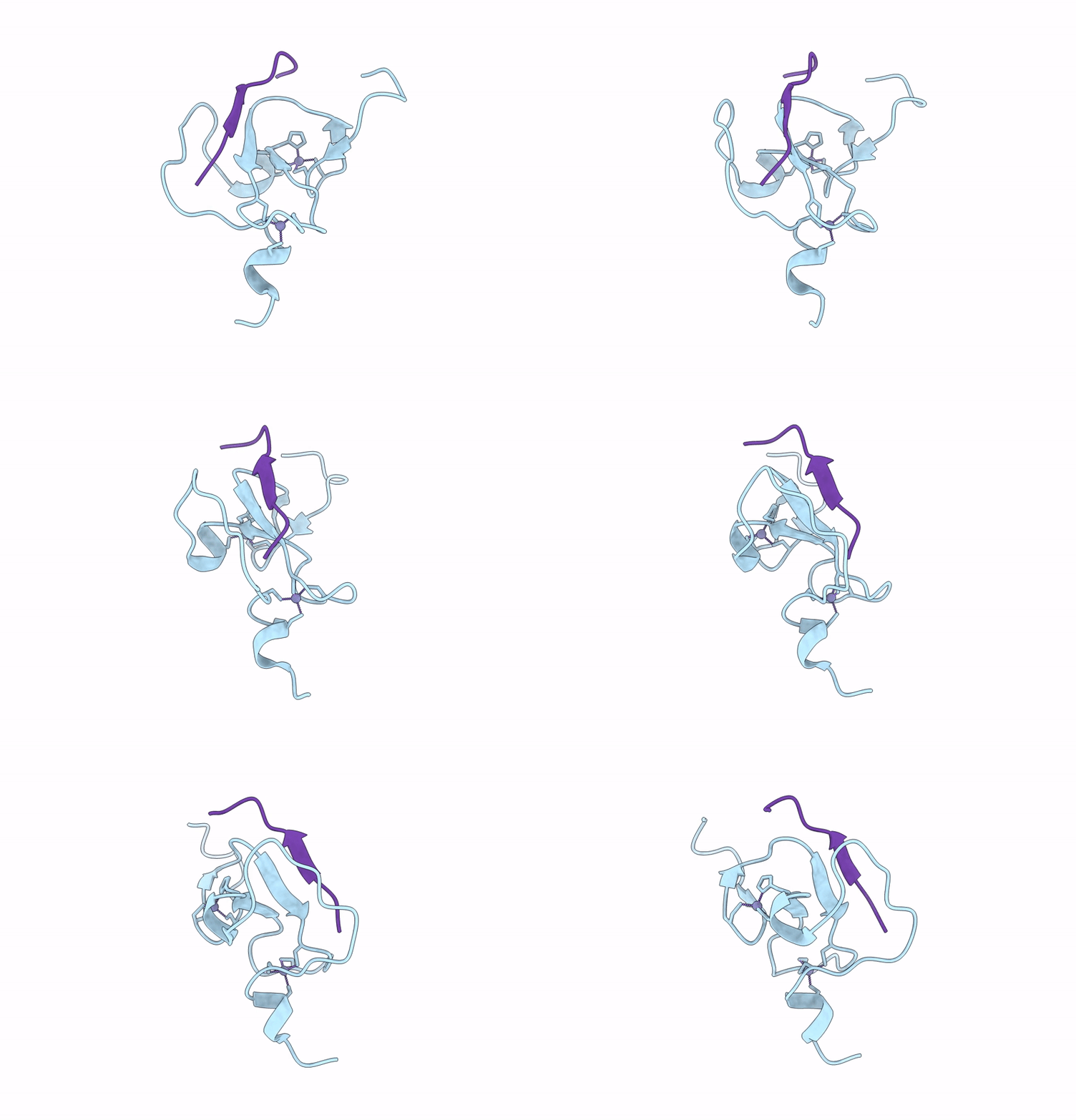
9M4S image
Deposition Date 2025-03-04
Release Date 2025-11-05
Last Version Date 2025-11-05
Entry Detail
PDB ID:
9M4S
Keywords:
Title:
crystal structure of Arabidopsis thaliana ING2 PHD finger in complex with an H3K4me3 peptide
Biological Source:
Source Organism:
Method Details:
Experimental Method:
Resolution:
1.60 Å
R-Value Free:
0.22
R-Value Work:
0.18
R-Value Observed:
0.18
Space Group:
P 61

Macromolecular Entities
Structures with similar UniProt ID
Protein Blast
Polymer Type:polypeptide(L)
Molecule:PHD finger protein ING2
Gene (Uniprot):ING2
Chain IDs:A
Chain Length:74
Number of Molecules:1
Biological Source:Arabidopsis thaliana
Structures with similar UniProt ID
Protein Blast
Polymer Type:polypeptide(L)
Molecule:Histone H3.1
Gene (Uniprot):HTR2, HTR3, HTR13, HTR9, HTR1
Chain IDs:B (auth: P)
Chain Length:10
Number of Molecules:1
Biological Source:Arabidopsis thaliana
Modified Residue
Compound ID Chain ID Parent Comp ID Details 2D Image
M3L B LYS modified residue
Ligand Molecules
Primary Citation
A pair of readers of histone H3K4 methylation recruit Polycomb repressive complex 2 to regulate photoperiodic flowering.
Nat Commun 16 9376 9376 (2025)
PMID: 41130979 DOI: 10.1038/s41467-025-64419-6

Abstact

The transition from vegetative growth to reproduction in flowering plants is often timed by seasonal changes in day length (photoperiod). In the long-day (LD) plant Arabidopsis thaliana, the photoperiod pathway induces a daily rhythmic activation of the florigen gene FLOWERING LOCUS T (FT) to promote the floral transition. Under inductive LDs, FT expression is activated around dusk, but to be repressed overnight and into the early afternoon the next day. Here, we report that AtING1 and AtING2, Arabidopsis homologs of the mammalian Inhibitor of Growth (ING) proteins, read di- and tri-methylated histone-3 lysine 4 (H3K4me2/me3) on FT chromatin and further recruit Polycomb-repressive complex 2 (PRC2) to repress FT expression at night and into the early afternoon the next day, following FT activation at dusk. This prevents precocious flowering under inductive LDs. Our study reveals that the H3K4me2/me3-ING1/2-PRC2 module timely represses FT expression following the daily rhythmic FT activation, to prevent excessive FT expression and thus precisely control flowering time, in response to inductive photoperiodic signals.

Legend

Protein

Chemical

Disease

Primary Citation of related structures
Feedback Form
Name
Email
Institute
Feedback