9M47 image
Deposition Date 2025-03-04
Release Date 2026-01-28
Last Version Date 2026-01-28
Entry Detail
PDB ID:
9M47
Title:
Substrate Promiscuous Cytochrome P450 RufO
Biological Source:
Source Organism(s):
Expression System(s):
Method Details:
Experimental Method:
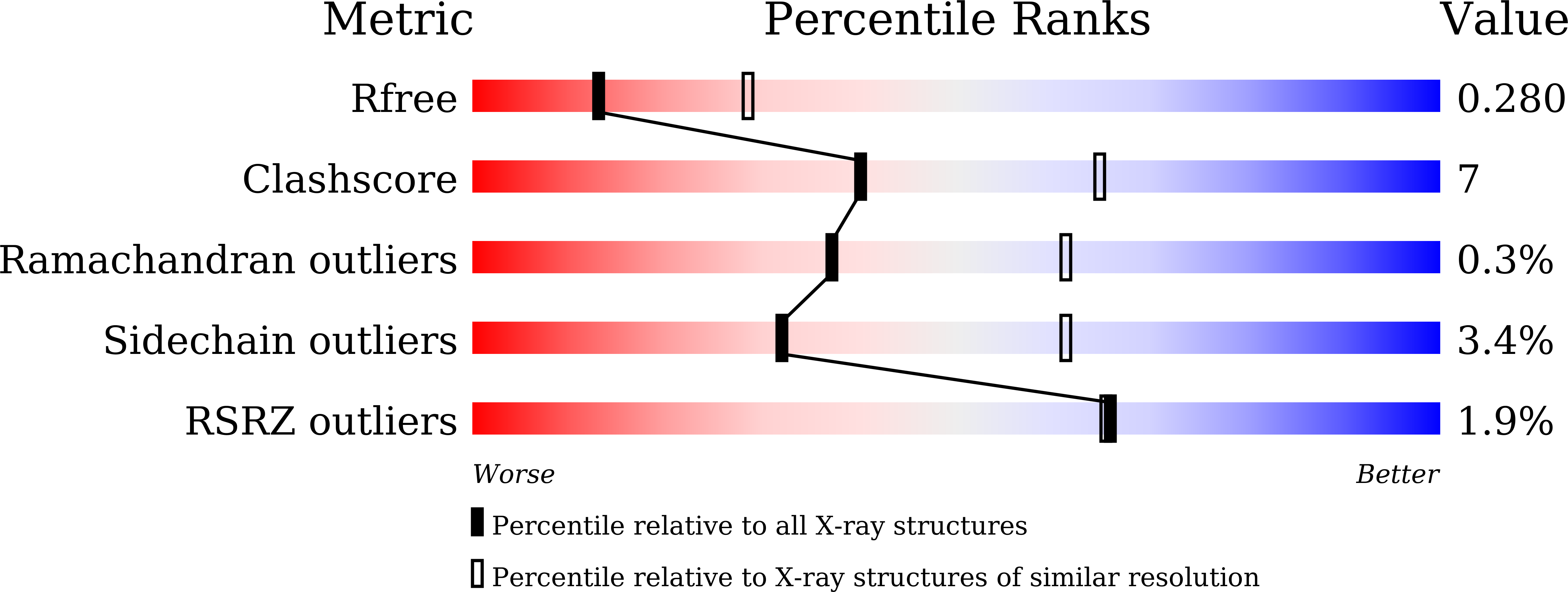
Resolution:
2.70 Å
R-Value Free:
0.28
R-Value Work:
0.22
Space Group:
P 41 21 2
Macromolecular Entities
Structures with similar UniProt ID
Protein Blast
Polymer Type:polypeptide(L)
Molecule:Cytochrome P450
Gene (Uniprot):rufO
Chain IDs:A
Chain Length:402
Number of Molecules:1
Biological Source:Streptomyces atratus
Ligand Molecules
Primary Citation
RufO, a cytochrome P450 (CYP) enzyme, recognition to putative substrates and a redox partner: Binding and structural insights.
Biophys.Chem. 329 107546 107546 (2026)
PMID: 41167129 DOI: 10.1016/j.bpc.2025.107546

Abstact

RufO is a Cytochrome P450 enzyme involved in synthesising Rufomycin, a circular peptide with antibacterial activity. Herein, we present structural and biophysical analyses to resolve the ambiguity of RufO's substrate specificity. The structure of unliganded RufO, alongside a series of computational and biophysical studies investigating its substrate specificity in the presence of ferredoxin, which is known to serve as an effector of the redox activities of several P450 enzymes. Contrary to reports on RufO's catalytic activity, monomeric L-tyrosine was not recognized by RufO in our isothermal titration calorimetry (ITC) experiments. Instead, RufO recognizes a range of putative substrates, particularly those containing methyl and nitro groups, suggesting a broader substrate scope. Additionally, we see that RufO binds to its redox partner CamB with micromolar affinity, and its interaction significantly enhances the putative substrate binding by ∼10-fold. Our crystal structure of RufO reveals similarities and differences in putative substrates and ferredoxin binding regions compared to other CYP450 enzymes. Our findings establish RufO might be a substrate-promiscuous enzyme with potential applications in the biocatalytic nitration of industrially relevant compounds.

Legend

Protein

Chemical

Disease

Primary Citation of related structures
Feedback Form
Name
Email
Institute
Feedback