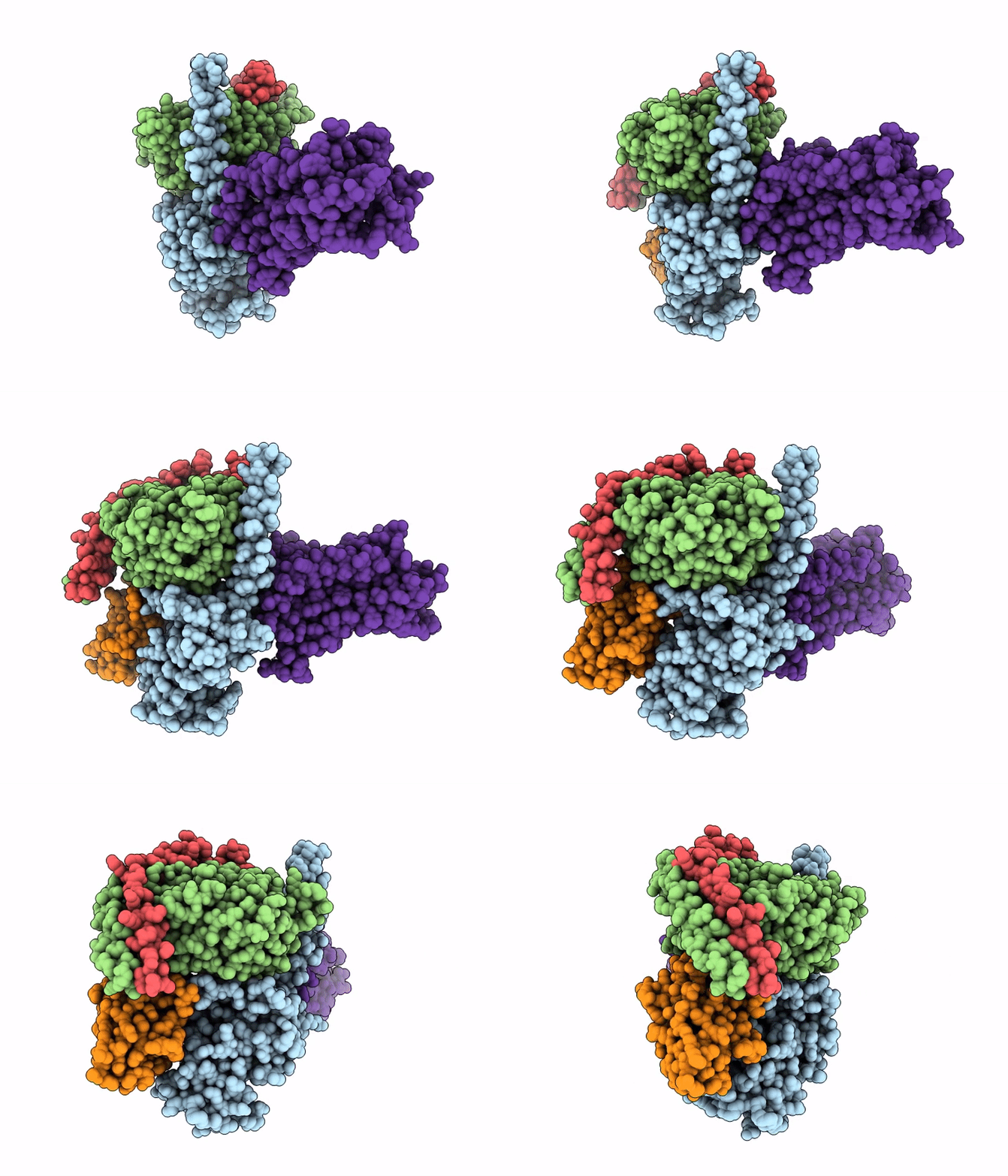
9M42 image
Deposition Date 2025-03-03
Release Date 2026-01-21
Last Version Date 2026-01-21
Entry Detail
PDB ID:
9M42
Title:
Structure-based discovery of potent agonists of the orphan receptor GPR139
Biological Source:
Source Organism(s):
Homo sapiens (Taxon ID: 9606)
Niallia circulans (Taxon ID: 1397)
Method Details:
Experimental Method:
Resolution:
3.20 Å
Aggregation State:
PARTICLE
Reconstruction Method:
SINGLE PARTICLE
Macromolecular Entities
Structures with similar UniProt ID
Protein Blast
Polymer Type:polypeptide(L)
Molecule:Guanine nucleotide-binding protein G(s) subunit alpha isoforms short
Gene (Uniprot):GNAS
Chain IDs:A
Chain Length:262
Number of Molecules:1
Biological Source:Homo sapiens
Structures with similar UniProt ID
Protein Blast
Polymer Type:polypeptide(L)
Molecule:Guanine nucleotide-binding protein G(I)/G(S)/G(T) subunit beta-1
Gene (Uniprot):GNB1
Chain IDs:B
Chain Length:341
Number of Molecules:1
Biological Source:Homo sapiens
Structures with similar UniProt ID
Protein Blast
Polymer Type:polypeptide(L)
Molecule:Guanine nucleotide-binding protein G(I)/G(S)/G(O) subunit gamma-2
Gene (Uniprot):GNG2
Chain IDs:C (auth: G)
Chain Length:97
Number of Molecules:1
Biological Source:Homo sapiens
Polymer Type:polypeptide(L)
Molecule:Nanobody 35
Chain IDs:D (auth: N)
Chain Length:161
Number of Molecules:1
Biological Source:Homo sapiens
Protein Blast
Polymer Type:polypeptide(L)
Molecule:Endo-1,4-beta-xylanase,Probable G-protein coupled receptor 139
Gene (Uniprot):xlnA, GPR139
Chain IDs:E (auth: R)
Chain Length:533
Number of Molecules:1
Biological Source:Niallia circulans, Homo sapiens
Ligand Molecules
Primary Citation
Ultra-large virtual screening unveils potent agonists of the neuromodulatory orphan receptor GPR139.
Nat Commun 17 129 129 (2025)
PMID: 41365886 DOI: 10.1038/s41467-025-66845-y

Abstact

The orphan G protein-coupled receptor (GPCR) GPR139 attracts interest as a target for neuropsychiatric disorders. Whereas the physiological functions of GPR139 remain elusive, a high-resolution receptor structure is now available. To assess whether structural information enables ligand discovery, we computationally dock 235 million compounds to the GPR139 binding site. Of 68 top-ranked compounds evaluated experimentally, five are full agonists with potencies ranging from 160 nM to 3.6 µM. Structure-guided optimization identifies one of the most potent GPR139 agonists, and a cryo-EM structure of the receptor-ligand complex confirms the predicted binding mode. Functional characterization provides insights into GPR139 signalling, and one agonist elicits behavioural effects in mice. We also explore the potential to replace experimental structure determination with the deep-learning method AlphaFold3, revealing a limited capability of artificial intelligence to model receptor-ligand interactions for understudied GPCRs. The results demonstrate how high-resolution GPCR structures combined with large-library docking can accelerate drug discovery.

Legend

Protein

Chemical

Disease

Primary Citation of related structures
Feedback Form
Name
Email
Institute
Feedback