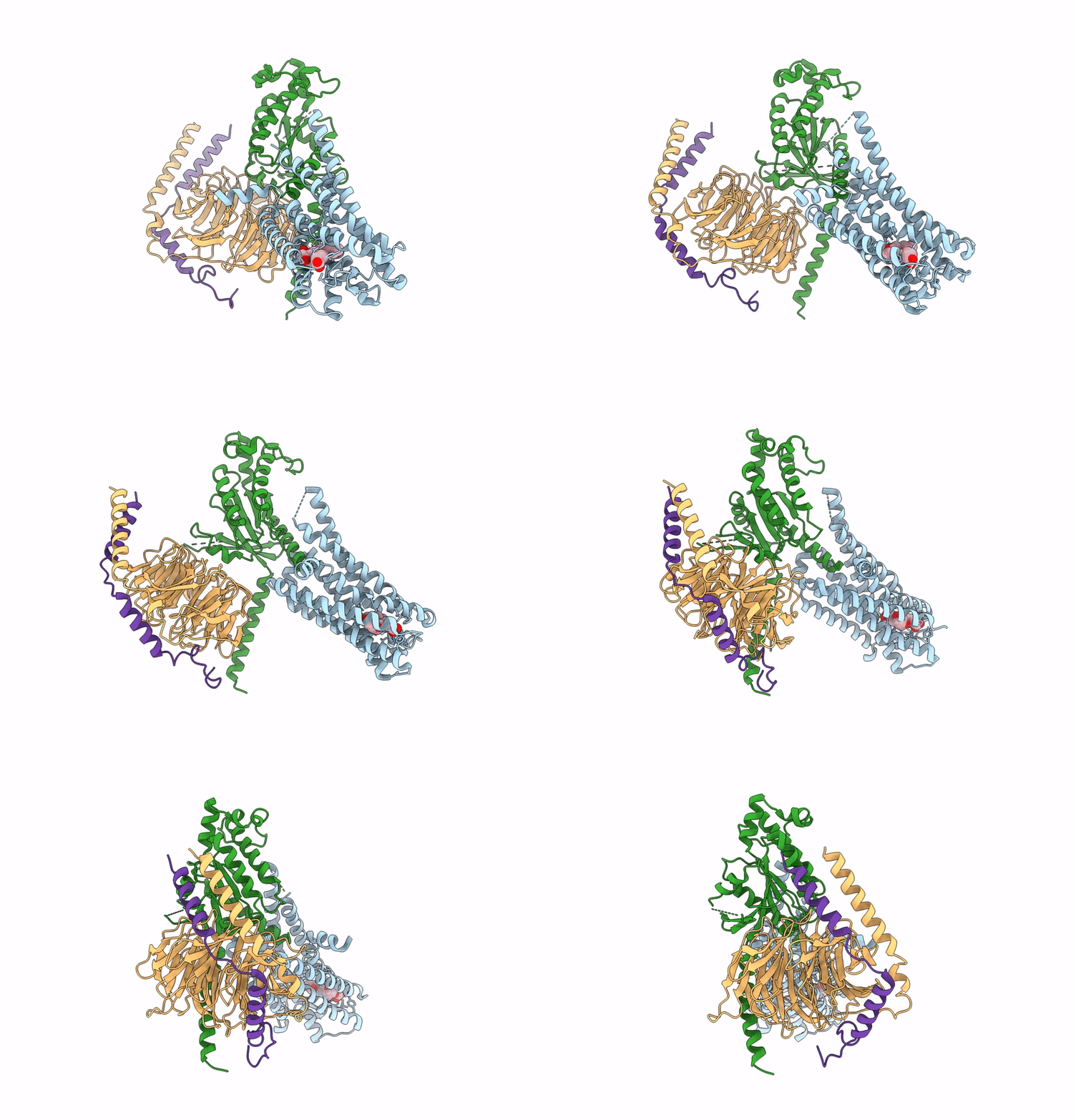
9M1H image
Deposition Date 2025-02-26
Release Date 2025-04-30
Last Version Date 2025-11-12
Entry Detail
PDB ID:
9M1H
Title:
Cryo-EM structure of PGE2-EP1-Gq complex
Biological Source:
Source Organism:
Homo sapiens (Taxon ID: 9606)
Host Organism:
Method Details:
Experimental Method:
Resolution:
2.55 Å
Aggregation State:
PARTICLE
Reconstruction Method:
SINGLE PARTICLE

Macromolecular Entities
Structures with similar UniProt ID
Protein Blast
Polymer Type:polypeptide(L)
Molecule:Prostaglandin E2 receptor EP1 subtype
Gene (Uniprot):PTGER1
Chain IDs:A
Chain Length:402
Number of Molecules:1
Biological Source:Homo sapiens
Protein Blast
Polymer Type:polypeptide(L)
Molecule:Guanine nucleotide-binding protein G(i) subunit alpha-1,Guanine nucleotide-binding protein G(s) subunit alpha isoforms short,Guanine nucleotide-binding protein G(q) subunit alpha
Gene (Uniprot):GNAQ, GNAS, GNAI1
Chain IDs:B
Chain Length:361
Number of Molecules:1
Biological Source:Homo sapiens
Structures with similar UniProt ID
Protein Blast
Polymer Type:polypeptide(L)
Molecule:Guanine nucleotide-binding protein G(I)/G(S)/G(T) subunit beta-1
Gene (Uniprot):GNB1
Chain IDs:C
Chain Length:345
Number of Molecules:1
Biological Source:Homo sapiens
Structures with similar UniProt ID
Protein Blast
Polymer Type:polypeptide(L)
Molecule:Guanine nucleotide-binding protein G(I)/G(S)/G(O) subunit gamma-2
Gene (Uniprot):GNG2
Chain IDs:D (auth: G)
Chain Length:71
Number of Molecules:1
Biological Source:Homo sapiens
Ligand Molecules
Primary Citation
Structural insights into the activation of the human prostaglandin E 2 receptor EP1 subtype by prostaglandin E 2.
Proc.Natl.Acad.Sci.USA 122 e2423840122 e2423840122 (2025)
PMID: 40366695 DOI: 10.1073/pnas.2423840122

Abstact

Prostaglandin E2 (PGE2) mediates diverse physiological processes through four G protein-coupled receptor subtypes (EP1-EP4). While structures of EP2, EP3, and EP4 have been determined, the structural basis for PGE2 recognition and activation of the EP1 receptor subtype has remained elusive due to its inherent instability. Here, we present the cryoelectron microscopy structure of the human EP1 receptor in complex with PGE2 and heterotrimeric Gq protein at 2.55 Å resolution, completing the structural characterization of the EP receptor family. Our structure reveals a unique binding mode of PGE2 within EP1, involving key interactions with residues in the orthosteric pocket. Notably, we observe a less pronounced outward displacement of transmembrane helix 6 compared to other EP receptor subtypes, suggesting a distinct activation mechanism for EP1. Through extensive mutational analyses, we identify critical residues involved in PGE2 recognition, EP1 activation, and Gq protein coupling. By overcoming the challenges associated with the instability of EP1, our findings provide valuable insights into the subtype-specific activation mechanisms of EP receptors and lay the foundation for the development of more selective EP1-targeted therapeutics.

Legend

Protein

Chemical

Disease

Primary Citation of related structures
Feedback Form
Name
Email
Institute
Feedback