9M1E image
Deposition Date 2025-02-25
Release Date 2026-03-04
Last Version Date 2026-03-04
Entry Detail
PDB ID:
9M1E
Title:
Crystal structure of the CPS-6 H148A/F122A versus cis-resveratrol complex
Biological Source:
Source Organism(s):
Expression System(s):
Method Details:
Experimental Method:
Resolution:
2.99 Å
R-Value Free:
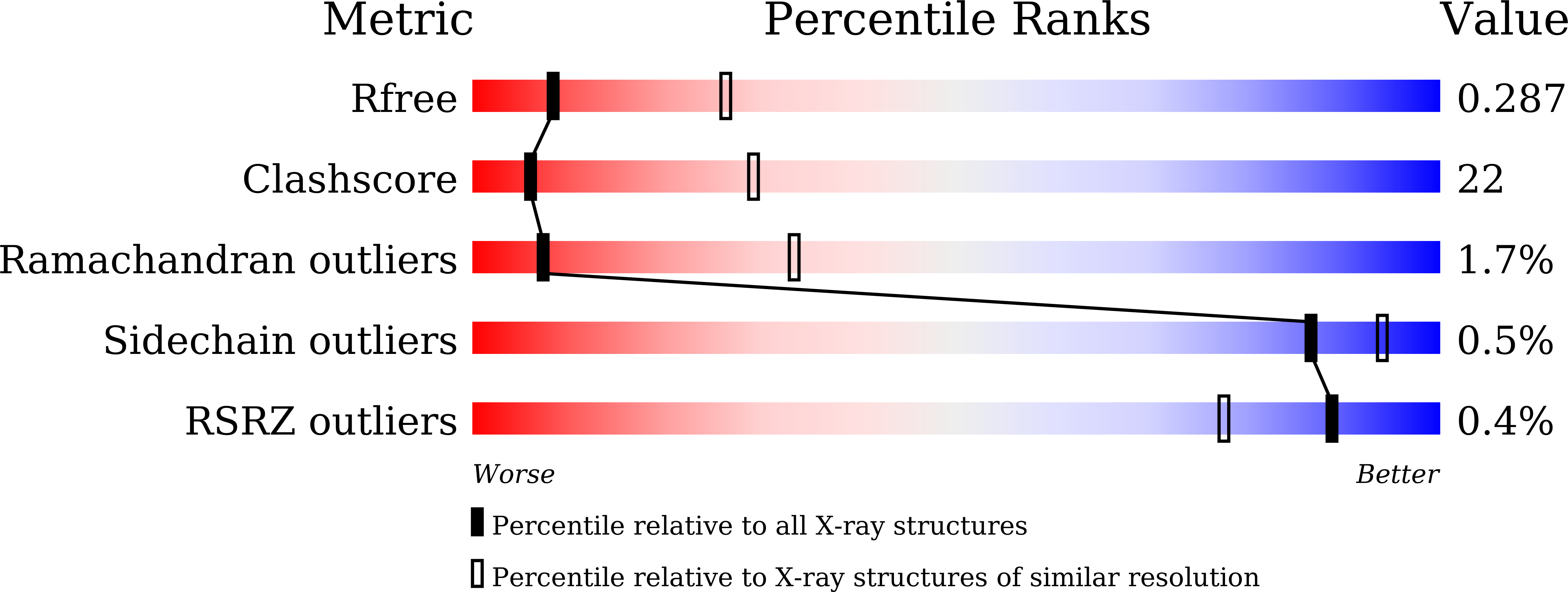
0.28
R-Value Work:
0.17
R-Value Observed:
0.18
Space Group:
P 1 21 1
Macromolecular Entities
Structures with similar UniProt ID
Protein Blast
Polymer Type:polypeptide(L)
Molecule:Endonuclease G, mitochondrial
Gene (Uniprot):cps-6
Mutagens:F122A and H148A
Chain IDs:A, B
Chain Length:252
Number of Molecules:2
Biological Source:Caenorhabditis elegans
Primary Citation
Crystal structure of endonuclease G in complex with DNA reveals how it nonspecifically degrades DNA as a homodimer
Nucleic Acids Res. 44 10480 10490 (2016)
PMID: 27738134 DOI: 10.1093/nar/gkw931

Abstact

Endonuclease G (EndoG) is an evolutionarily conserved mitochondrial protein in eukaryotes that digests nucleus chromosomal DNA during apoptosis and paternal mitochondrial DNA during embryogenesis. Under oxidative stress, homodimeric EndoG becomes oxidized and converts to monomers with diminished nuclease activity. However, it remains unclear why EndoG has to function as a homodimer in DNA degradation. Here, we report the crystal structure of the Caenorhabditis elegans EndoG homologue, CPS-6, in complex with single-stranded DNA at a resolution of 2.3 Å. Two separate DNA strands are bound at the ββα-metal motifs in the homodimer with their nucleobases pointing away from the enzyme, explaining why CPS-6 degrades DNA without sequence specificity. Two obligatory monomeric CPS-6 mutants (P207E and K131D/F132N) were constructed, and they degrade DNA with diminished activity due to poorer DNA-binding affinity as compared to wild-type CPS-6. Moreover, the P207E mutant exhibits predominantly 3'-to-5' exonuclease activity, indicating a possible endonuclease to exonuclease activity change. Thus, the dimer conformation of CPS-6 is essential for maintaining its optimal DNA-binding and endonuclease activity. Compared to other non-specific endonucleases, which are usually monomeric enzymes, EndoG is a unique dimeric endonuclease, whose activity hence can be modulated by oxidation to induce conformational changes.

Legend

Protein

Chemical

Disease

Primary Citation of related structures
Feedback Form
Name
Email
Institute
Feedback