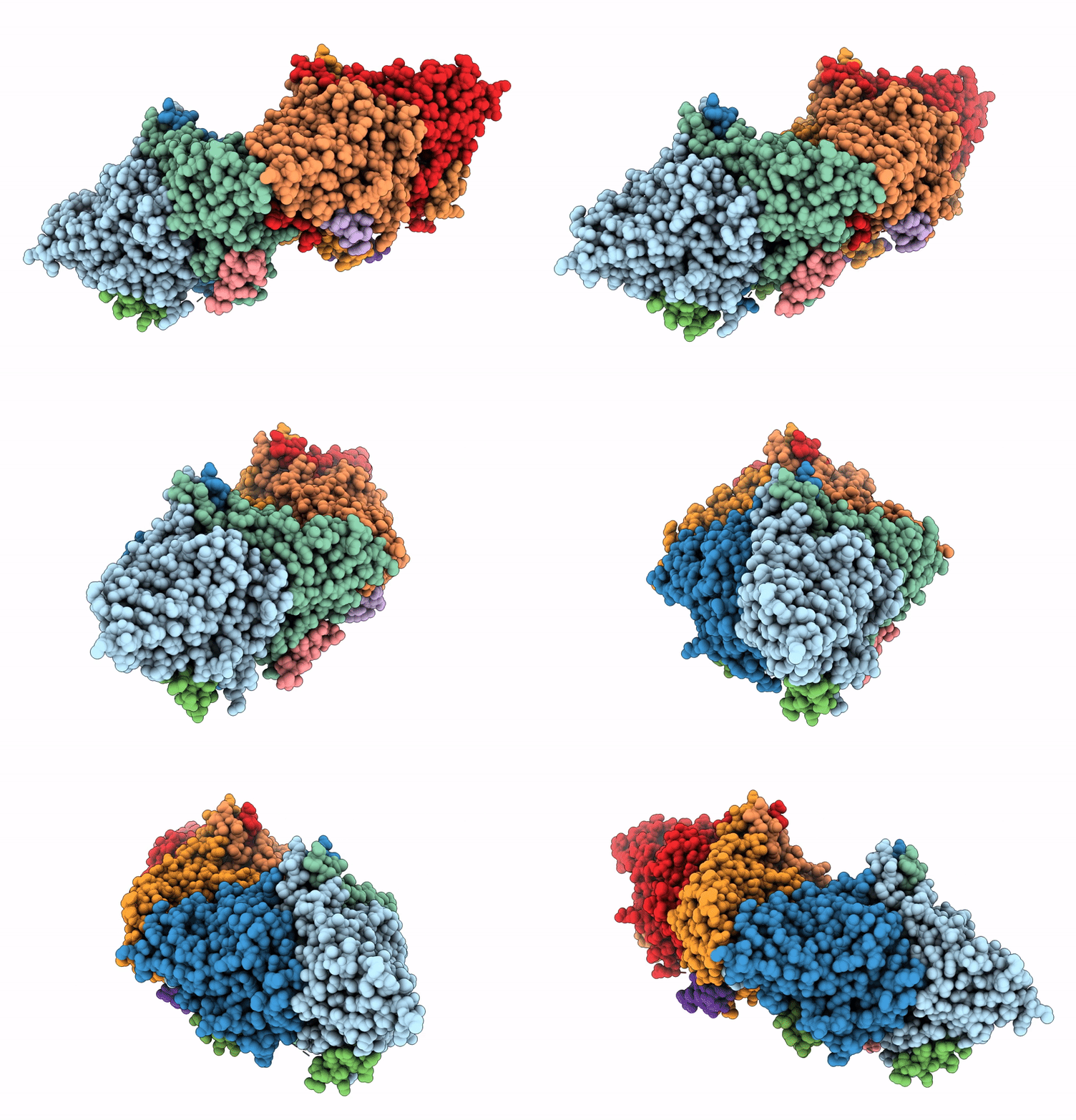
9LZL image
Deposition Date 2025-02-22
Release Date 2025-08-13
Last Version Date 2025-11-12
Entry Detail
PDB ID:
9LZL
Keywords:
Title:
Flat-contact of Flock House Virus early disassembly intermediate
Biological Source:
Source Organism:
Method Details:
Experimental Method:
Resolution:
3.10 Å
Aggregation State:
PARTICLE
Reconstruction Method:
SINGLE PARTICLE

Macromolecular Entities
Structures with similar UniProt ID
Protein Blast
Polymer Type:polypeptide(L)
Molecule:Capsid protein alpha
Gene (Uniprot):alpha
Chain IDs:A, C (auth: B), E (auth: C), G, I (auth: H), K (auth: I)
Chain Length:363
Number of Molecules:6
Biological Source:Flock house virus
Structures with similar UniProt ID
Protein Blast
Polymer Type:polypeptide(L)
Molecule:Capsid protein alpha
Gene (Uniprot):alpha
Chain IDs:B (auth: D), D (auth: E), F, H (auth: J), J (auth: K), L
Chain Length:44
Number of Molecules:6
Biological Source:Flock house virus
Ligand Molecules
Primary Citation
A Disassembly Intermediate of a Non-enveloped Virus Indicates the Pathway of Genome Release.
J.Mol.Biol. 437 169354 169354 (2025)
PMID: 40714052 DOI: 10.1016/j.jmb.2025.169354

Abstact

Disassembly of non-enveloped viruses in vivo are typically triggered by cellular factors such as host receptor binding, low pH in the early or late endosomal compartments, protease action in lysosomes, and localized changes in ionic concentrations. These triggers induce alterations in metastable capsids, resulting in the exposure of flexible capsid components and opening of gaps for genome release. Structural analysis of intermediate states is required to understand alterations in protein-protein and RNA-protein contacts in the pathway of capsid destabilization. Obtaining structural details of intermediates requires recreation of the in vivo transition states in stable forms, stepwise, in vitro. Here, we generated an asymmetric reconstruction of an early intermediate state in the disassembly pathway of Flock House Virus, a T = 3 icosahedral insect virus that is a model system for similar-sized non-enveloped viruses. The early intermediate was generated through judicious application, in vitro, of in vivo conditions such as receptor-binding-related transition and endosomal pH. The early intermediate showed asymmetric expansion, as well as asymmetric dynamic movement of the pocket factor, disordering of flexible membrane penetrating peptides and opening of gaps at the 2-fold axis, indicating that disassembly-related structural alterations may be local and not transpire throughout the icosahedral capsid. Surprisingly, the genomic RNA underwent a dramatic conformational alteration which superseded the relatively more subtle changes in the protein component. Recreation of disassembly-related transition states in vitro may be essential for structure-targeted, broadly effective inactivation strategies for non-enveloped viruses.

Legend

Protein

Chemical

Disease

Primary Citation of related structures
Feedback Form
Name
Email
Institute
Feedback