9LZJ image
Deposition Date 2025-02-21
Release Date 2025-12-31
Last Version Date 2025-12-31
Entry Detail
PDB ID:
9LZJ
Keywords:
Title:
The PSI3-IsiA43 complex with a closed double ring of IsiA proteins bound to a trimeric PSI core
Biological Source:
Source Organism:
Method Details:
Experimental Method:
Resolution:
3.40 Å
Aggregation State:
PARTICLE
Reconstruction Method:
SINGLE PARTICLE
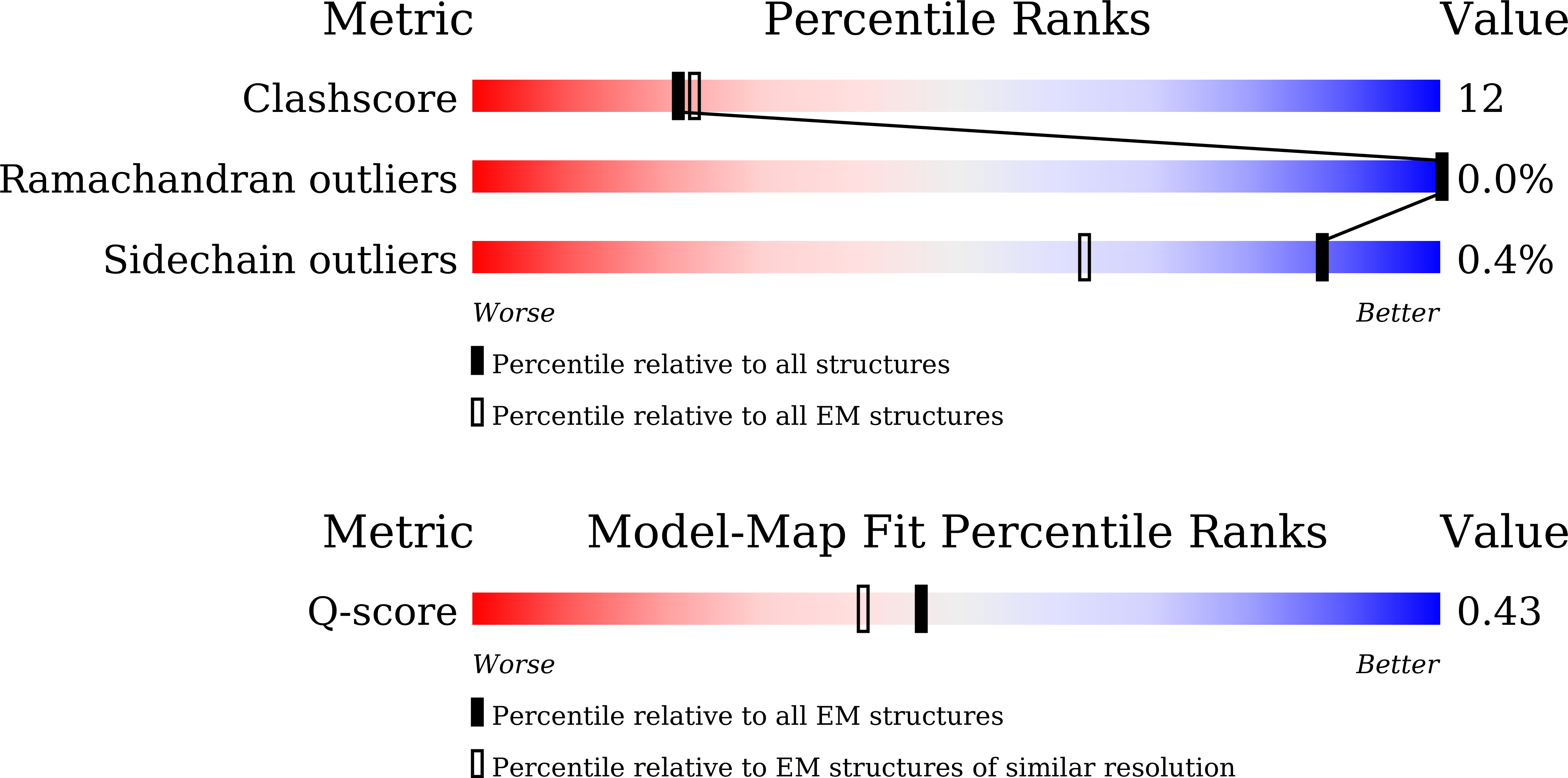
Macromolecular Entities
Structures with similar UniProt ID
Protein Blast
Polymer Type:polypeptide(L)
Molecule:Iron stress-induced chlorophyll-binding protein
Gene (Uniprot):isiA
Chain IDs:M (auth: a1), N (auth: a2), O (auth: a3), P (auth: a4), Q (auth: a5), R (auth: a6), EA (auth: b1), FA (auth: b2), GA (auth: b3), HA (auth: b4), IA (auth: b5), JA (auth: b6), WA (auth: c1), XA (auth: c2), YA (auth: c3), ZA (auth: c4), AB (auth: c5), BB (auth: c6), CB (auth: S), DB (auth: T), EB (auth: U), FB (auth: V), GB (auth: W), HB (auth: X), IB (auth: Y), JB (auth: Z), KB (auth: a), LB (auth: b), MB (auth: c), NB (auth: d), OB (auth: e), PB (auth: f), QB (auth: g), RB (auth: h), SB (auth: i), TB (auth: j), UB (auth: k), VB (auth: l), WB (auth: m), XB (auth: n), YB (auth: o), ZB (auth: p), AC (auth: q)
Chain Length:358
Number of Molecules:43
Biological Source:Thermosynechococcus vestitus BP-1
Structures with similar UniProt ID
Protein Blast
Polymer Type:polypeptide(L)
Molecule:Photosystem I P700 chlorophyll a apoprotein A1
Gene (Uniprot):psaA
Chain IDs:A (auth: aA), S (auth: bA), KA (auth: cA)
Chain Length:755
Number of Molecules:3
Biological Source:Thermosynechococcus vestitus BP-1
Structures with similar UniProt ID
Protein Blast
Polymer Type:polypeptide(L)
Molecule:Photosystem I P700 chlorophyll a apoprotein A2
Gene (Uniprot):psaB
Chain IDs:B (auth: aB), T (auth: bB), LA (auth: cB)
Chain Length:741
Number of Molecules:3
Biological Source:Thermosynechococcus vestitus BP-1
Structures with similar UniProt ID
Protein Blast
Polymer Type:polypeptide(L)
Molecule:Photosystem I iron-sulfur center
Gene (Uniprot):psaC
Chain IDs:C (auth: aC), U (auth: bC), MA (auth: cC)
Chain Length:81
Number of Molecules:3
Biological Source:Thermosynechococcus vestitus BP-1
Structures with similar UniProt ID
Protein Blast
Polymer Type:polypeptide(L)
Molecule:Photosystem I reaction center subunit II
Gene (Uniprot):psaD
Chain IDs:D (auth: aD), V (auth: bD), NA (auth: cD)
Chain Length:139
Number of Molecules:3
Biological Source:Thermosynechococcus vestitus BP-1
Structures with similar UniProt ID
Protein Blast
Polymer Type:polypeptide(L)
Molecule:Photosystem I reaction center subunit IV
Gene (Uniprot):psaE
Chain IDs:E (auth: aE), W (auth: bE), OA (auth: cE)
Chain Length:76
Number of Molecules:3
Biological Source:Thermosynechococcus vestitus BP-1
Structures with similar UniProt ID
Protein Blast
Polymer Type:polypeptide(L)
Molecule:Photosystem I reaction center subunit III
Gene (Uniprot):psaF
Chain IDs:F (auth: aF), X (auth: bF), PA (auth: cF)
Chain Length:164
Number of Molecules:3
Biological Source:Thermosynechococcus vestitus BP-1
Structures with similar UniProt ID
Protein Blast
Polymer Type:polypeptide(L)
Molecule:Photosystem I reaction center subunit VIII
Gene (Uniprot):psaI
Chain IDs:G (auth: aI), Y (auth: bI), QA (auth: cI)
Chain Length:38
Number of Molecules:3
Biological Source:Thermosynechococcus vestitus BP-1
Structures with similar UniProt ID
Protein Blast
Polymer Type:polypeptide(L)
Molecule:Photosystem I reaction center subunit IX
Gene (Uniprot):psaJ
Chain IDs:H (auth: aJ), Z (auth: bJ), RA (auth: cJ)
Chain Length:41
Number of Molecules:3
Biological Source:Thermosynechococcus vestitus BP-1
Structures with similar UniProt ID
Protein Blast
Polymer Type:polypeptide(L)
Molecule:Photosystem I reaction center subunit PsaK
Gene (Uniprot):psaK
Chain IDs:I (auth: aK), AA (auth: bK), SA (auth: cK)
Chain Length:83
Number of Molecules:3
Biological Source:Thermosynechococcus vestitus BP-1
Structures with similar UniProt ID
Protein Blast
Polymer Type:polypeptide(L)
Molecule:Photosystem I reaction center subunit XI
Gene (Uniprot):psaL
Chain IDs:J (auth: aL), BA (auth: bL), TA (auth: cL)
Chain Length:155
Number of Molecules:3
Biological Source:Thermosynechococcus vestitus BP-1
Structures with similar UniProt ID
Protein Blast
Polymer Type:polypeptide(L)
Molecule:Photosystem I reaction center subunit XII
Gene (Uniprot):psaM
Chain IDs:K (auth: aM), CA (auth: bM), UA (auth: cM)
Chain Length:31
Number of Molecules:3
Biological Source:Thermosynechococcus vestitus BP-1
Structures with similar UniProt ID
Protein Blast
Polymer Type:polypeptide(L)
Molecule:Photosystem I 4.8K protein
Gene (Uniprot):tsr0813
Chain IDs:L (auth: aX), DA (auth: bX), VA (auth: cX)
Chain Length:39
Number of Molecules:3
Biological Source:Thermosynechococcus vestitus BP-1
Primary Citation
Structural basis for the assembly and energy transfer between the cyanobacterial PSI core and the double-layered IsiA proteins.
Nat Commun ? ? ? (2025)
PMID: 41422266 DOI: 10.1038/s41467-025-67295-2

Abstact

Iron-limitation is a common stress factor in natural environments. To survive under iron-starved conditions, cyanobacteria overexpress iron stress-induced protein A (IsiA), which is crucial for light-harvesting and photoprotection. Multiple IsiA proteins form a single- or double-layered architecture encircling the photosystem I (PSI) core, forming various PSI-IsiA supercomplexes. The assembly and energy transfer mechanisms of double-layered PSI-IsiA supercomplexes remain unelucidated. Here, we present high-resolution structures of two PSI-IsiA supercomplexes isolated from the cyanobacterium Thermosynechococcus elongatus BP-1 cultured under iron-starved conditions. The PSI3-IsiA43 complex contains a trimeric PSI core surrounded by 43 IsiA subunits assembled into a closed double-ring. The PSI1-IsiA13 complex contains 13 IsiA proteins arranged in a double-layered architecture attached to the monomeric PSI core. Atomic force microscopy demonstrates the presence and distribution of different PSI-IsiA complexes within native thylakoid membranes isolated from iron-starved cells. Our findings provide insights into the structural variability and adaptive mechanisms of PSI-IsiA complexes.

Legend

Protein

Chemical

Disease

Primary Citation of related structures
Feedback Form
Name
Email
Institute
Feedback