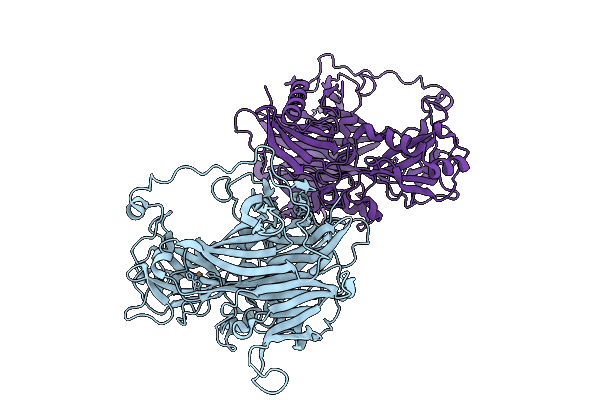
9LZ9 image
Deposition Date 2025-02-21
Release Date 2025-12-31
Last Version Date 2025-12-31
Entry Detail
PDB ID:
9LZ9
Keywords:
Title:
Reductive-half reaction intermediate of copper amine oxidase from Arthrobacter globiformis captured with short-a-axis diffraction data by mix-and-inject serial crystallography at 25-ms time delay
Biological Source:
Source Organism:
Method Details:
Experimental Method:
Resolution:
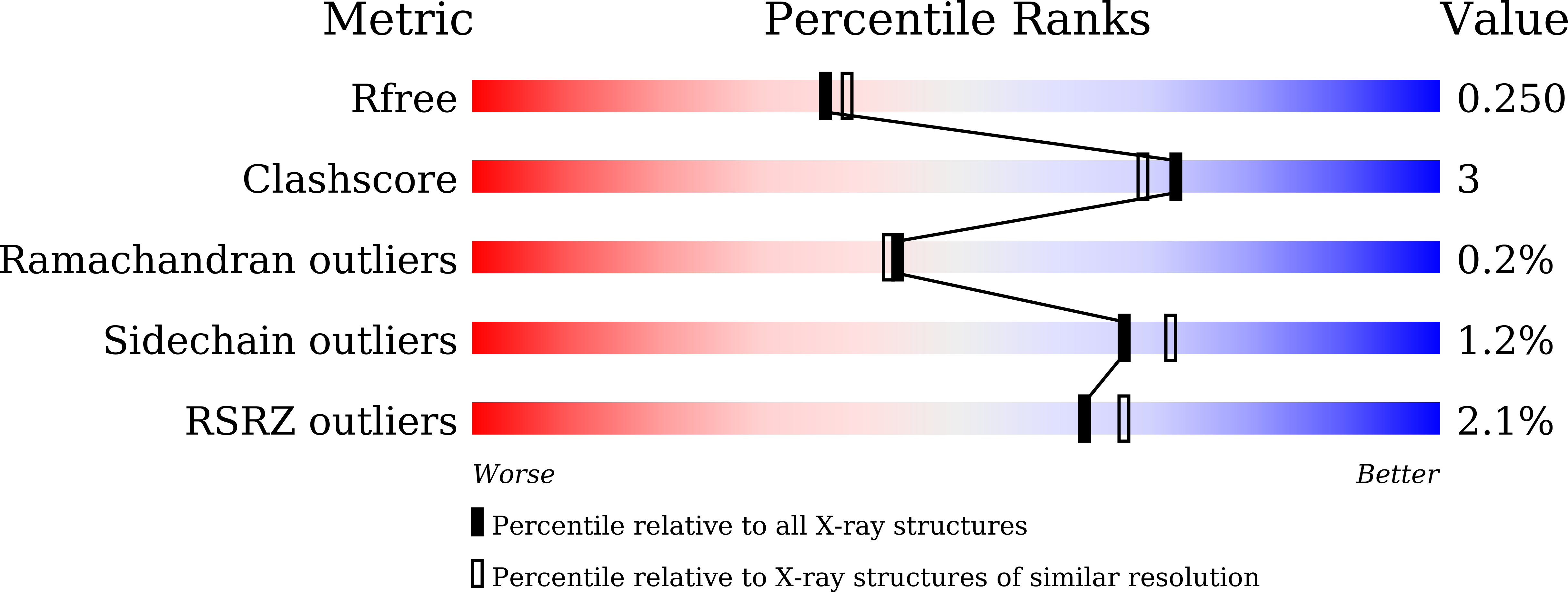
2.13 Å
R-Value Free:
0.24
R-Value Work:
0.20
R-Value Observed:
0.20
Space Group:
C 1 2 1
Macromolecular Entities
Structures with similar UniProt ID
Protein Blast
Polymer Type:polypeptide(L)
Molecule:Phenylethylamine oxidase
Chain IDs:A, B
Chain Length:620
Number of Molecules:2
Biological Source:Arthrobacter globiformis
Modified Residue
Compound ID Chain ID Parent Comp ID Details 2D Image
2TY A TYR modified residue
Ligand Molecules
Primary Citation
Real-time capture of domain movements during copper amine oxidase catalysis by mix-and-inject serial crystallography.
Nat Commun 16 11149 11149 (2025)
PMID: 41413268 DOI: 10.1038/s41467-025-67230-5

Abstact

Protein dynamics play a crucial role in various physiological functions, including enzyme catalysis. To explore conformational changes during enzyme catalysis, we conduct mix-and-inject serial crystallography, an advanced technique to capture time-resolved protein structures in real time, using the microcrystals of bacterial copper amine oxidase containing a protein-derived quinone cofactor. Within 50 ms of mixing the microcrystals (<4 μm) with a preferred substrate (2-phenylethylamine) under anaerobic conditions (reductive half-reaction), we observe domain movements associated with substrate binding and formation of a metastable reaction intermediate, a product Schiff-base of the quinone cofactor. At 100-1000 ms after mixing, conformational transition from aminoresorcinol to the semiquinone radical forms of the reduced cofactor progresses gradually, likely depending on the replacement of the product aldehyde by the next-cycle amine substrate that triggers the cofactor conformational change. Overall, this study provides structural insight into enzyme catalysis accompanying the active-site conformational changes that are hardly scrutinized by studies in solution.

Legend

Protein

Chemical

Disease

Primary Citation of related structures
Feedback Form
Name
Email
Institute
Feedback