9LWG image
Deposition Date 2025-02-14
Release Date 2025-12-24
Last Version Date 2025-12-24
Entry Detail
PDB ID:
9LWG
Keywords:
Title:
Zebrafish ovum lysosomal peptide:N-glycanase
Biological Source:
Source Organism:
Danio rerio (Taxon ID: 7955)
Host Organism:
Method Details:
Experimental Method:
Resolution:
2.70 Å
Aggregation State:
PARTICLE
Reconstruction Method:
SINGLE PARTICLE
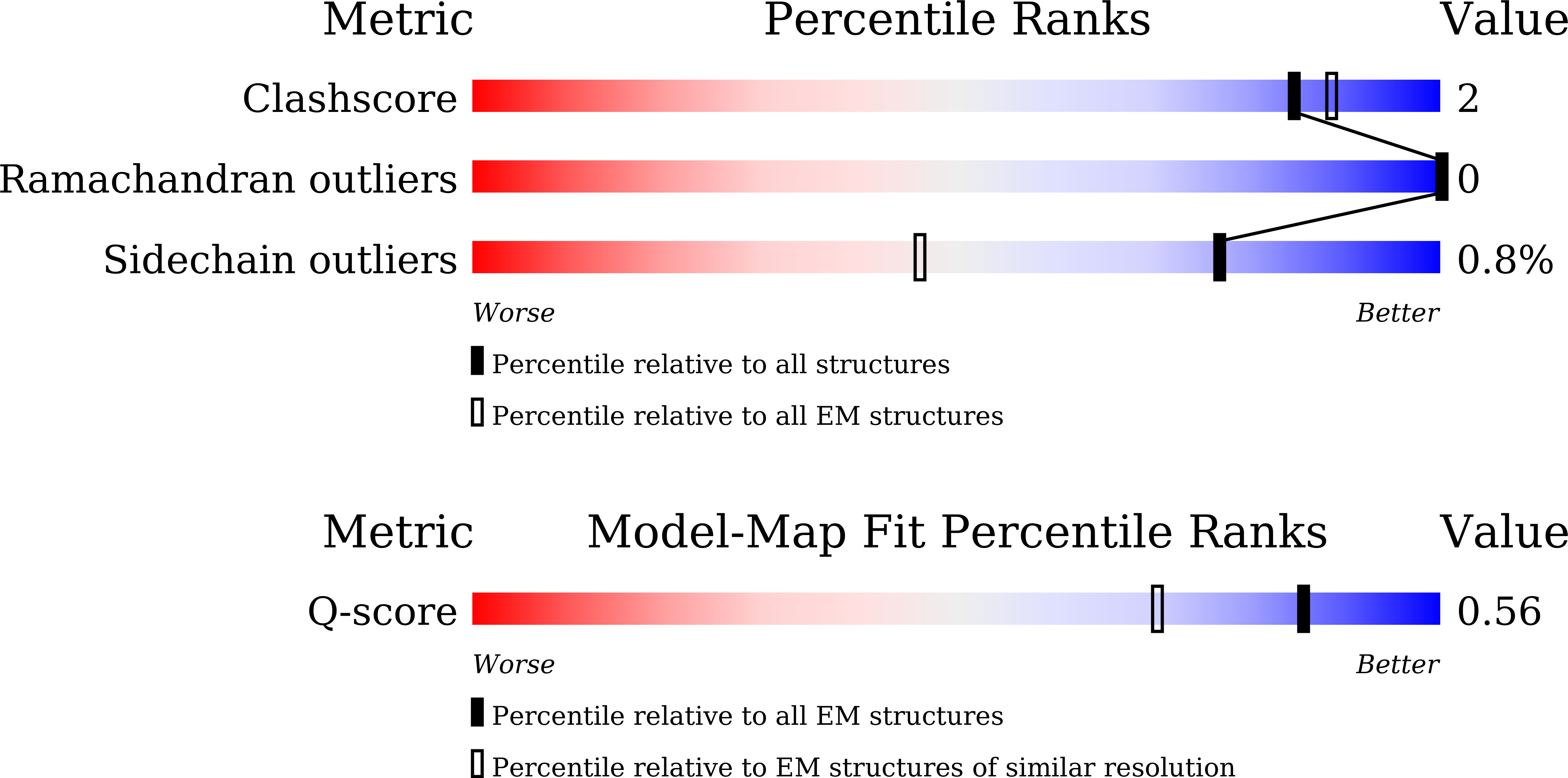
Macromolecular Entities
Structures with similar UniProt ID
Protein Blast
Polymer Type:polypeptide(L)
Molecule:Si:dkey-256h2.1
Gene (Uniprot):si:dkey-256h2.1
Chain IDs:A, B
Chain Length:687
Number of Molecules:2
Biological Source:Danio rerio
Ligand Molecules
Primary Citation
Structural characterization of zebrafish Ngly2, an ovary-enriched acid PNGase required for egg-free glycan production.
J.Biol.Chem. 301 110906 110906 (2025)
PMID: 41203122 DOI: 10.1016/j.jbc.2025.110906

Abstact

Peptide:N-glycanase (PNGase) is a deglycosylating enzyme acting on asparagine(N)-linked glycans on glycoproteins. It is well established that fish possesses two PNGases with distinct properties. One is a cytosolic PNGase (NGLY1 in humans), active at neutral pH and widely conserved among eukaryotes. The other is called acid PNGase and is found in fish embryos; it is active at acidic pH and is believed to be of lysosomal origin. The gene encoding the acid PNGase has not been identified in animals, and its evolutionary distribution has remained unknown. In this study, we identified the gene encoding the acid PNGase, which we named Ngly2, in zebrafish (Danio rerio). Interestingly, zebrafish Ngly2 was found to have structural similarity with bacterial PNGase (PNGase F) and indeed appeared to share common catalytic residues, despite the fact that these two enzymes exhibit quite distinct pH profiles. The structure of zebrafish Ngly2 was determined by cryo-EM, showing that it forms homodimers and that its substrate is accommodated in the cleft between the protease-associated domain and PNGase domain, where the catalytic residues are located. Tissue distribution analysis indicated that ngly2 was almost exclusively expressed in the ovary. A zebrafish ngly2-KO line was found to be fertile, survive well, and show no overt phenotypes, although it had significantly smaller fertilized eggs. It was also revealed that ngly2 KO resulted in a substantial reduction in the level of free oligosaccharides in fertilized eggs, implying that Ngly2, not Ngly1, is responsible for the formation of most, if not all, egg-free glycans.

Legend

Protein

Chemical

Disease

Primary Citation of related structures
Feedback Form
Name
Email
Institute
Feedback