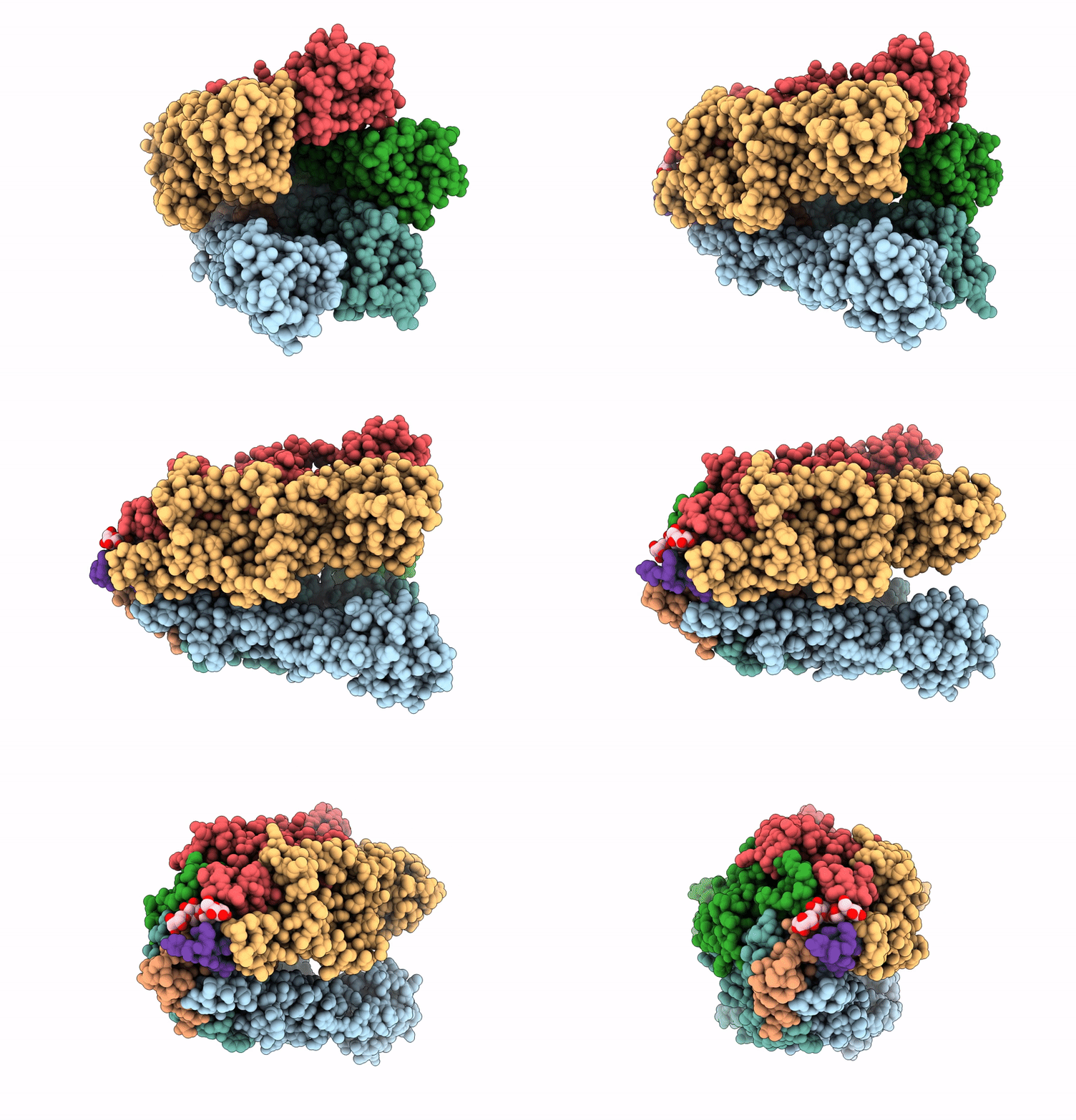
9LU9 image
Deposition Date 2025-02-08
Release Date 2025-04-09
Last Version Date 2025-04-09
Entry Detail
PDB ID:
9LU9
Keywords:
Title:
The chimeric flagellar motor complex between MotA1B1 from Paenibacillus sp. TCA20 and MotAB from E.coli, state 1
Biological Source:
Source Organism:
Method Details:
Experimental Method:
Resolution:
3.30 Å
Aggregation State:
PARTICLE
Reconstruction Method:
SINGLE PARTICLE

Macromolecular Entities
Structures with similar UniProt ID
Protein Blast
Polymer Type:polypeptide(L)
Molecule:Flagellar motor protein MotA
Gene (Uniprot):TCA2_3717
Chain IDs:A, B, C, D, E
Chain Length:264
Number of Molecules:5
Biological Source:Paenibacillus sp. TCA20
Structures with similar UniProt ID
Protein Blast
Polymer Type:polypeptide(L)
Molecule:MotB1,Motility protein B
Gene (Uniprot):motB
Chain IDs:F, G
Chain Length:319
Number of Molecules:2
Biological Source:Paenibacillus sp. TCA20, Escherichia coli
Ligand Molecules
Primary Citation
Cryo-EM Structure of the Flagellar Motor Complex from Paenibacillus sp. TCA20.
Biomolecules 15 ? ? (2025)
PMID: 40149971 DOI: 10.3390/biom15030435

Abstact

The bacterial flagellum, a complex nanomachine composed of numerous proteins, is utilized by bacteria for swimming in various environments and plays a crucial role in their survival and infection. The flagellar motor is composed of a rotor and stator complexes, with each stator unit functioning as an ion channel that converts flow from outside of cell membrane into rotational motion. Paenibacillus sp. TCA20 was discovered in a hot spring, and a structural analysis was conducted on the stator complex using cryo-electron microscopy to elucidate its function. Two of the three structures (Classes 1 and 3) were found to have structural properties typical for other stator complexes. In contrast, in Class 2 structures, the pentamer ring of the A subunits forms a C-shape, with lauryl maltose neopentyl glycol (LMNG) bound to the periplasmic side of the interface between the A and B subunits. This interface is conserved in all stator complexes, suggesting that hydrophobic ligands and lipids can bind to this interface, a feature that could potentially be utilized in the development of novel antibiotics aimed at regulating cell motility and infection.

Legend

Protein

Chemical

Disease

Primary Citation of related structures
Feedback Form
Name
Email
Institute
Feedback