9LTO image
Deposition Date 2025-02-06
Release Date 2026-01-28
Last Version Date 2026-01-28
Entry Detail
PDB ID:
9LTO
Keywords:
Title:
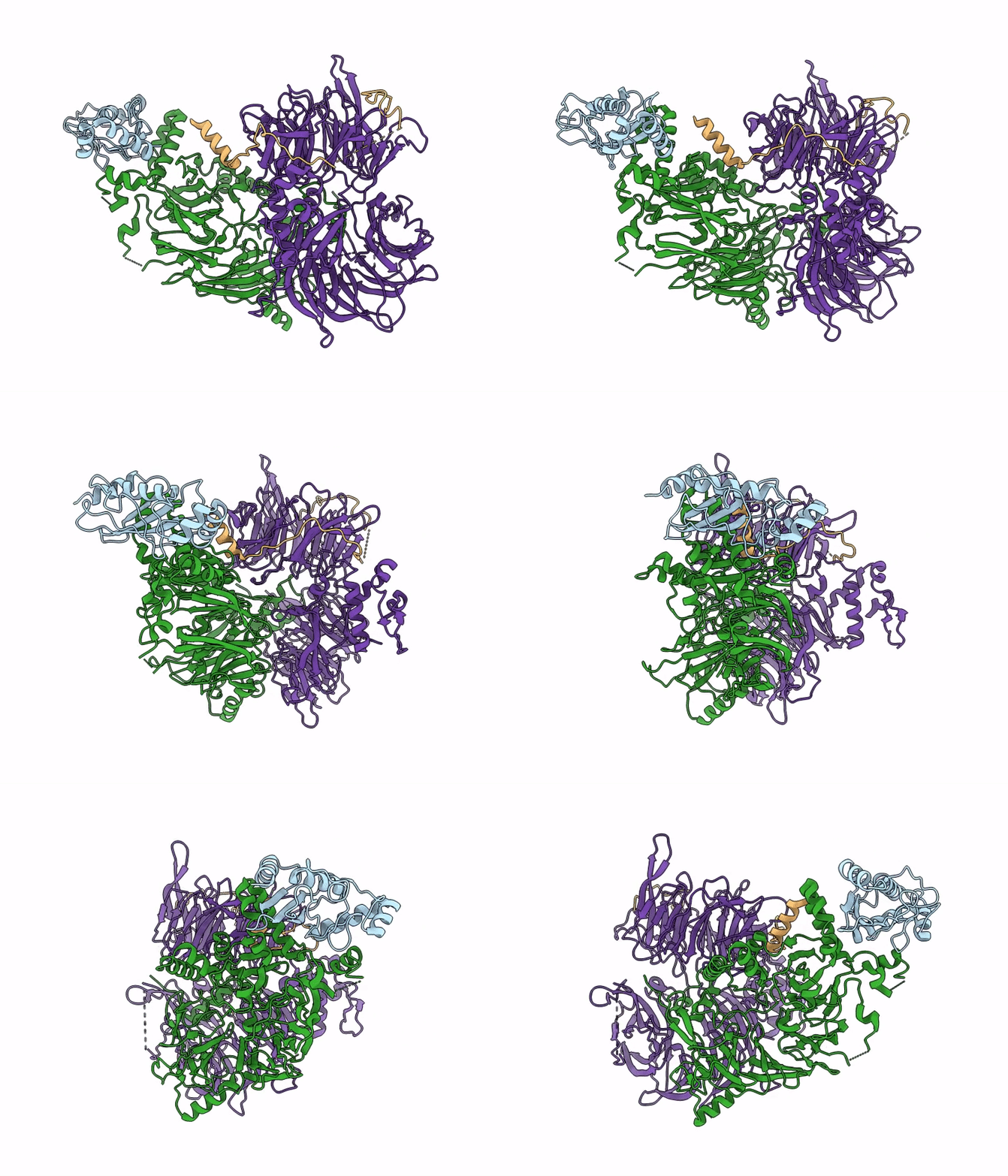
Cryo-EM structure of DDB1-DDA1-DET1-Ube2e2 complex
Biological Source:
Source Organism(s):
Homo sapiens (Taxon ID: 9606)
Expression System(s):
Method Details:
Experimental Method:
Resolution:
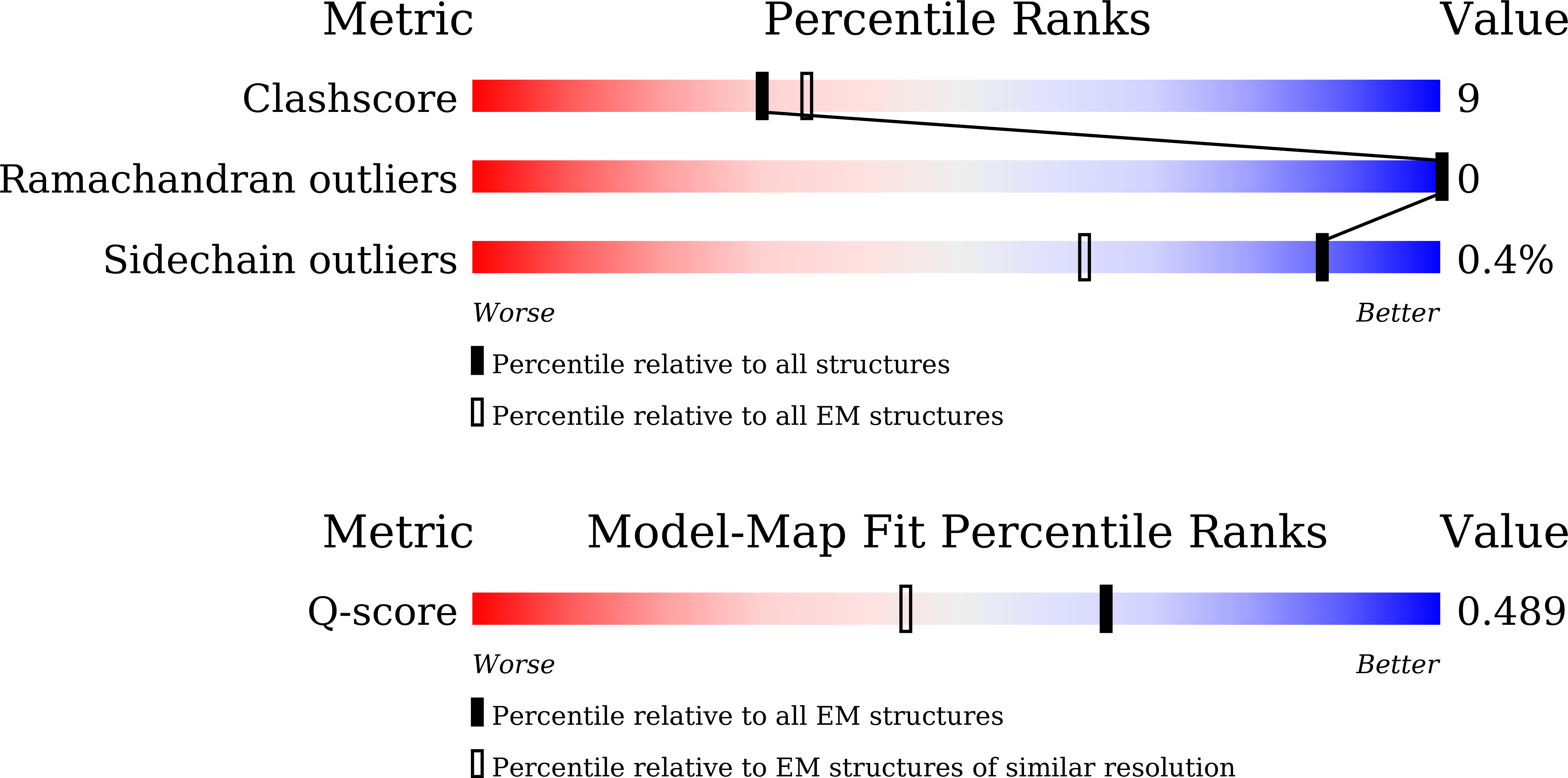
2.92 Å
Aggregation State:
PARTICLE
Reconstruction Method:
SINGLE PARTICLE
Macromolecular Entities
Structures with similar UniProt ID
Protein Blast
Polymer Type:polypeptide(L)
Molecule:Ubiquitin-conjugating enzyme E2 E2
Gene (Uniprot):UBE2E2
Chain IDs:A
Chain Length:201
Number of Molecules:1
Biological Source:Homo sapiens
Structures with similar UniProt ID
Protein Blast
Polymer Type:polypeptide(L)
Molecule:DET1 homolog
Gene (Uniprot):DET1
Chain IDs:C (auth: B)
Chain Length:550
Number of Molecules:1
Biological Source:Homo sapiens
Structures with similar UniProt ID
Protein Blast
Polymer Type:polypeptide(L)
Molecule:DET1- and DDB1-associated protein 1
Gene (Uniprot):DDA1
Chain IDs:D
Chain Length:102
Number of Molecules:1
Biological Source:Homo sapiens
Structures with similar UniProt ID
Protein Blast
Polymer Type:polypeptide(L)
Molecule:DNA damage-binding protein 1
Gene (Uniprot):DDB1
Chain IDs:B (auth: S)
Chain Length:1140
Number of Molecules:1
Biological Source:Homo sapiens
Ligand Molecules
Primary Citation
Cryo-EM structure of the human COP1-DET1 ubiquitin ligase complex.
Nat Commun 17 543 543 (2026)
PMID: 41540009 DOI: 10.1038/s41467-026-68375-7

Abstact

Ubiquitin modifications regulate fundamental cellular activities by modulating protein stability and function. The ubiquitin ligase COP1, which is present across species from plants to humans, plays a crucial role in the ubiquitination of developmental transcription factors. While COP1 can function independently, it can also be incorporated into CULLIN4-RING ubiquitin ligase (CRL4) complexes through the DET1 adaptor protein. Despite its biological significance, the structural and functional mechanisms of COP1 and DET1-containing complexes remains poorly understood. Here we present the cryo-electron microscopy structures of human COP1 in complex with DDB1-DDA1-DET1 and Ube2e2, revealing an inactive stacked assembly state. Co-expression with COP1 substrates including c-Jun or ETS2 disrupts this configuration, inducing a conformational rearrangement into a distinct dimeric state that allows substrate access. Structural modelling identifies the spatial organization of COP1 WD40 domains where substrate recruits. DET1 serves as a structural scaffold, bridging COP1 and Ube2e2 to initiate potential ubiquitin addition on substrates, while DDB1 recruits the CULLIN4-RBX1 complex to facilitate Ube2d3-mediated ubiquitin chain elongation. These results reveal the dynamic interplay between the structural states of the CRL4DET1-COP1 E3 ligase complex and its substrate specific activation mechanism, offering mechanistic insights into ubiquitination regulation and a basis for future studies on E3 ligase dynamics.

Legend

Protein

Chemical

Disease

Primary Citation of related structures
Feedback Form
Name
Email
Institute
Feedback