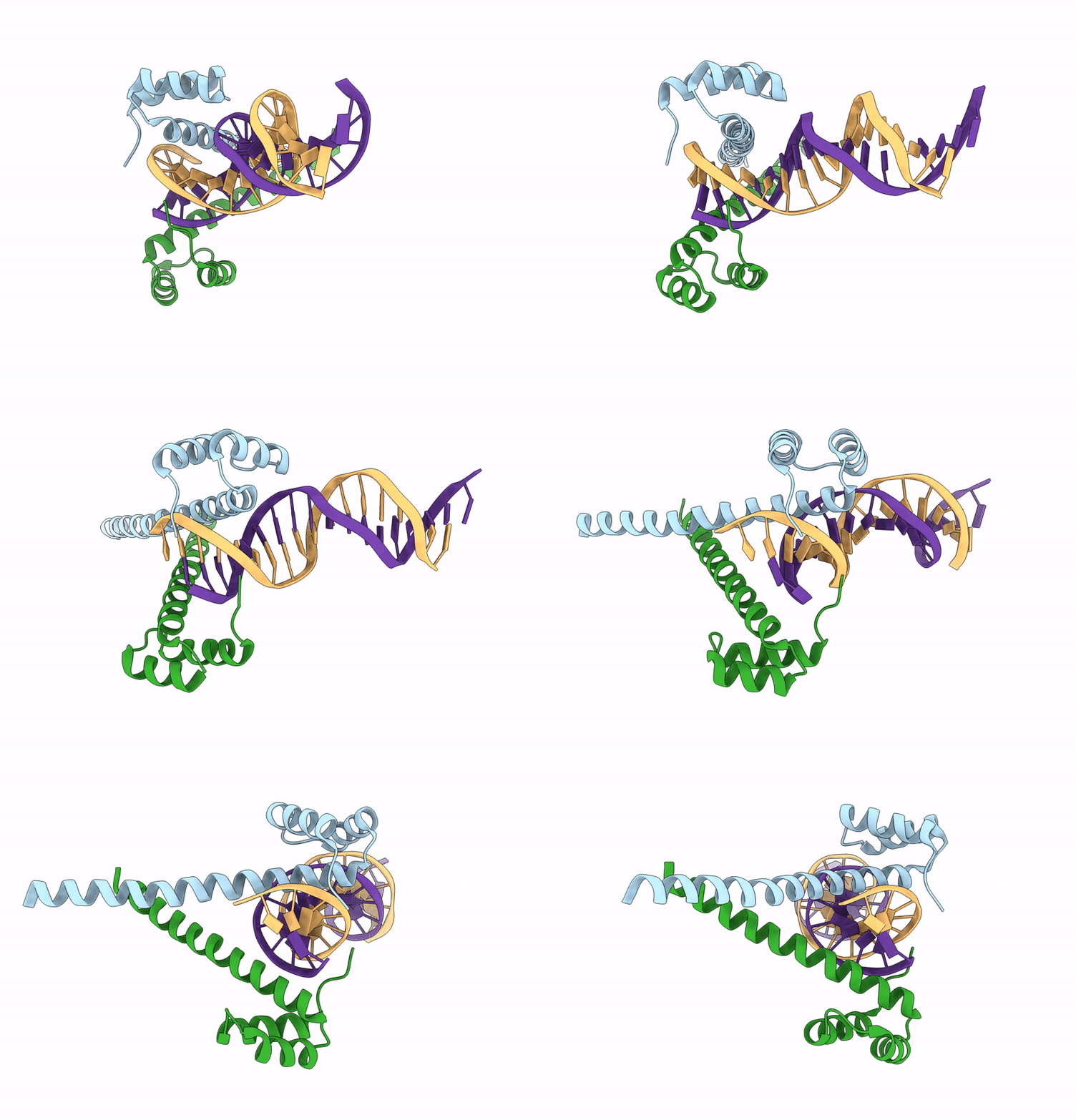
9LPE image
Deposition Date 2025-01-24
Release Date 2025-12-03
Last Version Date 2025-12-03
Entry Detail
PDB ID:
9LPE
Title:
ATPDF2 HDZIP domain complexed with DNA
Biological Source:
Source Organism:
Host Organism:
Method Details:
Experimental Method:
Resolution:
3.11 Å
R-Value Free:
0.28
R-Value Work:
0.27
R-Value Observed:
0.27
Space Group:
P 32 2 1

Macromolecular Entities
Structures with similar UniProt ID
Protein Blast
Polymer Type:polypeptide(L)
Molecule:Homeobox-leucine zipper protein PROTODERMAL FACTOR 2
Gene (Uniprot):PDF2
Chain IDs:A, B
Chain Length:112
Number of Molecules:2
Biological Source:Arabidopsis thaliana
Polymer Type:polydeoxyribonucleotide
Molecule:DNA (5'-D(*CP*TP*AP*AP*AP*TP*GP*CP*AP*GP*TP*GP*CP*AP*TP*TP*TP*A)-3')
Chain IDs:C
Chain Length:18
Number of Molecules:1
Biological Source:Arabidopsis thaliana
Polymer Type:polydeoxyribonucleotide
Molecule:DNA (5'-D(*GP*TP*AP*AP*AP*TP*GP*CP*AP*CP*TP*GP*CP*AP*TP*TP*TP*A)-3')
Chain IDs:D
Chain Length:18
Number of Molecules:1
Biological Source:Arabidopsis thaliana
Ligand Molecules
Primary Citation
Molecular insights into DNA recognition by HD-Zip transcription factors.
Plant Physiol. 198 ? ? (2025)
PMID: 40583771 DOI: 10.1093/plphys/kiaf292

Abstact

Homeodomain-leucine zipper (HD-Zip) genes encode a large family of plant-specific transcription factors (TFs) that are integral to plant development, growth, regulation, and responses to environmental and hormonal signals. While the roles and mechanisms of HD-Zip TFs have been extensively studied, the structural basis for their DNA recognition remains unclear. In this study, we analyzed DAP-seq data and identified consensus DNA motifs, 5'-AAT[W]AT-3' and 5'-[N]AAA[N][N]-3', preferentially bound by HD-Zip TFs. Both motifs feature a 5'-AA(T/A)-3' core, which is shared across previously identified HD-Zip target sequences, suggesting a common recognition feature within the HD-Zip family. Focusing on the well-characterized HD-Zip IV TF PROTEIN PRODUCTION FACTOR 2 (PDF2) from Arabidopsis (Arabidopsis thaliana) and its interaction with the L1 box DNA sequence, our structural and biochemical analyses revealed that the PDF2 HD-ZA module forms a dimer to specifically recognize the 5'-AATG-3' core through an asymmetric binding mode. In this mode, only the primary recognition helix of 1 protomer and the N-arm of the other protomer in the PDF2 HD-ZA dimer are involved in specific DNA interactions. Our study offers insights into the molecular mechanisms of HD-Zip TFs and provides a structural template for engineering applications in agricultural research.

Legend

Protein

Chemical

Disease

Primary Citation of related structures
Feedback Form
Name
Email
Institute
Feedback