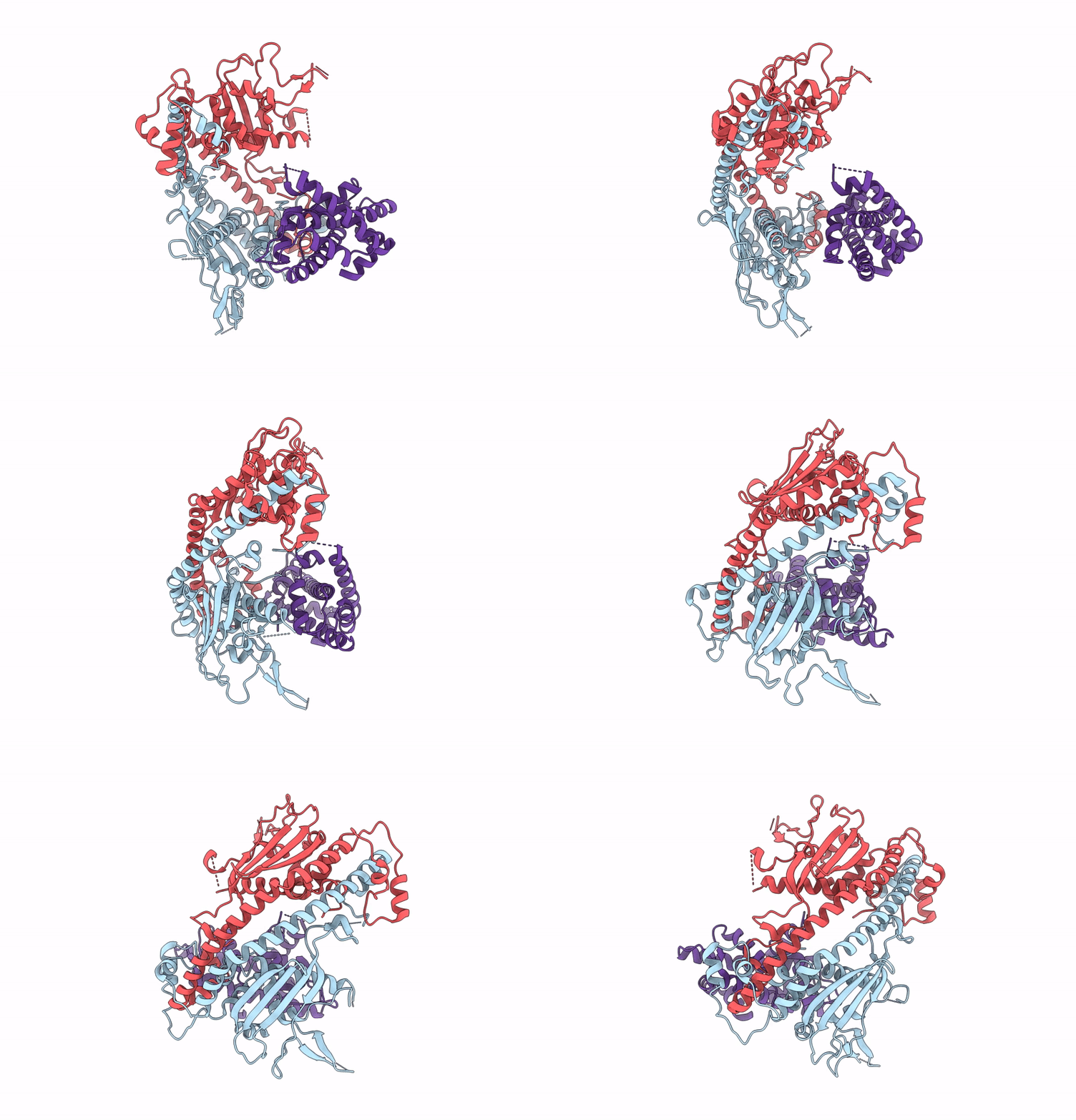
9LN8 image
Deposition Date 2025-01-21
Release Date 2025-12-24
Last Version Date 2026-02-11
Entry Detail
PDB ID:
9LN8
Keywords:
Title:
Structure of NAP1 in complex with H2A.Z-H2B
Biological Source:
Source Organism(s):
Expression System(s):
Method Details:
Experimental Method:
Resolution:
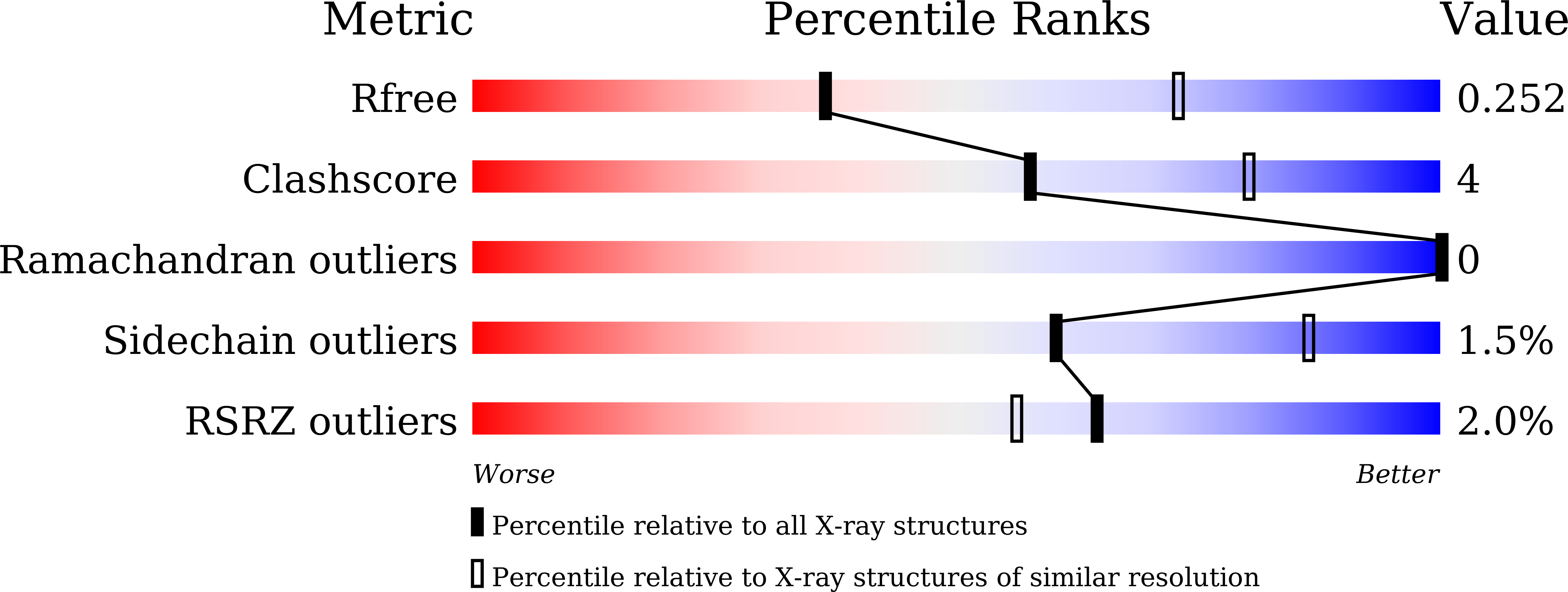
2.80 Å
R-Value Free:
0.25
R-Value Work:
0.21
R-Value Observed:
0.21
Space Group:
P 21 21 21
Macromolecular Entities
Structures with similar UniProt ID
Protein Blast
Polymer Type:polypeptide(L)
Molecule:Nucleosome assembly protein 1-like 1
Gene (Uniprot):nap-1
Chain IDs:A, B
Chain Length:308
Number of Molecules:2
Biological Source:Caenorhabditis elegans
Polymer Type:polypeptide(L)
Molecule:H2A.Z-H2B
Chain IDs:C (auth: D)
Chain Length:203
Number of Molecules:1
Biological Source:Caenorhabditis elegans
Ligand Molecules
Primary Citation
Structural insights into H2A-H2B and H2A.Z-H2B sliding on histone chaperone NAP1.
Acta Biochim.Biophys.Sin. ? ? ? (2025)
PMID: 41403246 DOI: 10.3724/abbs.2025241

Abstact

The evolutionarily conserved nucleosome assembly protein 1 (NAP1) functions as a histone chaperone for H2A-H2B, regulating nucleosome assembly and maintaining chromatin integrity. However, the dynamic and variable nature of the interactions between acidic NAP1 and basic H2A-H2B has obscured the molecular basis of its chaperoning activity. Here, we report the crystal structures of Caenorhabditis elegans NAP1 (CeNAP1) in complex with Xenopus laevis H2A-H2B (XlH2A-H2B) and with C. elegans H2A.Z-H2B (CeH2A.Z-H2B) at 3.35 Å and 2.8 Å, respectively. In our structures, H2A/H2A.Z-H2B binds to the acidic concave surface of CeNAP1 in three distinct poses, with two in the CeNAP1-XlH2A-H2B complex and one in the CeNAP1-CeH2A.Z-H2B complex. These poses are different from the two poses observed in the previously reported CeNAP1-CeH2A/H2A.Z-H2B structures. The predominant interaction involves engagement of the acidic CeNAP1 α6-carboxy-terminal (C-terminal) tail by the basic H2A/H2A.Z αN-α1 region, stabilized by salt bridges and electrostatic interactions. A comparative analysis of all five known poses reveals that H2A/H2A.Z-H2B can shift approximately 20.7 Å along the α6-C-terminal tail-C'-terminal tail-α6' axis. These findings demonstrate a sliding binding mode of H2A/H2A.Z-H2B on NAP1, providing new mechanistic insights into nucleosome assembly activity of histone chaperones.

Legend

Protein

Chemical

Disease

Primary Citation of related structures
Feedback Form
Name
Email
Institute
Feedback