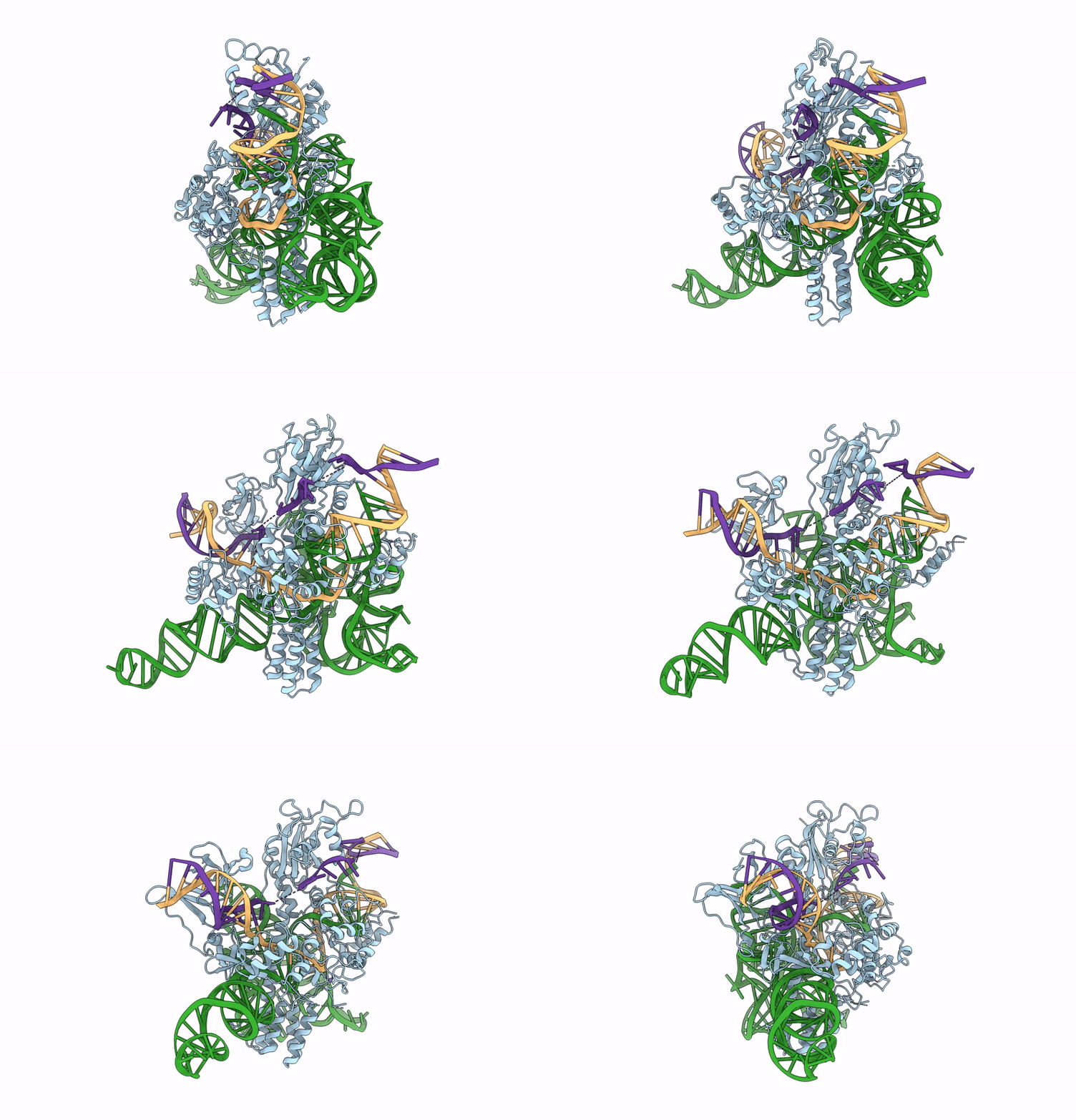
9LGI image
Deposition Date 2025-01-10
Release Date 2025-08-20
Last Version Date 2025-08-20
Entry Detail
PDB ID:
9LGI
Keywords:
Title:
Cryo-EM structure of a type II-D CRISPR-Cas9 in complex with single-guided RNA and double-stranded DNA
Biological Source:
Host Organism:
Method Details:
Experimental Method:
Resolution:
2.86 Å
Aggregation State:
PARTICLE
Reconstruction Method:
SINGLE PARTICLE
Macromolecular Entities
Structures with similar UniProt ID
Protein Blast
Polymer Type:polypeptide(L)
Molecule:HNH nuclease domain-containing protein
Gene (Uniprot):A2Y97_00035
Chain IDs:A
Chain Length:762
Number of Molecules:1
Biological Source:Nitrospirae bacterium RBG_13_39_12
Polymer Type:polyribonucleotide
Molecule:sgRNA (156-MER)
Chain IDs:B
Chain Length:156
Number of Molecules:1
Biological Source:Nitrospirae bacterium RBG_13_39_12
Polymer Type:polydeoxyribonucleotide
Molecule:DNA (41-MER)
Chain IDs:C
Chain Length:41
Number of Molecules:1
Biological Source:synthetic construct
Polymer Type:polydeoxyribonucleotide
Molecule:DNA (41-MER)
Chain IDs:D
Chain Length:41
Number of Molecules:1
Biological Source:synthetic construct
Ligand Molecules
Primary Citation
Structural insights into Type II-D Cas9 and its robust cleavage activity.
Nat Commun 16 7396 7396 (2025)
PMID: 40790018 DOI: 10.1038/s41467-025-62128-8

Abstact

Type II-D Cas9 proteins (Cas9d) are more compact than typical Type II-A/B/C Cas9s. Here, we demonstrate that NsCas9d from Nitrospirae bacterium RBG_13_39_12 derived from a metagenomic assembly exhibits robust dsDNA cleavage activity comparable to SpCas9 in vitro. Unlike typical Cas9 enzymes that generate blunt ends, NsCas9d produces 3-nucleotide staggered overhangs. Our high-resolution cryo-EM structure of the NsCas9d-sgRNA-dsDNA complex in its catalytic state reveals the target and non-target DNA strands positioned within the HNH and RuvC catalytic pockets, respectively. NsCas9d recognizes the 5'-NRG-3' protospacer adjacent motif (PAM), with 5'-NGG-3' showing the highest cleavage efficiency. Its sgRNA structure, resembling the 5' end of IscB ωRNA, along with structural features shared with other Cas9 variants, suggests that Cas9d are hypothesized to resemble evolutionary intermediates between other Cas9 sub-types and IscB. These findings deepen our understanding of Cas9 evolution and mechanisms, highlighting NsCas9d as a promising genome-editing tool due to its compact size, DNA cleavage pattern, and efficient PAM recognition.

Legend

Protein

Chemical

Disease

Primary Citation of related structures
Feedback Form
Name
Email
Institute
Feedback