9LEG image
Deposition Date 2025-01-07
Release Date 2026-02-04
Last Version Date 2026-02-04
Entry Detail
PDB ID:
9LEG
Title:
AMO complex
Biological Source:
Source Organism(s):
Expression System(s):
Method Details:
Experimental Method:
Resolution:
2.36 Å
Aggregation State:
PARTICLE
Reconstruction Method:
SINGLE PARTICLE
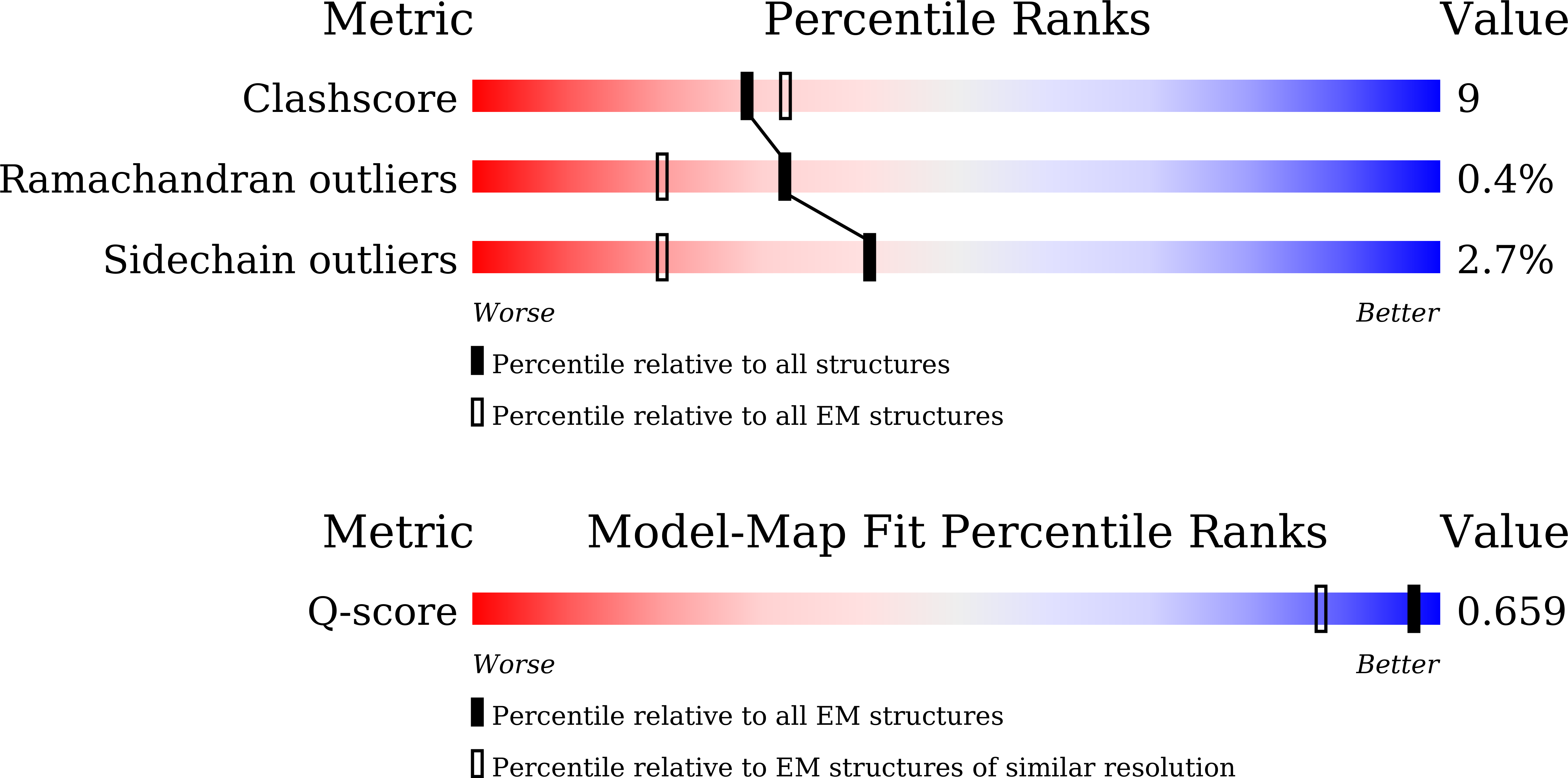
Macromolecular Entities
Structures with similar UniProt ID
Protein Blast
Polymer Type:polypeptide(L)
Molecule:Ammonia monooxygenase subunit A
Gene (Uniprot):SAMN05421881_11133
Chain IDs:A, F (auth: L), K (auth: U)
Chain Length:274
Number of Molecules:3
Biological Source:Nitrosomonas halophila
Structures with similar UniProt ID
Protein Blast
Polymer Type:polypeptide(L)
Molecule:Ammonia monooxygenase subunit B
Gene (Uniprot):SAMN05421881_11134
Chain IDs:B, G (auth: M), L (auth: V)
Chain Length:420
Number of Molecules:3
Biological Source:Nitrosomonas halophila
Structures with similar UniProt ID
Protein Blast
Polymer Type:polypeptide(L)
Molecule:Ammonia monooxygenase subunit C
Gene (Uniprot):SAMN05421881_11132
Chain IDs:C, H (auth: N), M (auth: W)
Chain Length:271
Number of Molecules:3
Biological Source:Nitrosomonas halophila
Structures with similar UniProt ID
Protein Blast
Polymer Type:polypeptide(L)
Molecule:Lipoprotein
Gene (Uniprot):SAMN05421881_103624
Chain IDs:D, I (auth: O), N (auth: X)
Chain Length:67
Number of Molecules:3
Biological Source:Nitrosomonas halophila
Structures with similar UniProt ID
Protein Blast
Polymer Type:polypeptide(L)
Molecule:AmoD
Gene (Uniprot):SAMN05421881_104318
Chain IDs:E, J (auth: P), O (auth: Y)
Chain Length:45
Number of Molecules:3
Biological Source:Nitrosomonas halophila
Primary Citation
Structural insights into the catalytic mechanism of ammonia monooxygenase.
Nat Commun 17 508 508 (2025)
PMID: 41387732 DOI: 10.1038/s41467-025-67194-6

Abstact

Ammonia monooxygenase (AMO) oxidizes ammonia to hydroxylamine. Limited knowledge of the structural information of AMO hinders our understanding of the molecular mechanism underlying ammonia oxidation, impacting the mitigation of greenhouse gas emissions and enhancing agricultural productivity using ammonium as a nitrogen source. Herein, we report the cryo-electron microscopy structure of the AMO complex from an isolated strain of ammonia-oxidizing bacteria (AOB). AMO is a cylinder-shaped homotrimeric assembly composed of five subunits. A single-transmembrane protein and a soluble protein are potentially crucial in signal transduction during ammonia oxidation and mediating interactions with the outer membrane protein assembly machinery. Three modeled coppers, along with an adjacent water-mediated hydrogen-bond network, may facilitate an efficient proton transfer pathway from the periplasmic CuB to the active site CuD within the inner membrane, where CuC and CuD will act in concert to catalyze substrate reaction. The distinctive surface charge characteristics of AMO provide valuable insights into the structural features that govern ammonium assimilation and material transport during ammonia oxidation. These findings shed light on the molecular complexities of AMO and provides a structural foundation for elucidating the catalytic mechanism of ammonia oxidation.

Legend

Protein

Chemical

Disease

Primary Citation of related structures
Feedback Form
Name
Email
Institute
Feedback