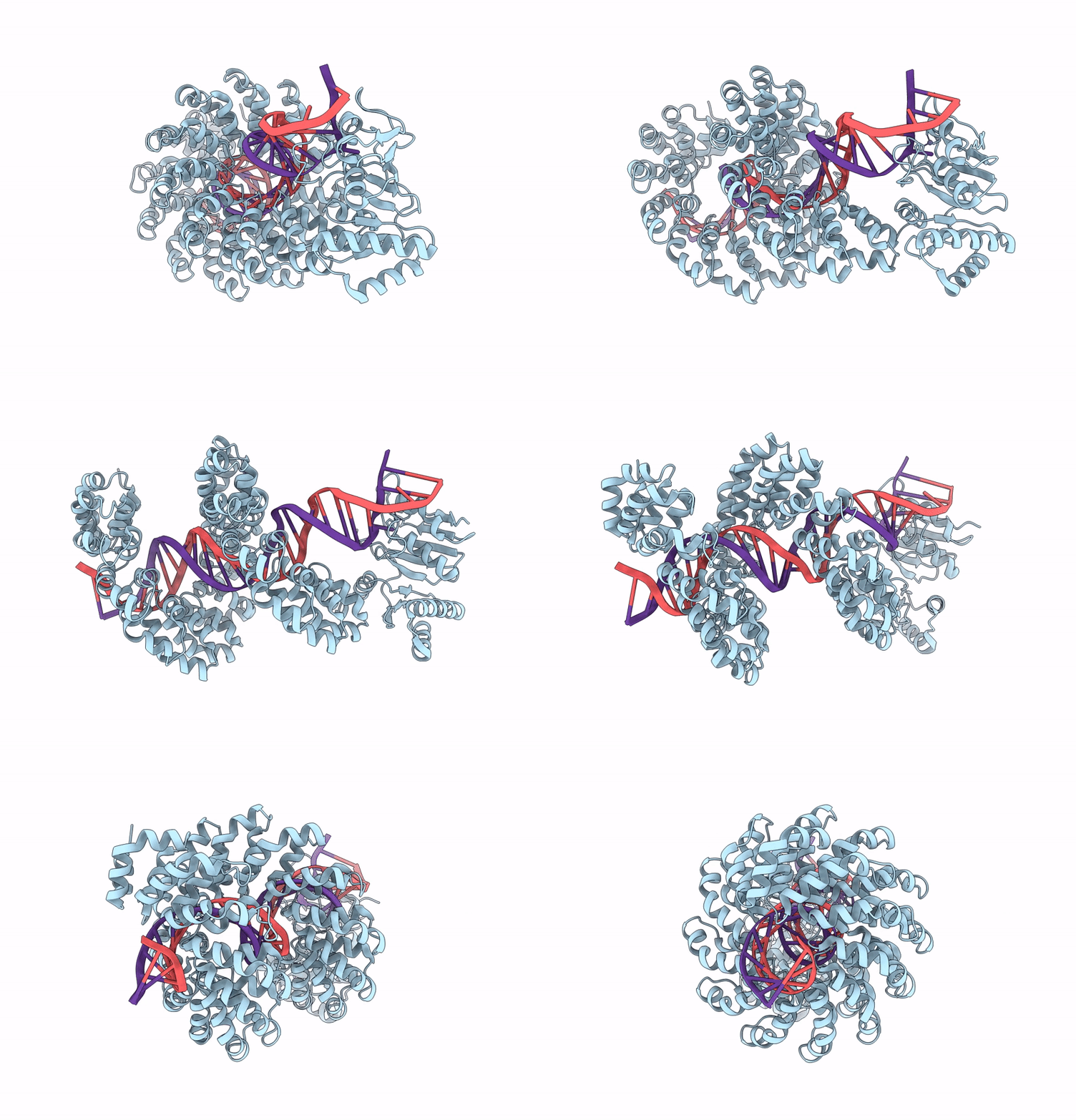
9LCY image
Deposition Date 2025-01-05
Release Date 2025-11-19
Last Version Date 2025-12-31
Entry Detail
PDB ID:
9LCY
Keywords:
Title:
Inactivate TOD6 with TC DNA substrate
Biological Source:
Source Organism:
Method Details:
Experimental Method:
Resolution:
3.02 Å
Aggregation State:
PARTICLE
Reconstruction Method:
SINGLE PARTICLE

Macromolecular Entities
Polymer Type:polypeptide(L)
Molecule:Inactivate TOD6
Chain IDs:A
Chain Length:886
Number of Molecules:1
Biological Source:synthetic construct
Polymer Type:polydeoxyribonucleotide
Molecule:TC DNA substrate forward strand
Chain IDs:B
Chain Length:31
Number of Molecules:1
Biological Source:synthetic construct
Polymer Type:polydeoxyribonucleotide
Molecule:TC DNA substrate reverse strand
Chain IDs:C
Chain Length:31
Number of Molecules:1
Biological Source:synthetic construct
Ligand Molecules
Primary Citation
Computational design of a high-precision mitochondrial DNA cytosine base editor.
Nat.Struct.Mol.Biol. 32 2575 2586 (2025)
PMID: 41249818 DOI: 10.1038/s41594-025-01714-2

Abstact

Bystander editing remains a major limitation of current base editors, hindering their precision and therapeutic potential. Here, we present a de novo protein design strategy that creates a structurally rigid interface between a DNA-binding TALE domain and a cytosine deaminase, forming a unified editing module termed TALE-oriented deaminase (TOD). Cryo-EM analysis of TOD-DNA complexes confirms that this precise spatial architecture tightly restricts the deaminase activity window, thereby minimizing unwanted deamination. To further enhance editing specificity, we develop a split version, termed DdCBE-TOD, which virtually eliminates off-target editing. As a proof of concept, we apply DdCBE-TOD to generate a mitochondrial disease mouse model and to correct a pathogenic mutation associated with MERRF syndrome in patient-derived cells, achieving single-nucleotide precision. This work introduces a generalizable and computationally guided approach for ultra-precise base editing, offering a promising platform for both mechanistic studies and therapeutic correction of single-nucleotide mutations.

Legend

Protein

Chemical

Disease

Primary Citation of related structures
Feedback Form
Name
Email
Institute
Feedback