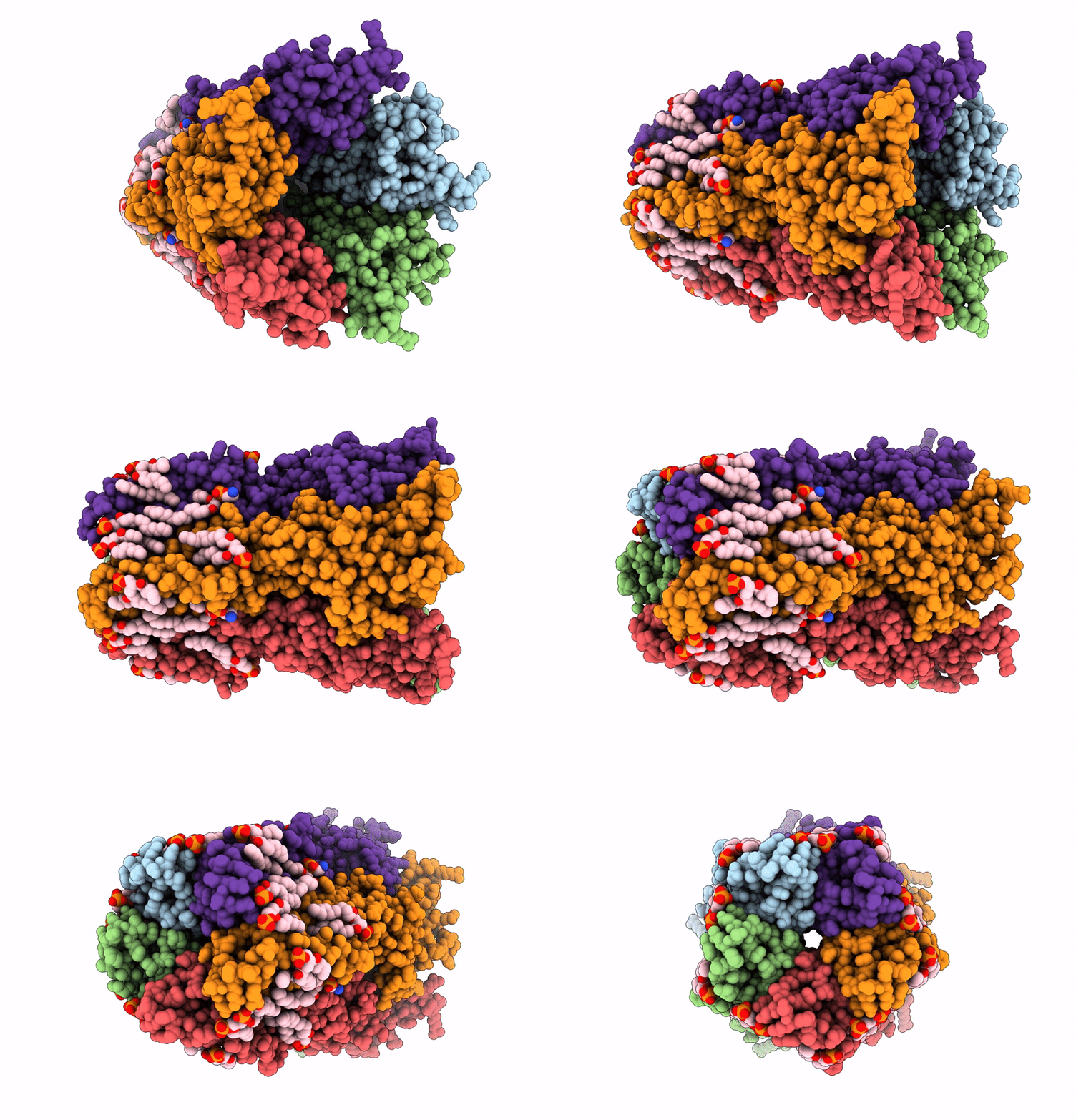
9LAG image
Deposition Date 2025-01-02
Release Date 2025-10-22
Last Version Date 2025-12-10
Entry Detail
PDB ID:
9LAG
Title:
Cryo-EM structure of nanodisc (PE:PS:PC) reconstituted GLIC at pH 4 in iiiii conformation
Biological Source:
Source Organism:
Host Organism:
Method Details:
Experimental Method:
Resolution:
2.96 Å
Aggregation State:
PARTICLE
Reconstruction Method:
SINGLE PARTICLE
Macromolecular Entities
Structures with similar UniProt ID
Protein Blast
Polymer Type:polypeptide(L)
Molecule:Proton-gated ion channel
Gene (Uniprot):glvI
Chain IDs:A, B (auth: E), C (auth: B), D (auth: C), E (auth: D)
Chain Length:312
Number of Molecules:5
Biological Source:Gloeobacter violaceus
Ligand Molecules
Primary Citation
Asymmetric gating of a homopentameric ion channel GLIC revealed by cryo-EM.
Proc.Natl.Acad.Sci.USA 122 e2512811122 e2512811122 (2025)
PMID: 41129221 DOI: 10.1073/pnas.2512811122

Abstact

Pentameric ligand-gated ion channels (pLGICs) are vital neurotransmitter receptors that are key therapeutic targets for neurological disorders. Although the high-resolution structures of these channels have been elucidated, capturing their dynamic conformational transitions remains challenging due to the transient nature of intermediate states. In this study, we investigated a prokaryotic proton-gated pLGIC, GLIC. In our cryo-EM data at pH 4.0, we identified and segregated asymmetric particles, which we precisely aligned to resolve high-resolution structures of several previously unresolved asymmetric intermediate states, in addition to symmetric closed and open states. Detailed structural analysis revealed systematic conformational changes at individual subunits driving the channel opening. Molecular dynamics simulations were used to assign the functional states. We further examined the roles of the F116 and Y251 residues, located at the domain interface, playing a central role in interdomain communication. In addition, patch-clamp experiments on GLIC I240A and L241A mutants, located in the M2 helix, demonstrated their importance in channel gating. Together, these results shed light on the sequential and asymmetric conformational transitions that occur during GLIC activation, offering a deeper mechanistic understanding of asymmetric gating in pLGICs.

Legend

Protein

Chemical

Disease

Primary Citation of related structures
Feedback Form
Name
Email
Institute
Feedback