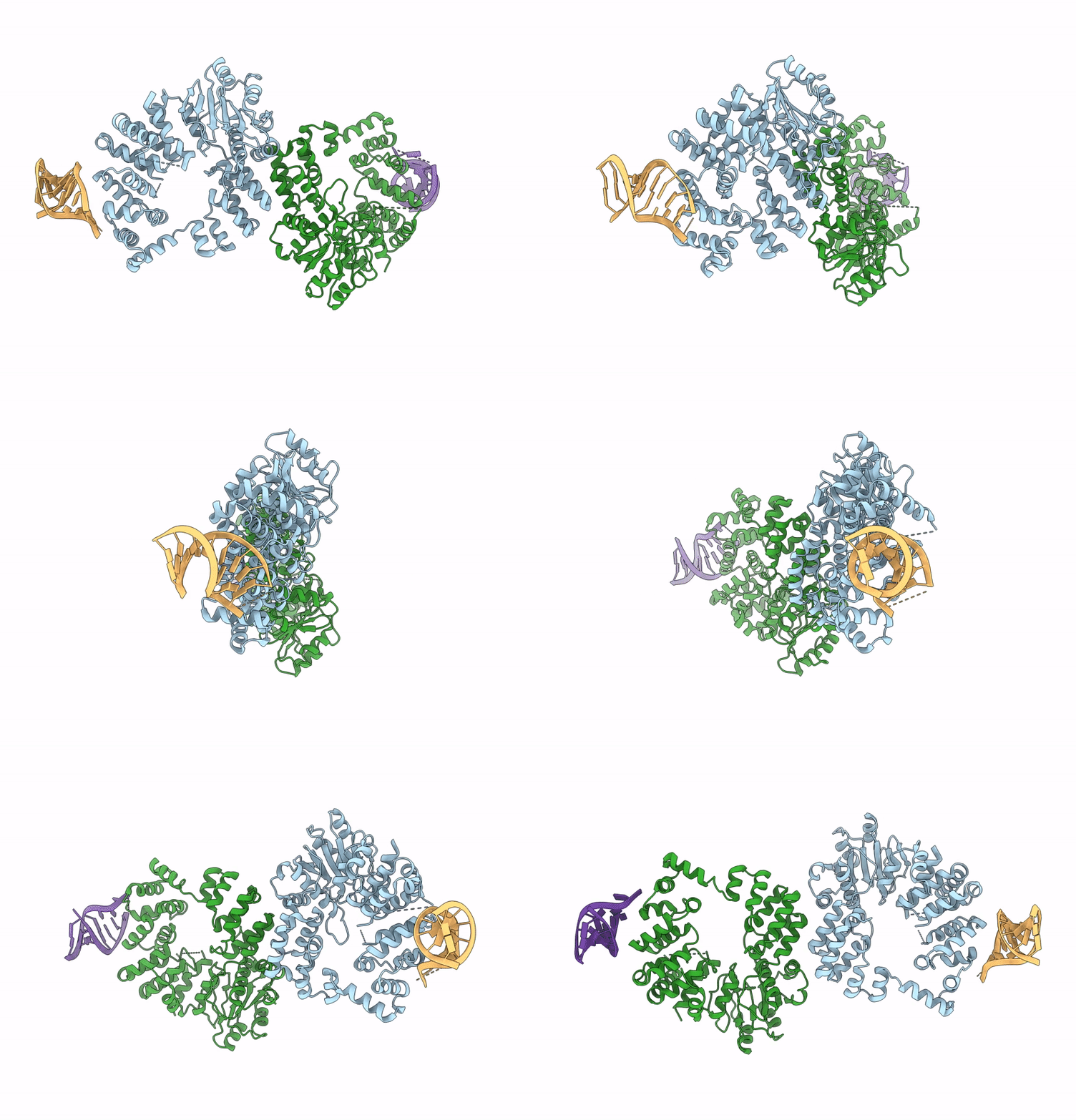
9L5Y image
Deposition Date 2024-12-23
Release Date 2025-12-10
Last Version Date 2025-12-10
Entry Detail
PDB ID:
9L5Y
Title:
Structure of Ro60 dimer from Thermus phage phiLo
Biological Source:
Source Organism:
Host Organism:
Method Details:
Experimental Method:
Resolution:
3.81 Å
Aggregation State:
PARTICLE
Reconstruction Method:
SINGLE PARTICLE
Macromolecular Entities
Polymer Type:polypeptide(L)
Molecule:TROVE domain-containing protein
Chain IDs:A, B
Chain Length:500
Number of Molecules:2
Biological Source:Thermus phage phiLo
Polymer Type:polyribonucleotide
Molecule:RNA (62-MER)
Chain IDs:C (auth: D), D (auth: F)
Chain Length:62
Number of Molecules:2
Biological Source:Thermus phage phiLo
Ligand Molecules
Primary Citation
Structural and molecular mechanisms of an Ro60 homolog from a Thermus bacteriophage.
Nucleic Acids Res. 53 ? ? (2025)
PMID: 40464688 DOI: 10.1093/nar/gkaf470

Abstact

Ro60 is a conserved RNA-binding protein essential for RNA quality control and implicated in autoimmune responses. In this study, we present the structural and functional characterization of φRo60, an Ro60 homolog from Thermus phage phiLo, with its crystal structure determined at 1.99 Å. Despite limited sequence identity with bacterial and amphibian homologs, φRo60 maintains the canonical doughnut-shaped architecture comprising HEAT repeats and a von Willebrand factor A domain. Surface electrostatic analysis reveals an extensive positively charged region across multiple α-helices, likely facilitating diverse RNA interactions. Moreover, φRo60 binds two Y RNA-like molecules (Yrl1 and Yrl2), identified from the phiLo genome, with distinct stoichiometries, leading to the formation of higher-order nucleocytoplasmic ribonucleoprotein (RNP) complexes. Cryo-electron microscopy of φRo60-Yrl2 RNP complexes revealed a minor population adopting a dimeric assembly, and key positively charged residues are important for φRo60-Yrl2 interactions. Additionally, φRo60 and Yrls interact with host Thermus thermophilus HB8 polynucleotide phosphorylase (PNPase), forming tripartite RYPER-like complexes and attenuating the ribonuclease activity of PNPase. These findings highlight φRo60 as a structurally adaptable Ro60 homolog capable of diverse RNA interactions and host factor recruitment, implying unique strategies for phages to counteract host defense systems in thermophilic environments.

Legend

Protein

Chemical

Disease

Primary Citation of related structures
Feedback Form
Name
Email
Institute
Feedback