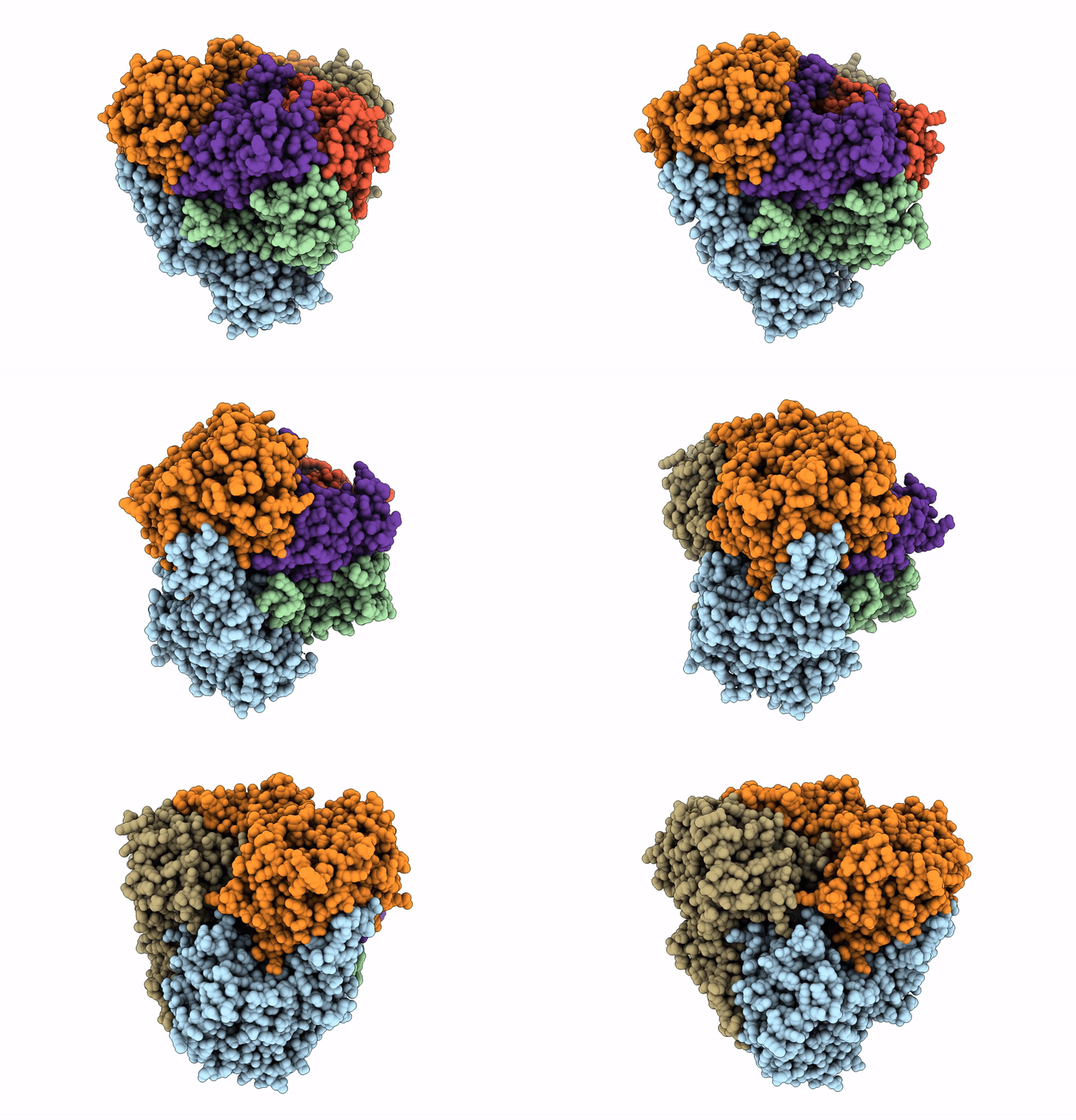
9L1W image
Deposition Date 2024-12-16
Release Date 2025-12-10
Last Version Date 2025-12-10
Entry Detail
PDB ID:
9L1W
Title:
3-phenylpropionate bound dioxygenase HcaE-HcaF
Biological Source:
Source Organism(s):
Method Details:
Experimental Method:
Resolution:
3.10 Å
Aggregation State:
PARTICLE
Reconstruction Method:
SINGLE PARTICLE
Macromolecular Entities
Structures with similar UniProt ID
Protein Blast
Polymer Type:polypeptide(L)
Molecule:3-phenylpropionate/cinnamic acid dioxygenase subunit alpha
Gene (Uniprot):hcaE
Chain IDs:A, C, E
Chain Length:453
Number of Molecules:3
Biological Source:Escherichia coli K-12
Structures with similar UniProt ID
Protein Blast
Polymer Type:polypeptide(L)
Molecule:3-phenylpropionate/cinnamic acid dioxygenase subunit beta
Gene (Uniprot):hcaF
Chain IDs:B, D, F
Chain Length:172
Number of Molecules:3
Biological Source:Escherichia coli K-12
Primary Citation
Structure-guided engineering of a Rieske-type aromatic dioxygenase for enhanced consumption of 3-phenylpropionic acid in Escherichia coli.
J Hazard Mater 491 137954 137954 (2025)
PMID: 40120277 DOI: 10.1016/j.jhazmat.2025.137954

Abstact

Industrial derived aromatic hydrocarbons are persistent environmental pollutants due to their chemical stability, posing both ecological and health risks. Rieske-type aromatic dioxygenases (RDOs), known for their role in dihydroxylation of aromatic rings, play a pivotal role in microbial consumption and degradation of such compounds. While the industrial application of these enzymes has been impeded by their instability and low biodegradation rate. In this study, we focused on optimization and application of the Rieske-type dioxygenase HcaEF from Escherichia coli (E. coli) K-12, which initializes the degradation of 3-phenylpropionic acid (3-PP) and cinnamic acid (CI). Using cryo-electron microscopy (cryo-EM), we determined the high-resolution structures of the apo-form and 3-PP bound form of HcaEF, revealing key insights into substrate specificity and thermal stability. Leveraging these structural insights, we engineered a Q73I variant of HcaEF. Upon introduction of this mutation, the turnover rate increased from 29.6 % to 43.8 %, showing ∼50 % improvement. Overexpression of this variant in E. coli K-12 significantly enhanced the strain's ability to utilize 3-PP, demonstrating the potential for microbial engineering in environmental bioremediation and industrial applications. Our findings not only deepen the understanding of substrate recognition in RDOs, but also pave the way for developing high-efficiency enzymes for aromatic compound bio-utilization.

Legend

Protein

Chemical

Disease

Primary Citation of related structures
Feedback Form
Name
Email
Institute
Feedback