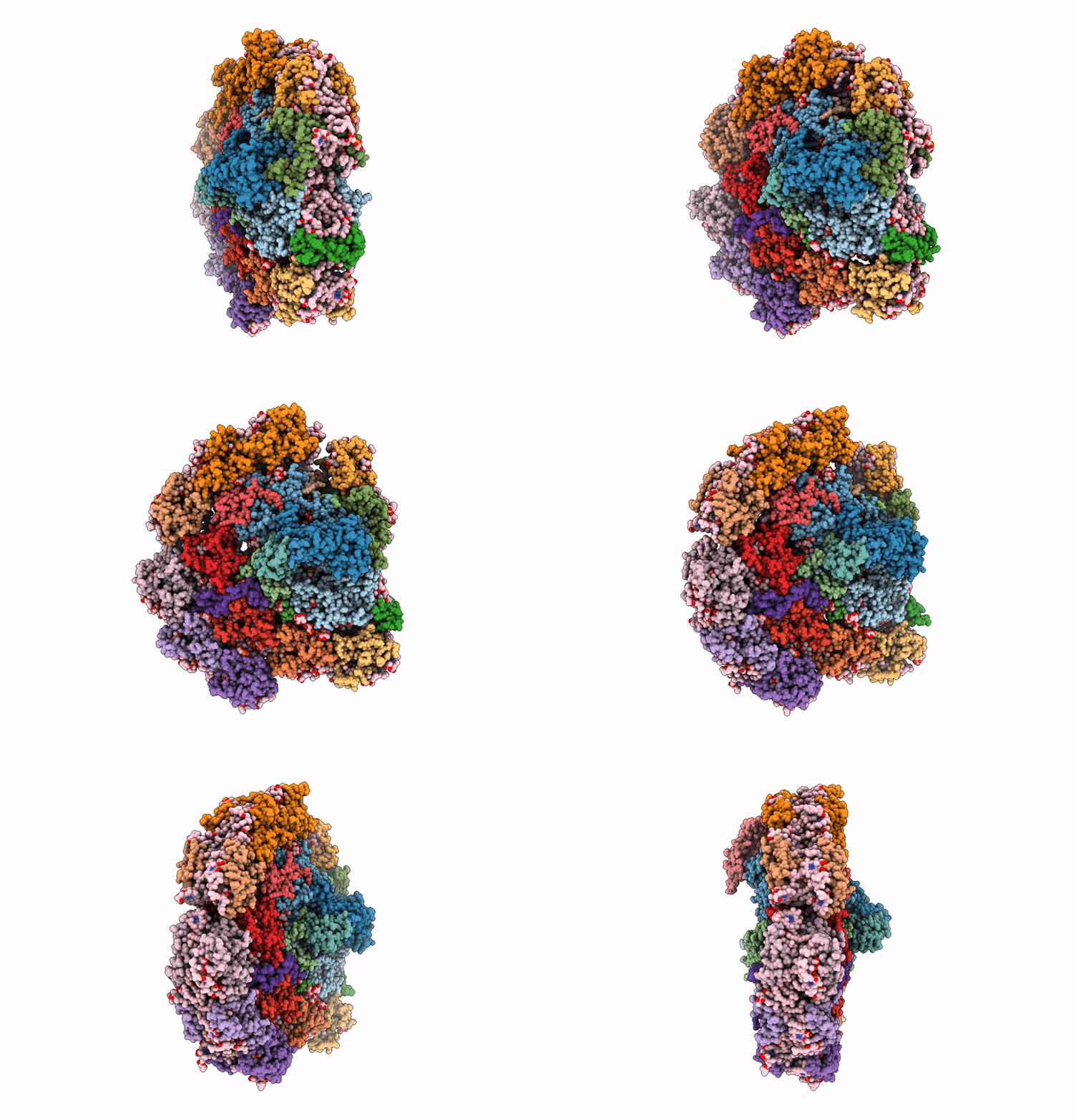
9L0K image
Deposition Date 2024-12-12
Release Date 2025-11-26
Last Version Date 2025-12-31
Entry Detail
PDB ID:
9L0K
Keywords:
Title:
Cryo-EM structure of PSI-11ACPIs from Rhodomonas sp. NIES-2332 at 2.14 angstrom resolution
Biological Source:
Source Organism(s):
Method Details:
Experimental Method:
Resolution:
2.14 Å
Aggregation State:
PARTICLE
Reconstruction Method:
SINGLE PARTICLE
Macromolecular Entities
Structures with similar UniProt ID
Protein Blast
Polymer Type:polypeptide(L)
Molecule:Photosystem I P700 chlorophyll a apoprotein A1
Chain IDs:A
Chain Length:217
Number of Molecules:1
Biological Source:Rhodomonas sp. NIES-2332
Structures with similar UniProt ID
Protein Blast
Polymer Type:polypeptide(L)
Molecule:Photosystem I P700 chlorophyll a apoprotein A2
Chain IDs:B
Chain Length:734
Number of Molecules:1
Biological Source:Rhodomonas sp. NIES-2332
Structures with similar UniProt ID
Protein Blast
Polymer Type:polypeptide(L)
Molecule:Photosystem I iron-sulfur center
Chain IDs:C
Chain Length:215
Number of Molecules:1
Biological Source:Rhodomonas sp. NIES-2332
Structures with similar UniProt ID
Protein Blast
Polymer Type:polypeptide(L)
Molecule:Photosystem I reaction center subunit II
Chain IDs:D
Chain Length:141
Number of Molecules:1
Biological Source:Rhodomonas sp. NIES-2332
Structures with similar UniProt ID
Protein Blast
Polymer Type:polypeptide(L)
Molecule:Photosystem I reaction center subunit IV
Chain IDs:E
Chain Length:64
Number of Molecules:1
Biological Source:Rhodomonas sp. NIES-2332
Structures with similar UniProt ID
Protein Blast
Polymer Type:polypeptide(L)
Molecule:Photosystem I reaction center subunit III
Chain IDs:F
Chain Length:188
Number of Molecules:1
Biological Source:Rhodomonas sp. NIES-2332
Structures with similar UniProt ID
Protein Blast
Polymer Type:polypeptide(L)
Molecule:Photosystem I reaction center subunit VIII
Chain IDs:G (auth: I)
Chain Length:36
Number of Molecules:1
Biological Source:Rhodomonas sp. NIES-2332
Structures with similar UniProt ID
Protein Blast
Polymer Type:polypeptide(L)
Molecule:Photosystem I reaction center subunit IX
Chain IDs:H (auth: J)
Chain Length:212
Number of Molecules:1
Biological Source:Rhodomonas sp. NIES-2332
Structures with similar UniProt ID
Protein Blast
Polymer Type:polypeptide(L)
Molecule:Photosystem I reaction center subunit PsaK
Chain IDs:K
Chain Length:87
Number of Molecules:1
Biological Source:Rhodomonas sp. NIES-2332
Structures with similar UniProt ID
Protein Blast
Polymer Type:polypeptide(L)
Molecule:Photosystem I reaction center subunit XI
Chain IDs:I (auth: L)
Chain Length:175
Number of Molecules:1
Biological Source:Rhodomonas sp. NIES-2332
Structures with similar UniProt ID
Protein Blast
Polymer Type:polypeptide(L)
Molecule:Photosystem I reaction center subunit XII
Chain IDs:J (auth: M)
Chain Length:212
Number of Molecules:1
Biological Source:Rhodomonas sp. NIES-2332
Polymer Type:polypeptide(L)
Molecule:PsaQ
Chain IDs:Y (auth: Q)
Chain Length:233
Number of Molecules:1
Biological Source:Rhodomonas sp. NIES-2332
Polymer Type:polypeptide(L)
Molecule:PsaR
Chain IDs:W (auth: R)
Chain Length:135
Number of Molecules:1
Biological Source:Rhodomonas sp. NIES-2332
Polymer Type:polypeptide(L)
Molecule:ACPI-a
Chain IDs:N (auth: a)
Chain Length:217
Number of Molecules:1
Biological Source:Rhodomonas sp. NIES-2332
Polymer Type:polypeptide(L)
Molecule:ACPI-b
Chain IDs:O (auth: b)
Chain Length:734
Number of Molecules:1
Biological Source:Rhodomonas sp. NIES-2332
Polymer Type:polypeptide(L)
Molecule:ACPI-c
Chain IDs:M (auth: c)
Chain Length:215
Number of Molecules:1
Biological Source:Rhodomonas sp. NIES-2332
Polymer Type:polypeptide(L)
Molecule:ACPI-d
Chain IDs:V (auth: d)
Chain Length:141
Number of Molecules:1
Biological Source:Rhodomonas sp. NIES-2332
Polymer Type:polypeptide(L)
Molecule:ACPI-h
Chain IDs:P (auth: h)
Chain Length:229
Number of Molecules:1
Biological Source:Rhodomonas sp. NIES-2332
Polymer Type:polypeptide(L)
Molecule:ACPI-i
Chain IDs:T (auth: i)
Chain Length:36
Number of Molecules:1
Biological Source:Rhodomonas sp. NIES-2332
Polymer Type:polypeptide(L)
Molecule:ACPI-k
Chain IDs:S (auth: k)
Chain Length:87
Number of Molecules:1
Biological Source:Rhodomonas sp. NIES-2332
Polymer Type:polypeptide(L)
Molecule:ACPI-l
Chain IDs:R (auth: l)
Chain Length:175
Number of Molecules:1
Biological Source:Rhodomonas sp. NIES-2332
Polymer Type:polypeptide(L)
Molecule:ACPI-m
Chain IDs:Q (auth: m), U (auth: j)
Chain Length:212
Number of Molecules:2
Biological Source:Rhodomonas sp. NIES-2332
Polymer Type:polypeptide(L)
Molecule:ACPI-n
Chain IDs:X (auth: n)
Chain Length:220
Number of Molecules:1
Biological Source:Rhodomonas sp. NIES-2332
Polymer Type:polypeptide(L)
Molecule:ACPI-s
Chain IDs:L (auth: s)
Chain Length:302
Number of Molecules:1
Biological Source:Rhodomonas sp. NIES-2332
Primary Citation
Structural analysis of PSI-ACPI and PSII-ACPII supercomplexes from a cryptophyte alga Rhodomonas sp. NIES-2332.
Front Plant Sci 16 1716939 1716939 (2025)
PMID: 41393888 DOI: 10.3389/fpls.2025.1716939

Abstact

Light energy is converted to chemical energy by two photosystems (PSI and PSII) in complex with their light-harvesting complex proteins (LHCI and LHCII) in photosynthesis. Rhodomonas is a member of cryptophyte alga whose LHCs contain unique chlorophyll a/c proteins (ACPs) and phycobiliproteins. We purified PSI-ACPI and PSII-ACPII supercomplexes from a cryptophyte Rhodomonas sp. NIES-2332 and analyzed their structures at high resolutions of 2.08 Å and 2.17 Å, respectively, using cryo-electron microscopy. These structures are largely similar to those reported previously from two other species of cryptophytes, but exhibited some differences in both the pigment locations and subunit structures. A part of the antenna subunits of both photosystems is shifted compared with the previously reported structures from other species of cryptophytes, suggesting some differences in the energy transfer rates from the antenna to the PSI and PSII cores. Newly identified lipids are found to occupy the interfaces between the antennae and cores, which may be important for assembly and stabilization of the supercomplexes. Water molecules surrounding three iron-sulfur clusters of the PSI core are found in our high-resolution structure, some of which are conserved from cyanobacteria to higher plants but some are different. In addition, our structure of PSII-ACPII lacks the subunits of oxygen-evolving complex as well as the Mn4CaO5 cluster, suggesting that the cells are in the S-growth phase, yet the PSI-ACPI structure showed the binding of PsaQ, suggesting that it is in an L-phase. These results suggest that the S-phase and L-phase can co-exist in the cryptophytic cells. The high-resolution structures of both PSI-ACPIs and PSII-ACPIIs solved in this study provide a more solid structural basis for elucidating the energy transfer and quenching mechanisms in this group of the organisms.

Legend

Protein

Chemical

Disease

Primary Citation of related structures
Feedback Form
Name
Email
Institute
Feedback