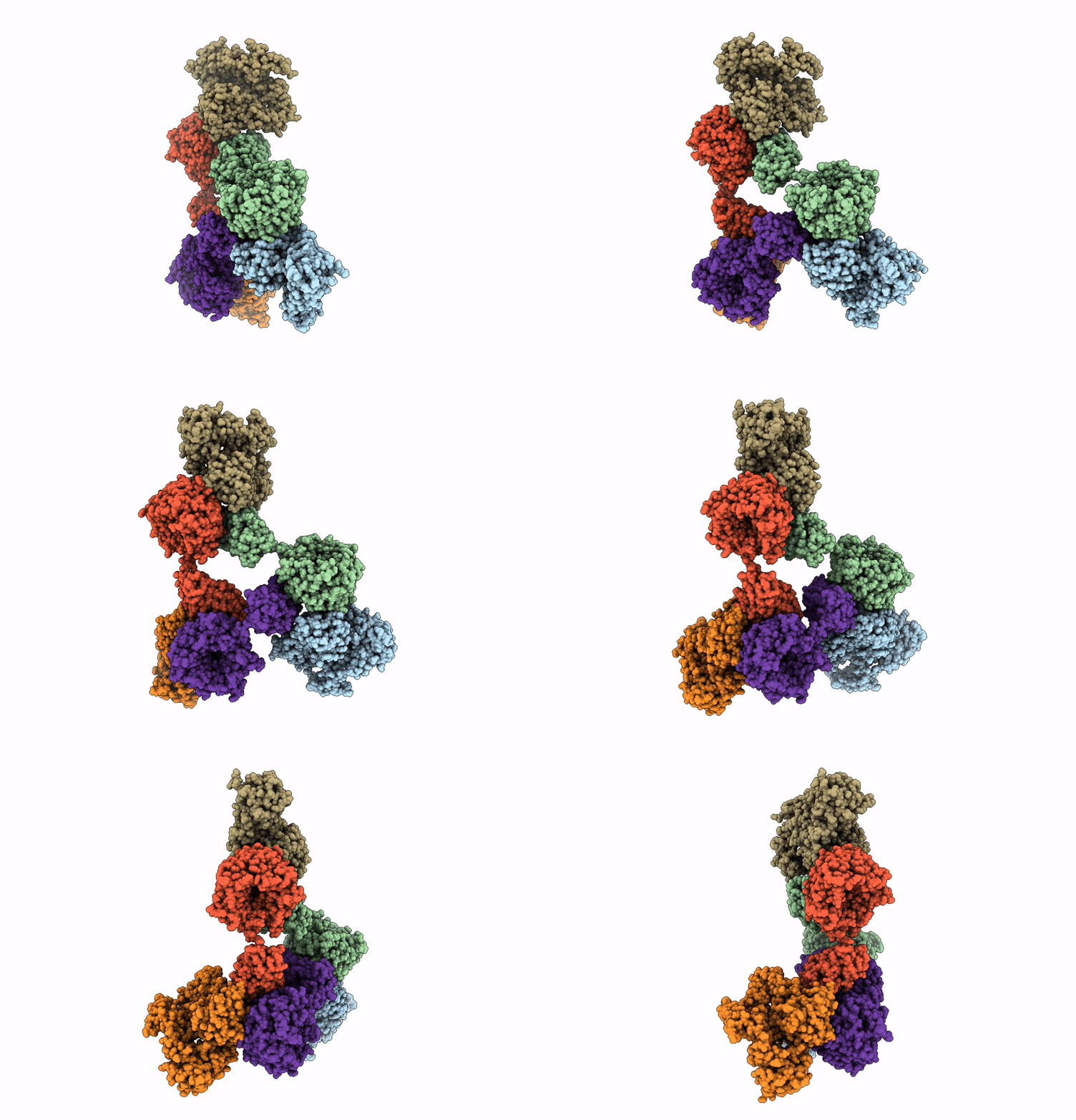
9KZT image
Deposition Date 2024-12-11
Release Date 2025-06-25
Last Version Date 2025-07-16
Entry Detail
PDB ID:
9KZT
Keywords:
Title:
Cryo-EM structure of the 3:3 LGI1-ADAM22 complex
Biological Source:
Source Organism:
Homo sapiens (Taxon ID: 9606)
Host Organism:
Method Details:
Experimental Method:
Resolution:
3.79 Å
Aggregation State:
PARTICLE
Reconstruction Method:
SINGLE PARTICLE
Macromolecular Entities
Structures with similar UniProt ID
Protein Blast
Polymer Type:polypeptide(L)
Molecule:Disintegrin and metalloproteinase domain-containing protein 22
Gene (Uniprot):ADAM22
Chain IDs:A, C, E
Chain Length:497
Number of Molecules:3
Biological Source:Homo sapiens
Structures with similar UniProt ID
Protein Blast
Polymer Type:polypeptide(L)
Molecule:Leucine-rich glioma-inactivated protein 1
Gene (Uniprot):LGI1
Mutagens:R470A
Chain IDs:B, D, F
Chain Length:544
Number of Molecules:3
Biological Source:Homo sapiens
Ligand Molecules
Primary Citation
Structural insights into heterohexameric assembly of epilepsy-related ligand-receptor complex LGI1-ADAM22.
Elife 14 ? ? (2025)
PMID: 40601686 DOI: 10.7554/eLife.105918

Abstact

Leucine-rich glioma-inactivated 1 protein (LGI1) is a secreted neuronal protein consisting of the N-terminal leucine-rich repeat (LRR) and C-terminal epitempin-repeat (EPTP) domains. LGI1 is linked to epilepsy, a neurological disorder that can be caused by genetic mutations of genes regulating neuronal excitability (e.g. voltage- or ligand-gated ion channels). ADAM22 is a membrane receptor that binds to LGI1 extracellularly and interacts with AMPA-type glutamate receptors via PSD-95 intracellularly to maintain normal synaptic signal transmission. Structural analysis of the LGI1-ADAM22 complex is important for understanding the molecular mechanism of epileptogenesis and developing new therapies against epilepsy. We previously reported the crystal structure of a 2:2 complex consisting of two molecules of LGI1 and two molecules of the ADAM22 ectodomain (ECD), which is suggested to bridge neurons across the synaptic cleft. On the other hand, multiangle light scattering, small-angle X-ray scattering, and cryo-electron microscopy (cryo-EM) analyses have suggested the existence of a 3:3 complex consisting of three molecules of LGI1 and three molecules of ADAM22. In the previous cryo-EM analysis, many observed particles were in a dissociated state, making it difficult to determine the three-dimensional (3D) structure of the 3:3 complex. In this study, we stabilized the 3:3 LGI1-ADAM22ECD complex using chemical cross-linking and determined the cryo-EM structures of the LGI1LRR-LGI1EPTP-ADAM22ECD and 3:3 LGI1-ADAM22ECD complexes at 2.78 Å and 3.79 Å resolutions, respectively. Furthermore, high-speed atomic force microscopy (HS-AFM) visualized the structural features and flexibility of the 3:3 LGI1-ADAM22ECD complex in solution. We discuss new insights into the interaction modes of the LGI1-ADAM22 higher-order complex and the structural properties of the 3:3 LGI1-ADAM22 complex.

Legend

Protein

Chemical

Disease

Primary Citation of related structures
Feedback Form
Name
Email
Institute
Feedback