9KZH image
Deposition Date 2024-12-10
Release Date 2026-02-18
Last Version Date 2026-02-18
Entry Detail
PDB ID:
9KZH
Title:
Cryo-EM structure of the RC complex from Rhodospirillum rubrum
Biological Source:
Source Organism(s):
Method Details:
Experimental Method:
Resolution:
2.74 Å
Aggregation State:
PARTICLE
Reconstruction Method:
SINGLE PARTICLE
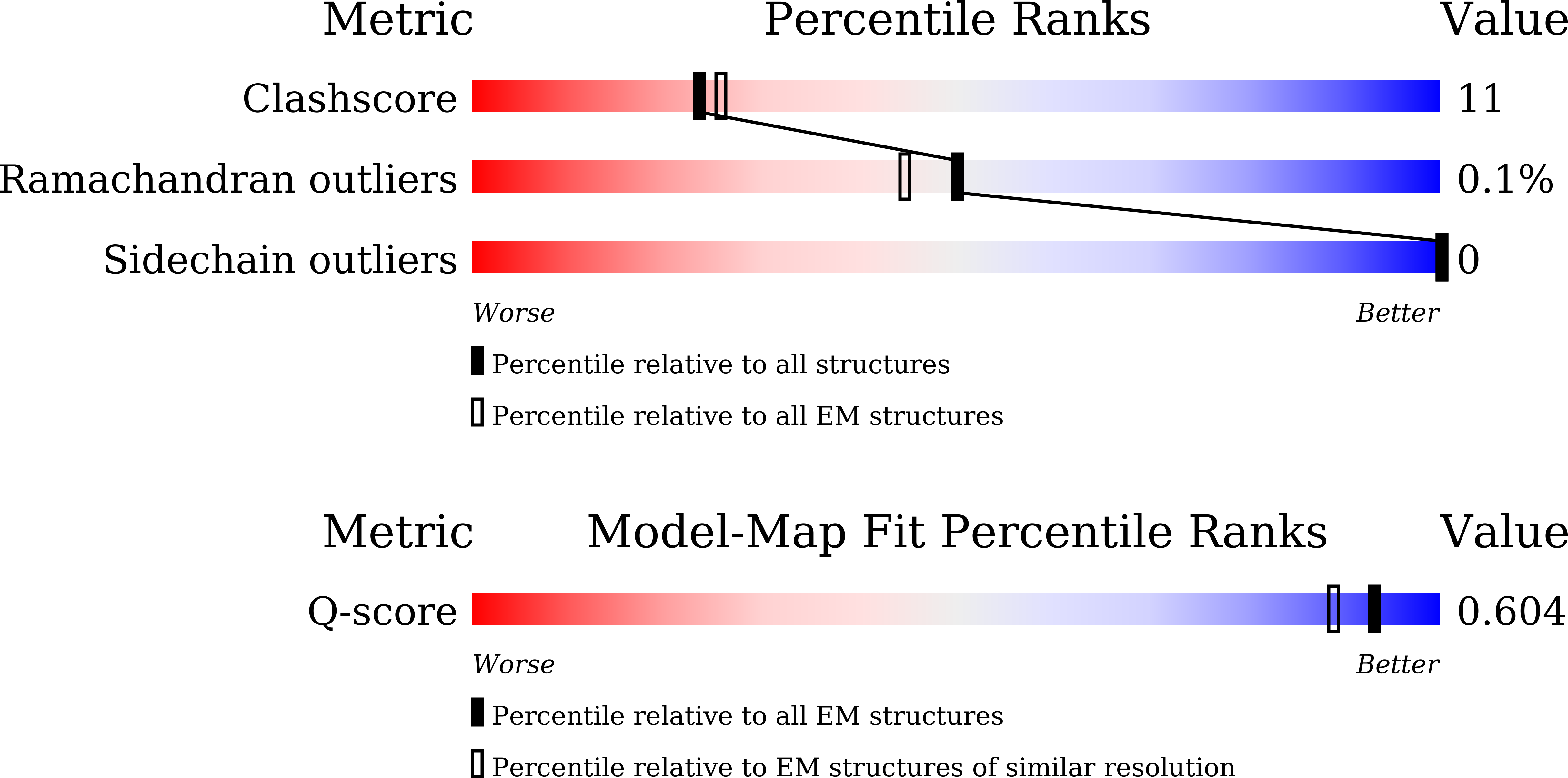
Macromolecular Entities
Structures with similar UniProt ID
Protein Blast
Polymer Type:polypeptide(L)
Molecule:Photoreaction center protein H
Chain IDs:C (auth: H)
Chain Length:257
Number of Molecules:1
Biological Source:Rhodospirillum rubrum
Structures with similar UniProt ID
Protein Blast
Polymer Type:polypeptide(L)
Molecule:Reaction center protein L chain
Gene (Uniprot):pufL
Chain IDs:A (auth: L)
Chain Length:276
Number of Molecules:1
Biological Source:Rhodospirillum rubrum
Structures with similar UniProt ID
Protein Blast
Polymer Type:polypeptide(L)
Molecule:Reaction center protein M chain
Gene (Uniprot):pufM
Chain IDs:B (auth: M)
Chain Length:306
Number of Molecules:1
Biological Source:Rhodospirillum rubrum
Primary Citation
Assembly, selectivity, and compatibility of bacterial photosynthetic complexes from divergent species detected in a chimeric strain.
Biochim Biophys Acta Bioenerg 1867 149584 149584 (2026)
PMID: 41611047 DOI: 10.1016/j.bbabio.2026.149584

Abstact

Photosynthetic complexes comprising light-harvesting (LH) and reaction center (RC) components are essential for biological energy conversion in photosynthesis. Assembly of these multi-protein structures is a topic of great interest, and assembly mechanisms appear to reflect the evolutionary diversity of the particular phototrophic organism. Here we constructed a photosynthetic chimera expressing the Roseiflexus castenholzii LH and Rhodospirillum rubrum RC complexes in a photocomplex-deficient Rsp. rubrum mutant, and spectroscopy confirmed LH expression with absorption maxima at 878 and 801 nm. The chimeric strain grew slower phototrophically than wildtype but faster than a strain containing only the RC, indicating partial energy transfer from LH to RC. Cryo-EM structural analysis revealed that the Rfl. castenholzii LH independently assembled into a closed ring of 15 αβ heterodimers lacking carotenoids, resulting in a blue-shifted Qy transition, while the Rsp. rubrum RC formed a separate complex with an RC:LH ratio of ∼17:1 instead of a typical 1:1. Structural differences, including the absence of two Rfl. castenholzii-specific small proteins, likely precluded formation of a conjoined LH-RC in the chimeric strain. These results reveal that distinct photocomplex assembly strategies exist in phylogenetically divergent species and underscore the modularity and adaptability of photosynthetic complexes, offering insights for artificial photosystem design.

Legend

Protein

Chemical

Disease

Primary Citation of related structures
Feedback Form
Name
Email
Institute
Feedback