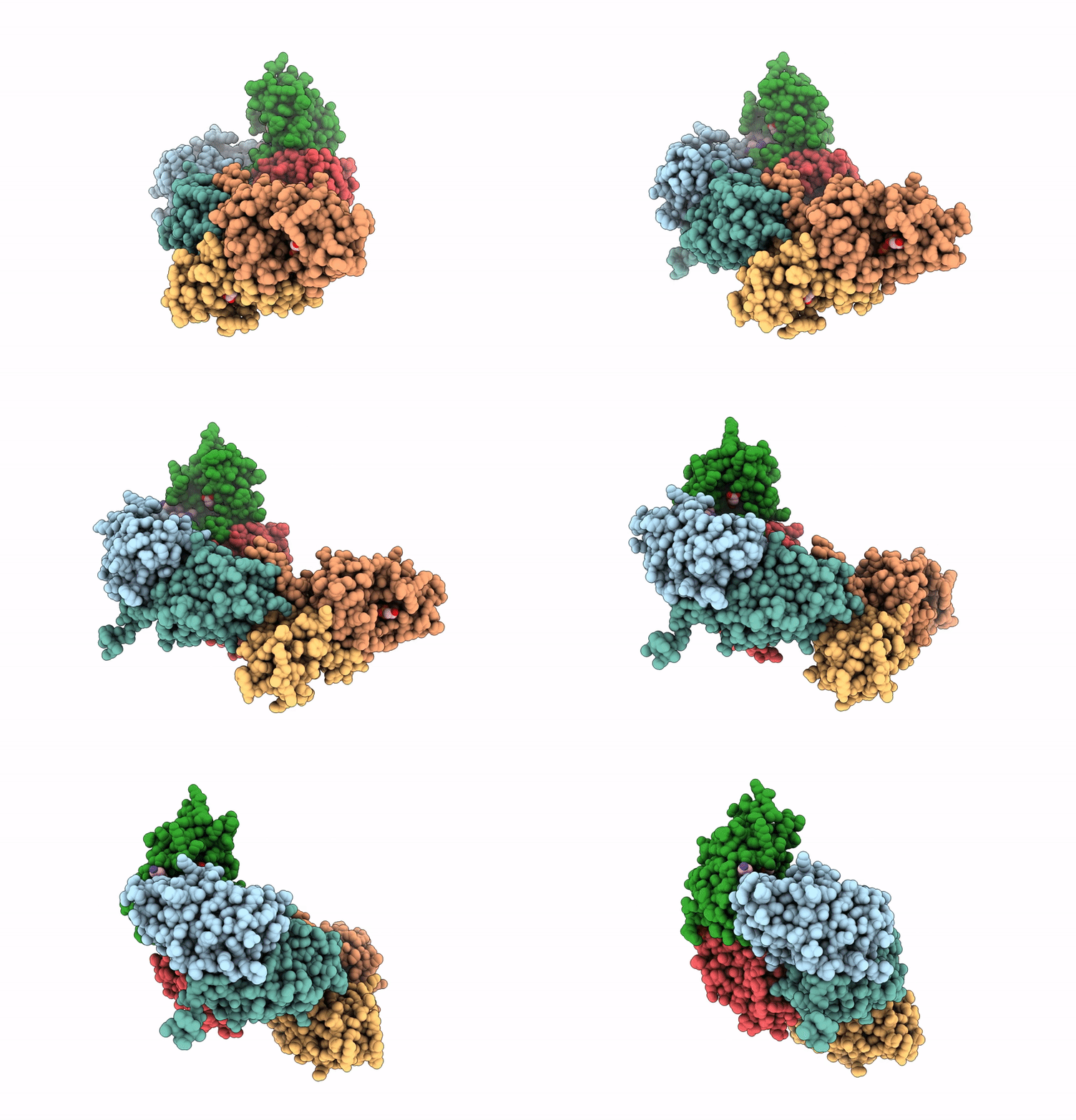
9KPY image
Deposition Date 2024-11-24
Release Date 2024-12-11
Last Version Date 2025-08-20
Entry Detail
PDB ID:
9KPY
Keywords:
Title:
Structure of Phosphopantetheine adenylyltransferase (PPAT) from Enterobacter spp. with the expression tag bound in the substrate binding site of a neighbouring molecule at 2.20 A resolution.
Biological Source:
Source Organism:
Method Details:
Experimental Method:
Resolution:
2.20 Å
R-Value Free:
0.26
R-Value Work:
0.20
Space Group:
C 1 2 1

Macromolecular Entities
Structures with similar UniProt ID
Protein Blast
Polymer Type:polypeptide(L)
Molecule:Phosphopantetheine adenylyltransferase
Gene (Uniprot):coaD
Chain IDs:A, B, C, D, E, F
Chain Length:173
Number of Molecules:6
Biological Source:Enterobacter sp. 638
Polymer Type:polypeptide(L)
Molecule:Heptapeptide
Chain IDs:G (auth: H)
Chain Length:7
Number of Molecules:1
Biological Source:Enterobacter sp. 638
Primary Citation
Protein-tags and their fragments as potent inhibitors of enzymes: Structure of the ternary complex of phosphopantetheine adenylyltransferase from Enterobacter spp. with tag-peptides and phosphonoacetic acid at 2.20 angstrom resolution.
Protein Sci. 34 e70216 e70216 (2025)
PMID: 40689715 DOI: 10.1002/pro.70216

Abstact

Phosphopantetheine adenylyltransferase (PPAT) catalyzes the penultimate step of coenzyme A (CoA) biosynthesis pathway by transferring the adenylyl group from adenosine triphosphate (ATP) to 4'-phosphopantetheine (PNS), yielding 3'-dephosphocoenzyme A and pyrophosphate. In this study, the recombinant PPAT from Enterobacter spp. strain 638 (EbPPAT) was purified and co-crystallized with phosphonoacetic acid (PAE). The structure showed the presence of three homodimers AB, CD, and EF in the asymmetric unit. The 14 extra N-terminal residues (Met-14 to Ser-1, 14-mer peptide) from the expression tag were observed in Molecules B and F. These tag-peptides occupied the PNS-binding sites of adjacent Molecules A and E, respectively. Additionally, a heptapeptide (Met-14 to Gly-8) was also observed in the PNS-binding site of Molecule C. Furthermore, two PAE molecules were present in the ATP-binding sites of Molecules B, D, and F, whereas a single PAE molecule was found in Molecules A, C, and E. This showed that tag-peptides blocked the PNS-binding site while PAE blocked the ATP-binding sites. Three peptides of the tag, including 14-mer (Met-14 to Ser-1), heptapeptide (Met-14 to Gly-8) and pentapeptide (Met-14 to Thr-10) were synthesized, and their binding affinities were estimated, which showed the KD values of 5.5 × 10-5, 1.8 × 10-8, and 7.3 × 10-9 M, respectively. PAE molecules bound to EbPPAT in the ATP-binding sites with a KD of 4.77 × 10-4 M. This is the first structure of PPAT with peptides bound in the substrate-binding sites, indicating a novel approach to design peptide inhibitors.

Legend

Protein

Chemical

Disease

Primary Citation of related structures
Feedback Form
Name
Email
Institute
Feedback